👇Click to enter, analyze battery data instantly👇
To fill the gap in the research on the correlation between the compression characteristics of lithium-ion battery electrodes and the state of charge (SOC), this study selected three mainstream electrode materials: artificial graphite (AG), nickel manganese cobalt oxide (NMC811), and lithium iron phosphate (LFP). Standardized compression tests were conducted under 0%, 50%, and 100% SOC conditions to systematically analyze the variation of their Young’s modulus. The study found that: the stiffness of the AG electrode significantly increased with the rise in SOC, with Young’s modulus increasing from 141 MPa to 190 MPa; the stiffness of the NMC811 electrode gradually decreased with increasing SOC, from 271 MPa to 188 MPa; while the compression characteristics of the LFP electrode were unaffected by SOC, maintaining a stable Young’s modulus around 182 MPa. This study reveals the SOC-dependent compression data of the LFP electrode for the first time and proposes two theoretical hypotheses: “porous structure dominates the deformation mechanism” and “particle diameter affects the microscopic response” to explain the above phenomena. This result provides key parameter support for battery structural optimization design and mechanical modeling, which is of great significance for improving the reliability of batteries in new energy vehicles and energy storage systems.
1. Main Text
Lithium-ion batteries are key energy storage technologies for achieving carbon neutrality goals, widely used in new energy vehicles, portable devices, and large-scale energy storage fields. The mechanical properties of the electrodes have a significant impact on battery performance and lifespan. Different structures of battery electrodes are subjected to continuous compressive forces during use, which in turn affects the electrode porosity, ion transport efficiency, and cycling stability.
The expansion phenomenon of the active materials in the electrode during the lithium-ion insertion/extraction process can cause changes in the coating thickness and porosity of the electrode, necessitating mechanical parameter modeling and analysis. Young’s modulus, as an important mechanical parameter, plays a key role in multi-scale modeling of batteries. However, there are significant differences between the Young’s modulus at the material level and that at the electrode level, and there is currently limited research on the variation of Young’s modulus at the electrode level with respect to the state of charge (SOC), especially for experimental data related to lithium iron phosphate (LFP) electrodes.
Current research faces two major issues: first, the experimental methods lack a unified standard, with significant differences in parameters such as preload, strain rate, and number of cycles in compression tests across different studies, making it difficult to compare experimental data; second, the research subjects are relatively limited, mostly focusing on graphite electrodes, with insufficient studies on the SOC-dependent characteristics of mainstream cathode materials such as nickel manganese cobalt (NMC) and lithium iron phosphate (LFP). This study aims to standardize the experimental process, supplement the SOC-dependent compression characteristic data of LFP electrodes, and reveal the differences in mechanical behavior of different electrodes, providing theoretical support for battery mechanical design.
2. Experimental Methods
(1) Experimental Materials and Electrode Parameters
This study used two types of 5Ah soft-pack batteries produced by Hunan Lishen Technology as experimental subjects, both using AG as the anode, with cathode materials being NMC811 and LFP, respectively. Table 1 shows the key parameters of the electrodes provided by the manufacturer, indicating significant differences at both micro and macro levels: the single-side coating thickness of the AG anode reaches 76.5μm, porosity 33%, and D50 particle size is 13.5μm; the NMC811 cathode has a coating thickness of 52μm, porosity 31%, and D50 particle size of 10.5μm; while the LFP cathode has a coating thickness of 84μm, porosity 35%, and its D50 particle size is only 1.4μm, about one-tenth of that of AG and NMC811, which is crucial for explaining subsequent experimental phenomena.
Table 1 Original Parameters of Experimental Electrodes
| Electrode | Porosity (%) | Coating Thickness (μm) | Current Collector Thickness (μm) | D50 Particle Size (μm) | Active Material Ratio (wt%) |
|---|---|---|---|---|---|
| AG | 33 | 76.5 | 8 | 13.5 | 95.7 |
| NMC811 | 31 | 52 | 12 | 10.5 | 96.4 |
| LFP | 35 | 84 | 15 | 1.4 | 96.5 |
(2) Electrode Pre-treatment and Sample Preparation
To ensure the accuracy of the experimental data, the batteries were subjected to 10 complete CC-CV mode electrochemical cycles in a constant temperature chamber at 20°C, with a charge and discharge rate set to C/2. The voltage window for the NMC811 battery was 3.0V-4.2V, while for the LFP battery it was 2.50V-3.65V, with a cutoff current for the CV stage set at C/20. After cycling, the batteries were pre-charged to 0%, 50%, and 100% SOC using the coulomb counting method and allowed to rest for 24 hours to promote uniform distribution of lithium elements.
Sample preparation was conducted in an argon glove box (O₂, H₂O < 1.0ppm): the batteries were disassembled, and the electrode-separator assembly was unfolded to punch out circular samples with a diameter of 18mm, which were cleaned with dimethyl carbonate for 2 hours to remove residual electrolyte lithium salts; 24 samples of each electrode-SOC combination were stacked and sealed in aluminum-plastic bags with a vacuum of 50mbar to prevent air interference with the test results.
(3) Compression Testing and Potential Characterization
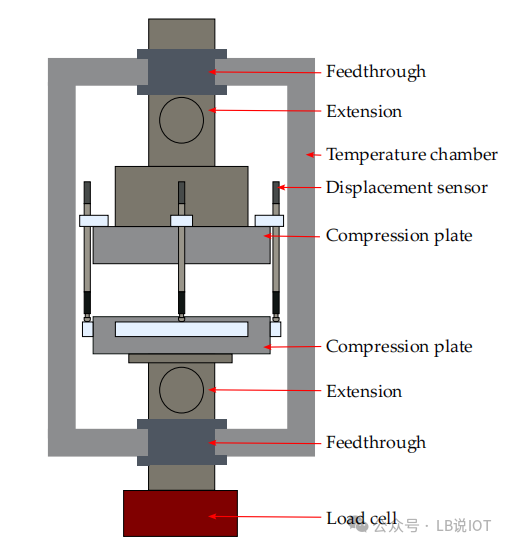
Compression tests were conducted using a ZwickRoell Z020/TH universal testing machine, equipped with a load sensor (±1% accuracy below 200N, ±0.5% above) and three tactile displacement sensors. The test began with a preload of 0.5MPa to ensure sufficient contact between the sample and the device, gradually increasing the pressure to 2.5MPa over 6 hours, and recording a correction curve using a steel reference sample to compensate for the compression deformation of the device and aluminum-plastic bag.
To characterize the state of the electrode materials, a coin-type half-cell was assembled: a 14mm diameter electrode sample was used as the working electrode, separated from the lithium metal counter electrode by a 16mm diameter, 260μm thick glass fiber separator, and 80μL of LP572 electrolyte was injected. The potential (φ) of the working electrode relative to the lithium metal was measured using a Basytec CTS tester at 25°C, establishing the correlation between SOC and the chemical state of the material.
3. Results and Discussion
(1) SOC-Dependent Compression Characteristics of Three Electrodes
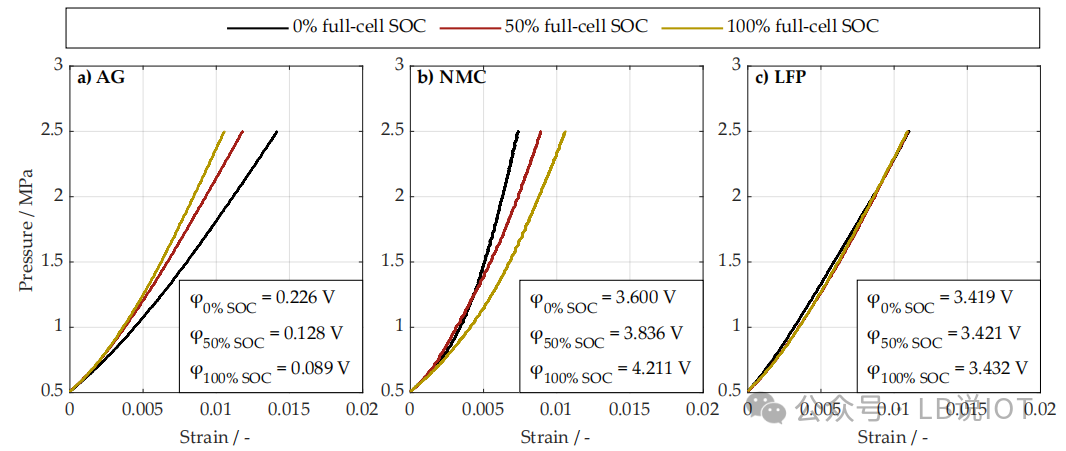
The stress-strain curves obtained from the experiments (Figure 2) reveal the differences in mechanical responses of the three electrodes under different states of charge (SOC):
-
AG Anode: Its stiffness shows an increasing trend with rising SOC, with a linearized Young’s modulus of 141MPa at 0% SOC, increasing to 190MPa at 100% SOC, an increase of 34%. This phenomenon is attributed to the densification of the graphite particles after lithium insertion, but the porous structure of the electrode buffers the transmission of particle deformation, resulting in a modulus increase (34%) at the electrode level being much lower than that at the material level (reported in literature as 32GPa→109GPa).
-
NMC811 Cathode: Stiffness is negatively correlated with SOC, with Young’s modulus at 271MPa at 0% SOC, decreasing to 188MPa at 100% SOC, a decrease of 30%. This result complements the conclusion from nanoindentation experiments that the modulus of NMC material increases with lithium content, indicating that the mechanical properties of the electrode are the result of the intrinsic properties of the material and the porous structure working together—despite the increased stiffness of NMC particles, the change in porosity dominated the overall stiffness decrease.
-
LFP Cathode: The Young’s modulus remains stable around 182MPa at different SOCs, experimentally confirming for the first time that its compression characteristics are independent of SOC. This finding aligns with material-level studies (LFP Young’s modulus stabilizing at 125GPa) and explains the excellent structural stability of LFP batteries during cycling.
Through three parallel tests of the NMC811 and LFP electrodes at 50% SOC, the repeatability of the experiments was verified, with a relative standard deviation of Young’s modulus of only about 4%, significantly smaller than the modulus fluctuations caused by SOC changes (AG ±34%, NMC811 ±30%), ensuring the reliability of the research results.
(2) Core Theoretical Framework for Explaining Phenomena
This study constructs a dual-dimensional theoretical model based on experimental phenomena, systematically explaining the differences in compression characteristics of different electrode materials:
Theory 1: Modulus-Deformation Coupling Effect
The electrode compression process involves mechanisms such as porous structure collapse, binder softening, and active particle displacement, with the contribution of active particle deformation being less than 5%. The Young’s modulus of AG and NMC811 materials shows dynamic changes with lithium content (AG modulus increases, NMC811 significantly increases), and this intrinsic mechanical performance evolution is transmitted to the macro scale of the electrode through microscopic particle deformation, triggering the SOC-dependent response of overall stiffness. In contrast, the stability of LFP material’s modulus cuts off the correlation path between particle deformation and electrode stiffness.
Theory 2: Particle Size Scale Effect
The particle size of the electrode has a significant regulatory effect on the evolution of the microstructure. The D50 particle size of the LFP electrode is only 1.4μm, significantly smaller than that of AG (13.5μm) and NMC811 (10.5μm). The volume change of particles caused by lithium insertion/extraction (usually < 5%) is unlikely to cause substantial changes in porosity and contact state in the small particle LFP system; whereas the volume fluctuations of large particles in AG and NMC811 can reshape the internal stress network of the electrode, leading to dynamic changes in compression characteristics with SOC.
The above theoretical model requires further research through two sets of validation experiments: ① preparing LFP electrodes with different particle size distributions to quantify the weight of particle size on SOC dependence; ② conducting wet-state mechanical tests of the electrolyte system to analyze the potential interference of binder swelling behavior on compression characteristics.
4. Conclusion
This study systematically explores the SOC-dependent compression characteristics of three mainstream lithium battery electrodes (AG, NMC811, LFP) through standardized compression testing, filling the data gap related to LFP electrodes for the first time. The main research findings are as follows:
-
Differentiation of Electrode Mechanical Behavior: The stiffness of the AG electrode increases with rising SOC, while the stiffness of the NMC811 electrode decreases with increasing SOC, and the mechanical performance of the LFP electrode is unaffected by SOC. These findings align with material property studies and provide key parameter support for multi-scale modeling of batteries.
-
Innovative Theoretical Mechanisms: The hypotheses of “porous structure dominating deformation” and “particle diameter regulating microscopic changes” provide a new analytical perspective for explaining electrode mechanical behavior.
-
Innovative Testing Methods: Standardizing preload (0.5MPa), strain rate, and testing temperature parameters resolves the issue of comparability in previous experimental data, establishing a standardized testing paradigm for subsequent similar research.
In terms of engineering applications, the results of this study have significant guiding value: for the NMC811 battery’s characteristic of stiffness reduction at high SOC, battery pack fixing pressure can be optimized to prevent excessive deformation of the electrodes; utilizing the mechanical stability of LFP electrodes can simplify the design of energy storage battery packaging, reducing manufacturing costs. Future research can focus on changes in mechanical properties of electrodes after cycling aging and wet-state mechanical characteristics of electrodes, further improving the theoretical system of lithium battery mechanical design.
Core Source:Schabenberger, T.; Durdel, A.; Kiicher, S.; Jossen, A. SOC-Dependent Compression of Lithium-Ion Battery Electrodes. Batteries2025, 11, 430.