At the 2025 China International Industrial Expo, domestic chips have become a focal point. In recent years, with the rapid development of artificial intelligence and smart manufacturing, the boundaries between industrial control and smart terminals have gradually blurred, leading to new development opportunities in the industrial chip market. According to the latest research data, the market size of China’s industrial SoC is expected to grow by more than double digits year-on-year in 2024, and the share of domestic manufacturers is steadily increasing, gradually becoming an important force in promoting the transformation of smart manufacturing. From the application end to the upstream of the industrial chain, more and more manufacturers are re-evaluating the strategic position of industrial chips. Moreover, as the process of industrial intelligence accelerates, the market’s demand for high-performance, long-lifecycle, and fully-ecological industrial-grade chips is becoming increasingly urgent.
MIR DATABANK
01
Launch of “Chip” Products, Exceptional Value
It is well known that traditional industrial chips are mostly simple MCU-type chips that can only perform basic industrial control functions, referred to as “microcontrollers.” However, driven by the wave of artificial intelligence, emerging industrial scenarios have higher requirements for computing power and functionality, making traditional MCUs increasingly inadequate. Some manufacturers have therefore opted for high-performance consumer-grade chips as a transitional solution to support the upgrade of industrial intelligence. However, this approach has also raised new issues—consumer-grade chips often exhibit redundancy in performance and functionality in industrial scenarios, and their reliability may not meet the stringent requirements of industrial environments.
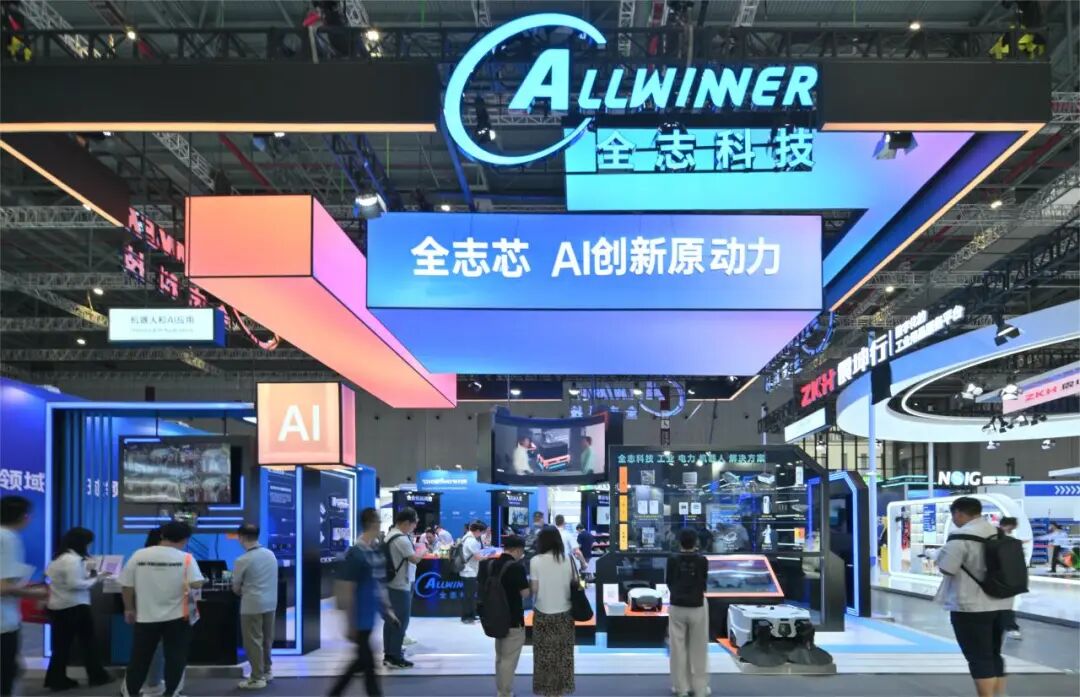
Based on the aforementioned industry pain points, Allwinner Technology recently launched the high-performance industrial processor T153 at the Shanghai Industrial Expo.The T153 is oriented towards the needs of smart industry, with systematic optimizations in computing power, scalability, and software ecology, balancing high performance with high reliability, and can be widely applied in core industrial control and interaction segments such as PLCs, HMIs, and industrial gateways.
• In terms of computing power, the T153 adopts a heterogeneous design with a quad-core Arm® Cortex®-A7 processor and a single-core RISC-V XuanTie E907 processor, ensuring high-performance application processing while achieving high-precision real-time control through dedicated microcontrollers, providing a solid computing foundation for complex industrial automation scenarios. Additionally, the chip integrates multiple computing units such as ISP image processing and G2D graphics acceleration, supporting DDR3 / DDR3L / DDR4 memory, offering powerful computing performance and rapid response, capable of handling high-demand automation tasks.
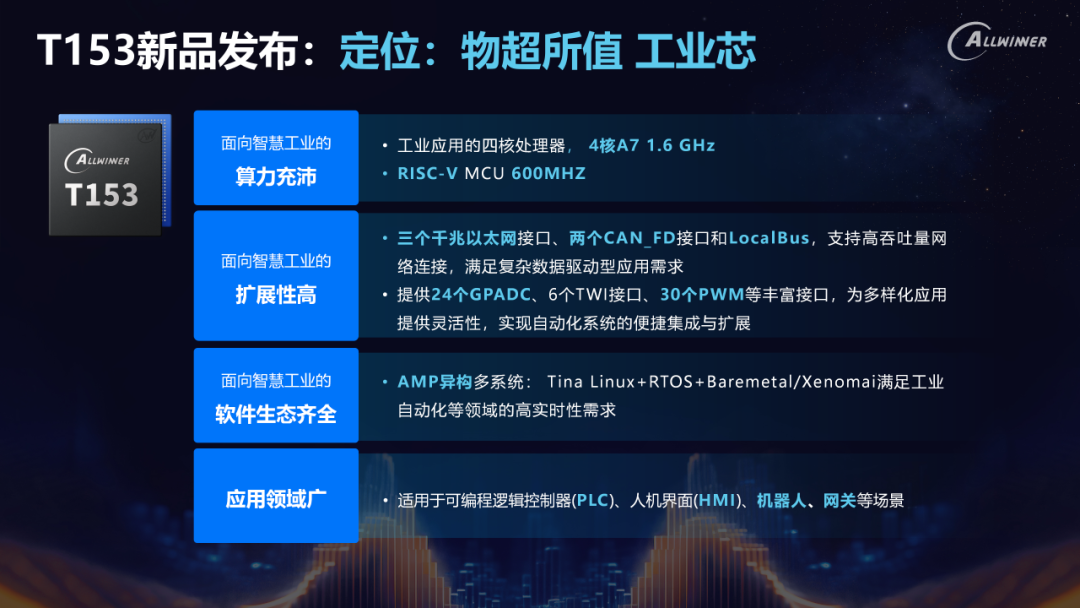
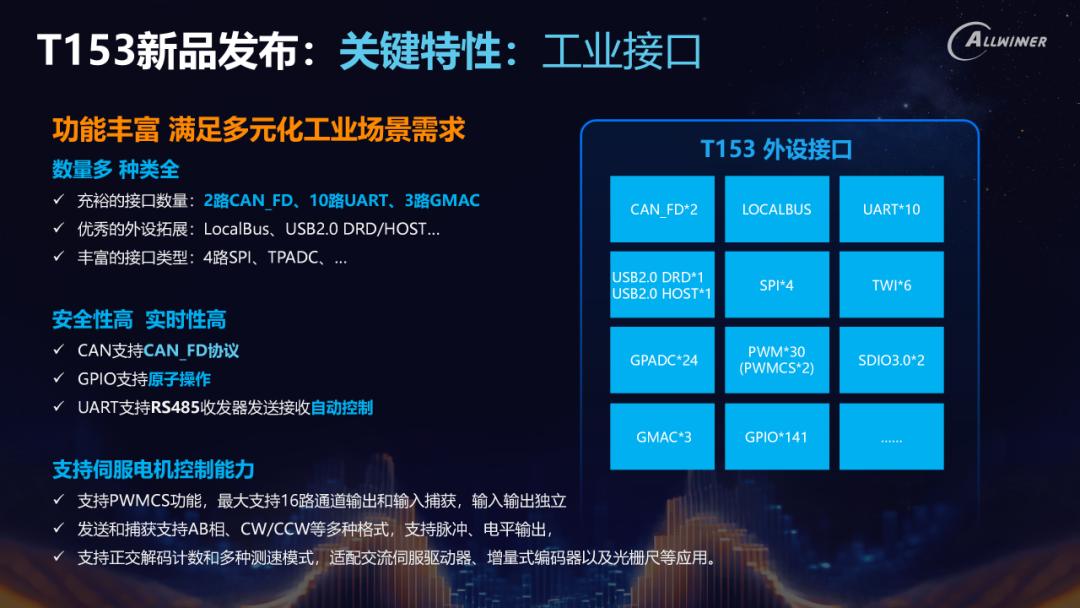
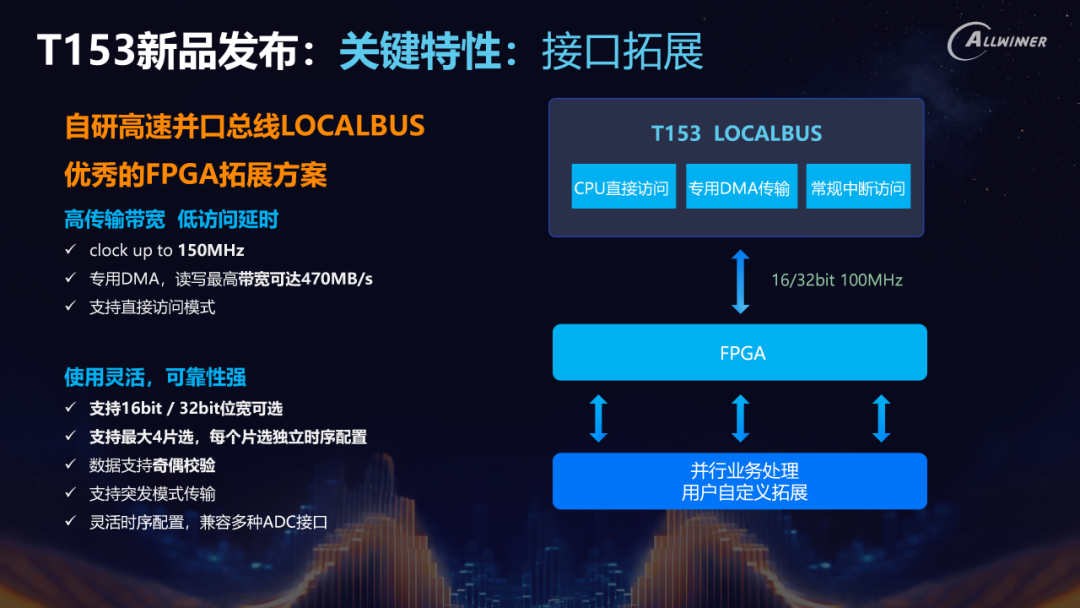
• In terms of scalability, the T153 is equipped with three Gigabit Ethernet interfaces, two CAN-FD interfaces, and LocalBus, supporting high-throughput network connections to meet the needs of complex data-driven applications. Its integrated image signal processor and display engine can provide clear real-time visual feedback for precision manufacturing process management. As shown in the figure, the T153 also offers 24 GPADC, 6 TWI interfaces, 30 PWM, and other rich interfaces, providing flexibility for diverse applications and facilitating convenient integration and expansion of automation systems.
• In terms of safety, this chip meets industrial safety certification requirements such as IEC-60730 Class-B and PSA L1, ensuring reliable operation in harsh industrial environments.
If having competitive products is just the foundation, then whether software and ecology develop in synergy is the key to determining whether the chip can truly be implemented. The complexity of the industrial market lies not only in the diversity of applications but also in the high requirements for software and protocol compatibility.On one hand, the traditional industrial market already has a very large stock, and entering this stock market requires adaptation in software and interface protocols to the traditional industrial software ecology;On the other hand, the emerging forms of industrial products bring more requirements for SoC chip software solutions, with products such as robotic arms, dexterous hands, and industrial-grade AI emerging one after another, imposing new demands on software systems and frameworks. In response to these two points, Allwinner Technology has provided answers through continuous innovation in software architecture and ecological synergy.
In terms of software ecology, the T153 supports AMP heterogeneous multi-system (Tina Linux + RTOS + Baremetal), allowing for flexible configuration of multiple different operating systems to meet the high real-time requirements in fields such as industrial automation, forming a complete software ecology oriented towards smart industry.
At the same time, Su Jiajia, General Manager of Allwinner Technology’s System Software Center, mentioned in a speech that Allwinner is continuously promoting the optimization of software platform operating systems for real-time performance, compatibility with mainstream industrial protocols, security hardening, and AI edge inference, truly achieving “reliable hardware, easy-to-use software, and a complete ecology. Among them, the distributed architecture software of “one master and multiple slaves” is an important software achievement launched by the company in response to the needs of the industrial sector.
MIR DATABANK
02
Allwinner Technology’s Deep Cultivation and Layout in the Industrial “Chip” Track
As one of the earliest listed chip companies in China, Allwinner Technology has laid a solid R&D foundation in fields such as smart application processors SoC, high-performance analog devices, and wireless interconnect chips since the tablet era. In recent years, Allwinner Technology has performed outstandingly in multiple product markets, including smart hardware, smart robotics, smart home appliances, smart IoT, tablets, network set-top boxes, as well as power analog devices and wireless communication modules. Especially in the emerging consumer electronics field, leveraging its technological advantages and product competitiveness, Allwinner’s market share has significantly led, establishing deep cooperation with many industry-leading clients such as Xiaomi, Tencent, Alibaba, Baidu, Midea, and Haier, and gradually expanding into the automotive sector, collaborating with mainstream automakers such as Changan, FAW, SAIC, Geely, and Hongqi on product and technology cooperation. Through an integrated collaborative model of “computing power + algorithms + products + services,” Allwinner is jointly promoting the large-scale production of products such as smart speakers, robotic vacuum cleaners, smart cockpits, and smart home appliances,and occupying a major supplier position in multiple sub-markets.
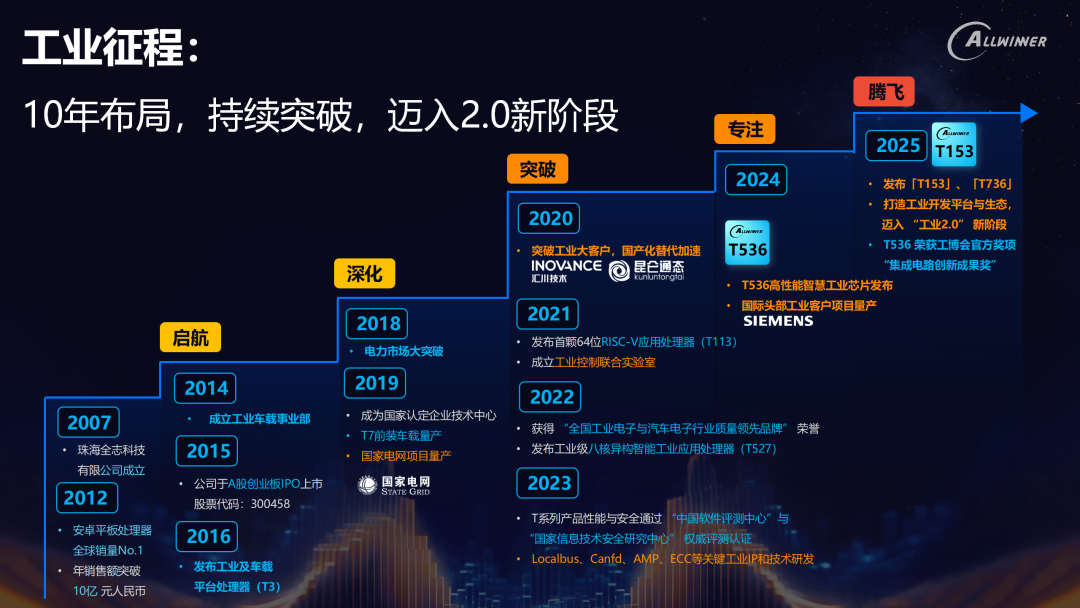
This long-term technological accumulation and industrial practice have enabled Allwinner to not only meet the reliability and durability requirements of high-end consumer electronics brands but also naturally possess the capability to enter the industrial chip field.
Allwinner’s industrial chip strategy is not limited to product launches but is deeply integrated with industrial demands.
In fact, Allwinner has been deeply involved in the industrial chip market for a long time. As early as 2014, the year before Allwinner Technology was listed on the A-share market, Allwinner established the Industrial Vehicle Division, focusing on the R&D and market application of high-reliability, high-stability industrial-grade chips. In 2016, Allwinner launched its first dedicated processor T3 for the industrial sector, with cumulative shipments exceeding 50 million units to date. Subsequently, Allwinner quickly entered the power industry and successfully entered the State Grid supply chain in 2018, achieving the full process from R&D to mass production of power products in just one year. In 2020, its annual shipment of power products exceeded 1 million units, further validating Allwinner’s growth potential in the industrial market.
With the continuous diversification of industrial demands, Allwinner has gradually established a relatively complete product matrix in the industrial chip field. From T7, A40i, T507, T517, T113, and T527, to the recent T536, T736, and the T153 launched at the Industrial Expo, Allwinner has gradually formed a platform-type SoC solution covering different computing power levels, with application scenarios encompassing PLCs, HMIs, industrial gateways, and industrial control computers.
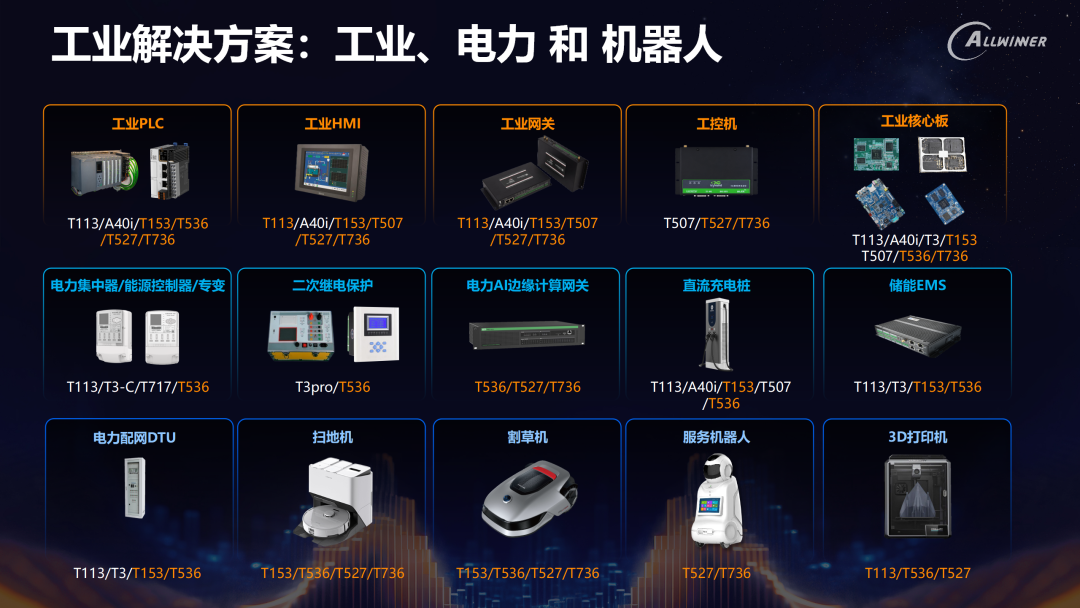
Allwinner’s expansion in the industrial market relies not only on its technological accumulation but also on the joint promotion of partners and the industrial ecosystem.On the commercial level, Allwinner has successively reached strategic cooperation with leading manufacturers in the industrial field such as Inovance Technology and Kunlun Tongtai;In terms of technological innovation, in 2021, it jointly established an industrial control joint laboratory with Inovance Technology; in 2022, it launched the industrial-grade octa-core heterogeneous smart application processor T527, which was awarded the title of “National Leading Brand in Industrial Electronics and Automotive Industry Quality”; in 2023, Allwinner’s T series products passed authoritative certification from the China Software Evaluation Center and the National Information Technology Security Research Center in terms of performance and safety, and significant progress was made in the R&D of key industrial IPs such as LocalBus, CAN FD, AMP, and ECC; in 2024, Allwinner made its debut at the China International Industrial Expo, launching the industrial control dedicated chip T536, while also successfully achieving mass production of projects in collaboration with global industrial giant Siemens. MIR Rui Industrial believes that this “technology + ecology” dual-drive model is the core path for Allwinner to achieve sustainable development in the industrial market.
After years of development, Allwinner has established a chip quality system that is “fully industrial-grade and partially automotive-grade,” with the product market’s defect rate performance fully “in the hundreds,” gaining widespread recognition from leading industrial and automotive clients. It is worth noting that all of this is inseparable from continuous investment in R&D. According to financial report data, in the first half of 2025, Allwinner’s R&D investment reached 27,537.92 million yuan, accounting for 20.60% of operating income, an increase of 4.28% compared to the same period last year. In the field of industrial chips, which requires long-term accumulation, high R&D investment has become an important guarantee for the company to maintain its competitiveness.
Conclusion
From an industrial trend perspective, the industrial chip market is shifting from “product-driven” to “systematic competition.” In the future, computing power will no longer be the only standard, long lifecycle, full-stack ecology, safety, and protocol compatibility will become key indicators for whether chips can enter core industrial segments. With the in-depth application of artificial intelligence in industrial control, edge computing, and human-computer interaction, the industrial SoC market is transitioning from the traditional microcontroller pattern to a new stage characterized by platformization and ecological integration.
In this transformation process, domestic manufacturers are facing historic opportunities. On one hand, the uncertainty of the international supply chain has strengthened the demand for localization; on the other hand, the intelligent upgrade of China’s manufacturing industry is also nurturing a huge demand for high-performance, customizable, and open industrial-grade chips. It is foreseeable that in the coming years, the Chinese industrial chip market will present a development trend of “diversified demand, deepened application scenarios, and ecological collaboration.”
For Allwinner, continuously forming a closed loop in computing power, ecology, and application implementation will be the core of its competitive edge. Looking at the broader industry, Chinese industrial chip manufacturers need not only breakthroughs in isolated points but also how to form synergy in dimensions such as technological iteration, standard adaptation, and ecological construction to promote domestic industrial chips from “replacement” to “leadership.”
 *Log in toMIR DATABANK Manufacturing Industry Professional Data Platform to obtain more manufacturing industry data information, company information, and research reports! https://www.mirdatabank.comContact UsCustomer Service WeChat: mm2450599812MIR DATABANK – Beijing HeadquartersYan Xuehui +86-18600855341[email protected]Shen Xia +86-13683509940[email protected]MIR DATABANK – Shanghai BranchLi Yujie +86-18221802598[email protected]Li Xuejiao +86-15921636781[email protected]MIR DATABANK – Wuhan BranchLi Xuejiao +86-15921636781[email protected]MIR DATABANK – Shenzhen BranchLiu Guo +86-15120045385[email protected]
 Click here to read the original text