Attention engineers in consumer electronics and industrial control! SONIX microcontrollers are becoming a popular choice in embedded design due to their “high integration, low power consumption, and excellent cost-performance ratio”—you can find them in everything from coffee machines to smart home appliances, and from industrial sensors to medical devices. This article simplifies the selection process by avoiding complex parameters and breaking down decisions by scenario, helping you avoid pitfalls in selection 👇
🤔 Why do engineers love SONIX microcontrollers? 3 Core Advantages
- High integration, cost-saving! Built-in UART, I2C, SPI communication protocols, timers, PWM, ADCs, and other peripherals eliminate the need for additional external components, reducing BOM costs by 20%-30%, and allowing PCB size to shrink by over 15%;
- Easy to develop, short cycle! Supports assembly/MCU C programming, provides complete source code, circuit diagrams, and hardware interface documentation, enabling beginners to quickly get started and shortening project development cycles by 1-2 months;
- Strong stability, wide adaptability! Operating temperature range of -40℃ to 85℃, suitable for both industrial and consumer scenarios, with some models already in mass production in over 20,000 devices, exhibiting extremely low failure rates.
🏆 5 Popular Models! Scenario-Based Selection Made Easy
1. SN8P2711B → Entry-level general-purpose model (cost-sensitive devices)
✅ Core Highlights: 8-bit MCU, the king of cost-performance, with extremely simplified peripheral circuitry, requiring only 3 capacitors to operate
✅ Key Parameters: Program storage capacity 4KB, RAM 128B, supports I2C/UART communication, 2 PWM outputs
✅ Typical Applications: Remote controls, LED light strips, small toys, simple sensor modules
✅ Selection Reason: Cost as low as a few yuan, suitable for mass production of low-cost consumer electronics, low development difficulty, beginner-friendly
2. SN8P2622A → First choice for industrial control (requires precise control scenarios)
✅ Core Highlights: Enhanced 8-bit core, rich timer functions, supports multi-channel interrupts, strong anti-interference capability
✅ Key Parameters: Program storage capacity 8KB, RAM 256B, 4-channel 10-bit ADC, 6 PWM outputs
✅ Typical Applications: Industrial sensors, motor drives, relay controls, automation production line monitoring nodes
✅ Selection Reason: Wide operating voltage range (2.5V-5.5V), resistant to electromagnetic interference, suitable for harsh industrial environments
3. SN32F240B → High-performance 32-bit model (complex function devices)
✅ Core Highlights: 32-bit ARM Cortex-M0 core, fast computation speed, supports large-capacity storage expansion
✅ Key Parameters: Maximum clock frequency 48MHz, program storage capacity 64KB, RAM 8KB, supports USB 2.0, CAN communication
✅ Typical Applications: Smart appliance main control, IoT terminals, small gateways, data collectors
✅ Selection Reason: Balances performance and power consumption, handles complex algorithm processing effortlessly, ideal for IoT projects
4. SN8P2501A → Best-selling consumer electronics model (smart home appliances/small appliances)
✅ Core Highlights: Optimized for appliance control, built-in touch detection module, supports multi-key recognition
✅ Key Parameters: Program storage capacity 6KB, RAM 192B, supports I2C/SPI communication, includes LED driver
✅ Typical Applications: Coffee machines, rice cookers, fans, smart switches, humidifiers
✅ Selection Reason: Touch response is sensitive, capable of implementing core functions such as water temperature control and gear adjustment, already mass-produced in over 20,000 coffee machines, stability verified in the market
5. SN32F103 → High-end multifunction model (complex industrial/medical devices)
✅ Core Highlights: 32-bit high-performance core, built-in hardware encryption module, supports various communication interface expansions
✅ Key Parameters: Maximum clock frequency 72MHz, program storage capacity 128KB, RAM 20KB, 12-bit ADC, supports DMA transfer
✅ Typical Applications: Medical device data processing, industrial automation main control, high-end sensor nodes, automotive electronics
✅ Selection Reason: Strong computing power, supports complex control logic and data processing, meets high reliability requirements for medical/industrial applications
🚀 4 Golden Rules for Avoiding Selection Pitfalls
- Select the core based on functionality: For simple controls (LEDs, buttons), choose 8-bit models (e.g., SN8P2711B); for complex algorithms (data processing, IoT), choose 32-bit models (e.g., SN32F240B);
- Leave redundancy in storage capacity: It is recommended to have 30% more program storage capacity than the actual requirement to avoid insufficient capacity for future function expansions;
- Prioritize integrated peripherals: Prefer models with built-in required communication protocols (e.g., I2C, USB) and functional modules (e.g., ADC, PWM) to reduce external components;
- Consider temperature range for industrial scenarios: Industrial/automotive devices must select wide temperature range models (-40℃~85℃), while consumer electronics can choose standard models (0℃~70℃).
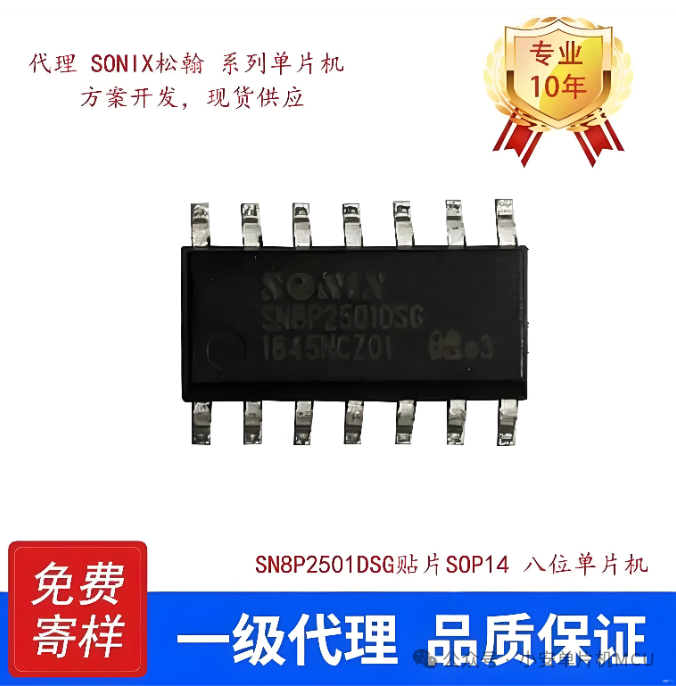
💡 Real Case: Coffee Machine Project Selection Practice
A certain appliance factory in Shenzhen developed a smart coffee machine, with the core requirement being precise control of grinding, brewing, and heating, while being cost-sensitive:
- Final Selection: SN8P2501A
- Selection Logic: Built-in timer and interrupt system for precise control of water temperature and grinding time; supports user interface module and sensor communication without the need for additional expansion chips; assembly programming ensures low resource consumption, with a failure rate of <0.1% in mass applications;
- Results: BOM costs reduced by 25%, development cycle shortened by 1.5 months, with over 20,000 units produced without large-scale failures.
❓ Frequently Asked Questions
🔸 What programming languages are supported by SONIX microcontrollers?
They support assembly language and MCU C language; assembly is suitable for scenarios pursuing extreme performance and low power consumption, while C language is suitable for rapid development and complex logic implementation, with complete programming examples provided by the official documentation.
The core advantage of SONIX microcontrollers is “precise matching of scenarios + high cost-performance ratio”; there is no need to blindly pursue high performance; selecting the right model can save costs and improve efficiency!

#SONIXMicrocontroller #EmbeddedSelection #MCUSelectionGuide #ConsumerElectronicsDesign #IndustrialControl #MicrocontrollerTechnology