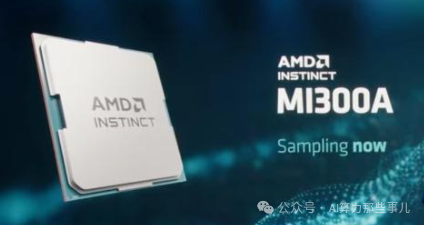
The MI300A is AMD’s next-generation data center-level APU (Accelerated Processing Unit) released in 2023, and it is the world’s first HPC chip to seamlessly integrate an x86 CPU and GPU in the same package. It utilizes Chiplet and 3D packaging technology, offering strong general computing and AI acceleration capabilities.
Key architectural highlights:
-
Fusion Architecture: Includes a 24-core EPYC Zen4 CPU and a CDNA3 architecture GPU.
-
Unified Memory Architecture (UMA): CPU and GPU share high-bandwidth memory (HBM3).
-
Chiplet Packaging: Utilizes 9 chiplets (3 CPUs + 6 GPUs).
-
HBM3 Video Memory: Supports up to 128GB (shared).

1
MI300A Technical Specifications
| Parameter | MI300A |
|---|---|
| Architecture | Zen4 (CPU) + CDNA3 (GPU) |
| CPU Core Count | 24 Core EPYC |
| GPU Compute Units (CDNA3) | 100+ CU |
| Memory Type | HBM3 |
| Memory Capacity | 128GB (CPU/GPU shared) |
| Memory Bandwidth | Over 5 TB/s |
| TDP Power Consumption | ~500W |
| Package Type | OAM (for supercomputing modules) |
| Instruction Set Support | x86_64, ROCm, FP64/FP32/TF32 |
📌 Summary: The MI300A is the most integrated and cutting-edge AI + HPC hybrid chip.
2
Competitive Comparison and Performance Advantages
Comparison with NVIDIA H100:
| Comparison Dimension | AMD MI300A | NVIDIA H100 SXM |
|---|---|---|
| Architecture Form | CPU + GPU Fusion Chip | Independent GPU, requires external CPU |
| AI Training Performance | Medium to High, suitable for FP64/FP32 training | Very strong, suitable for TF32/FP16 training |
| HPC Capability | Strong, especially suitable for simulation and modeling scenarios | Strong, focused on AI fields |
| Memory Architecture | CPU/GPU shared HBM3 (UMA) | GPU exclusively uses HBM3, not shared with CPU |
| Usage Threshold | More suitable for overall deployment in supercomputing platforms | More suitable for AI computing clusters (requires accompanying CPU) |
| Software Ecosystem | ROCm (continuously evolving) | CUDA (most mature) |
| Application Direction | Supercomputing simulation + AI mixed workloads | Large model training, inference optimization |
✅ The MI300A is not a “graphics card replacement” but rather a supercomputing node control engine, more like an “AI + HPC integrated chip”.
3
Application Scenarios and Market Value
The MI300A is not aimed at being the “fastest chip for training Transformer models” but rather to provide a “platform-level chip” that excels in supercomputing simulation, AI model integration, and multi-task parallelism.
Key Application Scenarios:
1. National Supercomputing Centers / HPC Facilities
-
The US Oak Ridge National Laboratory’s Exascale supercomputer “El Capitan” is built using the MI300A;
-
High-precision scenarios such as simulation, biological computing, nuclear reactor modeling, and astrophysical simulation;
-
Unified memory can reduce data transfer bottlenecks between CPU and GPU.
2. AI + Scientific Computing Integration Platforms
-
Simultaneously run scientific simulation tasks and AI model training/inference;
-
For example: embedding large models in real-time during astrophysical simulations for auxiliary predictions;
-
Very suitable for scenarios requiring collaboration between physical modeling and generative models.
3. Private AI/HPC Hybrid Cloud Nodes
-
One chip for multiple uses, reducing the cost of “GPU card + CPU motherboard” combinations;
-
ROCm ecosystem continues to evolve, adapting to new scenarios such as LLM, Diffusion, Graph AI.
📌 The MI300A is a “high-dimensional energy block” in the AI era; it does not win by single benchmark scores but impresses users with its platform integration capability.
4
Cost Analysis and Return on Investment
Currently, the MI300A is not aimed at the consumer market, primarily targeting government agencies, supercomputing centers, and energy/biotechnology companies as its customer base. Its unit cost is relatively high, but deployment density and unified architecture advantages are significant.
1. Estimated Procurement Costs (Unofficial Quotes):
| Item | Estimated Value (Mid-2025) |
|---|---|
| Cost per MI300A module | $10,000~$15,000 |
| Cost per OAM server node | ¥150,000~¥200,000 / node |
| Comparison: H100 server | ¥250,000~¥300,000 / node |
2. Return on Investment Logic:
-
✅ Single node can replace traditional CPU + multiple GPU architectures, reducing system complexity;
-
✅ Unified memory reduces data transfer time, improving overall task completion efficiency;
-
✅ In hybrid computing scenarios (such as AI for HPC),the cost per unit of computation time is lower;
-
✅ The MI300X (pure GPU version with large memory) will be launched later, forming a product matrix combination.
💡 The investment value lies not in “single graphics card performance” but in “platform structural efficiency + maintenance costs + deployment density”.
5
Conclusion: The MI300A is a super entry chip for the era of AI + HPC integration.
The AMD MI300A does not compete with NVIDIA in the CUDA ecosystem but opens up a new path in AI + scientific integration scenarios:
📌 It is not a “stronger graphics card” but a “more integrated main chip”.
Why is it important?
✅ It makes “CPU and GPU” no longer two chips but a single integrated “super core”;
✅ It reduces hardware assembly and increases deployment density, representing an important form for future data centers;
✅ It provides a non-CUDA route for domestic computing power and heterogeneous ecosystems;
✅ It is not aimed at “maximizing model parameters” but at “optimizing the computing ecosystem”.
-END-
The author’s statement: All content published by this WeChat public account (hereinafter referred to as “this account”) is for reference and communication purposes only and does not constitute any investment, legal, medical, or other professional advice.
1. Some content of this account comes from the internet or other public channels. We strive to ensure the accuracy and reliability of the information, but we do not make any express or implied guarantees regarding its authenticity, completeness, or timeliness.
2. For reproduced and referenced content, we will indicate the source within a reasonable range. If there are copyright issues, please contact us in a timely manner, and we will handle it as soon as possible.
3. Users should make their own judgments and consult relevant professionals before making any decisions based on the content of this account. This account and its operating team are not responsible for any direct or indirect losses caused by the use of this account’s content.
In conclusion: In the future, I will continue to share more interesting technology hotspots, policy interpretations, AI movie analyses, hot 100 questions, and practical operations on the public account “AI Computing Power Matters”. Here, we do not talk about boring code, but discuss the interesting “computing power world”. Click to follow with your little hand! Why is it worth following?
✅Industry Frontier: Real-time tracking and unlocking current hot topics in the AI computing power industry✅Technical Analysis: Understanding the computing power, low-altitude, and AI full industry chain in a 100-question format, focusing on core technologies for in-depth analysis and practical operations
✅Product Evaluation: Focusing on mainstream domestic and foreign manufacturers’ related software and hardware solutions, forming evaluation reports✅Scenario Practice: Analyzing various manufacturers’ solutions in different industry fields, conducting case breakdowns and analyses, while focusing on how to operate and manage computing power projects, and how to design AI + industry solutions✅Book and Film Insights: Reviewing past AI-related movies and books, analyzing the past, glimpsing reality, and looking to the future✅Investment Opportunities:Focusing on upstream and downstream enterprises in the entire industry chain, analyzing core tracks, and interpreting financial reports
✅Full Resource Library:Compiling policy documents, standards, and industry reports related to AI computing power, available for review and regular analysis
✅Project Application: Analyzing medium- and long-term national debt, provincial and ministerial-level projects, etc., in the AI field, providing application support✅Resource Links:VIP resource groups, linking the upstream and downstream industries of computing power, connecting supply and demand, and occasionally dropping exclusive activity participation qualifications (offline salons, you might be the owner of a VIP seat)
●AI unmanned live streaming selling courses: How are algorithms harvesting the anxiety of mothers when technology becomes a scythe?
●Beware! Your privacy is being auctioned in real-time! How does the “information black hole” exposed in the 315 evening party turn everyone into transparent people?
●In the 2025 government work report, there is a shocking code for the rise of China’s computing power! What kind of big chess game is China playing?
●$500 billion bet on the “Stargate”, is the road to American AI hegemony filled with thorns or smooth sailing?