Introduction
Hello everyone, I am Mai Ge. Today, I would like to recommend an open-source smart home project.
In the era of the Internet of Things (IoT), the ESP8266 and ESP32 chips have become favorites in embedded development.
These low-cost, high-performance Wi-Fi modules are widely used in smart homes, automation systems, and sensor networks.
However, the original firmware is often limited by cloud dependency, closed nature, and security issues.
<span>Tasmota</span>, as an open-source alternative firmware, has completely changed this situation. It offers local control, flexible expansion, and seamless integration, making it highly favored by embedded engineers.
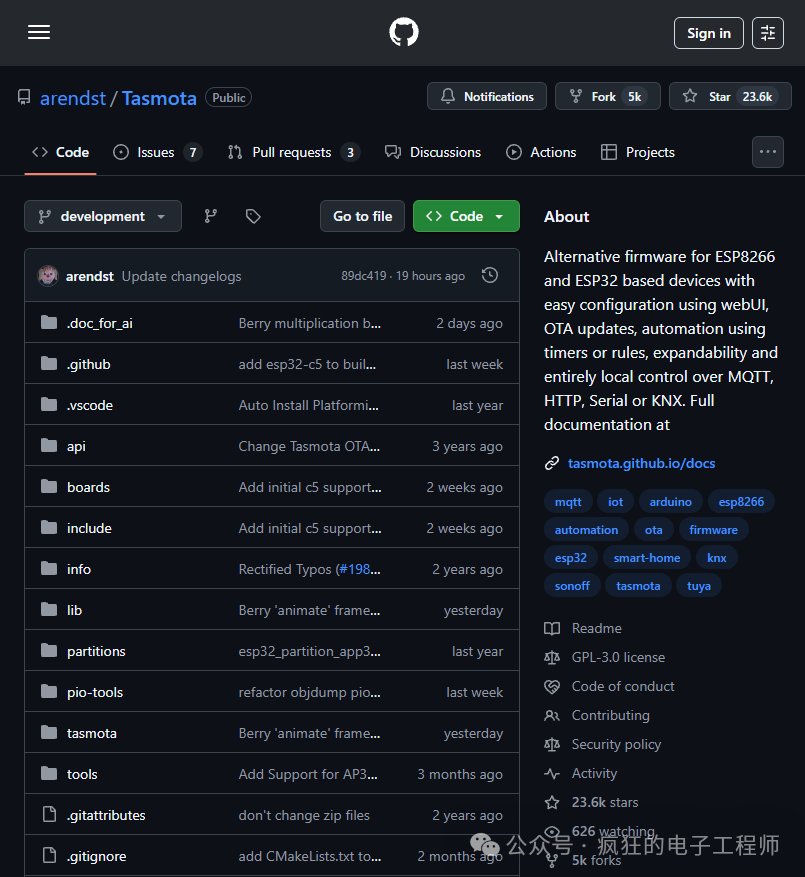
This article will delve into the Tasmota project, based on its GitHub repository (https://github.com/arendst/Tasmota), exploring its core value from a technical perspective to help you quickly get started and apply it in practical development.
Project Overview
Tasmota is an open-source project led by Theo Arends (arendst), initiated in 2016, aimed at providing alternative firmware for ESP8266 and ESP32 devices.
This firmware is built on PlatformIO and supports hundreds of IoT devices, such as Sonoff smart switches, Tuya modules, and custom sensor boards.
Unlike vendor firmware, Tasmota emphasizes local control, avoiding cloud dependency, ensuring data privacy and system stability.
The project repository contains complete source code, documentation, and binaries. The latest version (as of August 2025) focuses on stability optimization and protocol expansion. The installation process is straightforward and easy to follow.
Project Features
The core of Tasmota lies in its technical depth and flexibility, with the following key features:
-
Easy Configuration and WebUI: Built-in responsive web interface supports real-time configuration of GPIO, Wi-Fi, and protocol parameters. No programming is required to map pins to relays, sensors, or PWM outputs. Compared to Espressif’s IDF framework, Tasmota simplifies the entry barrier but allows customization through
<span>user_config_override.h</span>for options like enabling specific drivers. -
OTA Updates and Automation: Supports Over-The-Air firmware upgrades, avoiding physical intervention. The automation engine is based on timers and a rules system, for example, using Lua-like scripts for conditional triggers (e.g., “if temperature > 30 then turn on light”). The rules support variables, expressions, and chained execution, suitable for complex scenarios.
-
Protocol Expansion and Local Control: Integrates MQTT, HTTP, Serial, and KNX without the need for cloud services. The MQTT client supports TLS encryption, ensuring secure transmission. KNX integration allows seamless connection with home bus systems. Highly extensible: add custom features through the Berry scripting language (similar to Lua) or integrate third-party drivers like the MHZ19 CO2 sensor.
-
Hardware Optimization and Security: For the ESP8285, only DOUT flash mode is supported, using a 1M no SPIFFS linked script to optimize code space. GPIO driver covers IR sending, I2C sensors (like HTU21), and PWM control. The project emphasizes security: warns of high voltage risks and provides a backup configuration mechanism. Community-driven HomeAssistant Discovery simplifies integration, supporting UDP multicast and Zigbee bridging.
-
Community and Documentation: Comprehensive documentation (https://tasmota.github.io/docs/) covers everything from flashing to advanced scripting. The Discord chat room (https://discord.gg/Ks2Kzd4) and GitHub Discussions provide real-time support. Many contributors, including driver authors like Heiko Krupp (IRSend) and Stephan Hadinger (Zigbee/Berry optimization).
Compared to closed firmware, Tasmota’s open-source nature allows for deep customization, such as modifying the core stack to support custom protocol stacks or low-power modes.
Development Use Cases
Tasmota shines in embedded development, with several hardcore use cases, including actual code and configurations:
-
Smart Home Automation: Flash a Sonoff Basic switch, configure the Template as “Sonoff Basic”. Set up the MQTT broker (like Mosquitto) through the WebUI, with rule example:
<span>Rule1 on Power1#state=1 do publish home/light/status on endon</span>. Integrate with HomeAssistant for voice control. Hardcore extension: use Berry scripts to add custom sensor fusion, such as merging DHT22 temperature and humidity data to calculate comfort index. -
Sensor Network Construction: Deploy a multi-node network on ESP32. Configure KNX group addresses for interaction with Siemens bus.
Example: Map GPIO0 as button input, trigger rules to output Serial to an external MCU. During development, use PlatformIO to compile, adding
<span>#define USE_ZIGBEE</span>to enable Zigbee bridging, supporting Philips Hue bulb emulation.Actual testing: deploy a 10-node network, MQTT topic subscription for data aggregation, with latency < 50ms.
-
Industrial Monitoring Prototype: Custom ESP8266 board integrating MHZ19 CO2 sensor. Configuration:
<span>Backlog Module 0; Template {"NAME":"CO2 Monitor","GPIO":[0,0,0,0,0,0,0,0,0,0,0,0,0],"FLAG":0,"BASE":18}</span>.Rules:
<span>Rule on Analog#CO2>1000 do Power1 on endon</span>, triggering relay alarm.Hardcore point: push updates via OTA, combining Deep Sleep mode to reduce power consumption to microamps.
Extend to biological applications: integrate BioPython-like drivers (though not Python, but can simulate) to monitor greenhouse environments.
-
Security System Integration: Use Tasmota to drive HC-SR04 ultrasonic sensor, rules detect intrusions and HTTP POST to server. Example code modification: enable
<span>#define USE_HC_SR04</span>in<span>user_config_override.h</span>, compile and deploy via OTA. Combine with Shutter driver for curtain automation.
These use cases demonstrate Tasmota’s modularity: from GPIO abstraction to protocol stack, everything can be hacked. Note the migration path: upgrading from older versions requires following specific versions (e.g., v8.5.1 parameter layout changes) to avoid data loss.
Conclusion
Tasmota is not just firmware; it is an open-source paradigm for embedded IoT. It unleashes the potential of ESP8266/ESP32, providing localization, extensibility, and security that far exceed vendor solutions.
Whether for prototyping or production deployment, its WebUI, rules engine, and community support can accelerate the development cycle.
I recommend starting with the WebInstaller and exploring Berry scripts to unlock advanced features.
The project is active, and contributions are welcome. In the wave of IoT, Tasmota proves that open-source is the way to go. Go star it on GitHub and start your smart journey!