Introduction:
In the rapid development of smart vehicles, the in-vehicle communication bus acts like the “digital nervous system” of the vehicle, connecting various “nerve endings” of perception, decision-making, and execution. The Star Ring OS communication bus (VBS, Vehicle Bus System) not only provides a unified protocol and efficient transmission mechanism but also enhances reliability and security to automotive standards, aiming to create an efficient, safe, and scalable communication hub for smart vehicles. Next, we will comprehensively interpret the core capabilities of this “digital nervous system” from background, architecture, technical features to practical application scenarios.
1. Overview of the Communication Bus
The in-vehicle communication bus (VBS, Vehicle Bus System) is an efficient data interaction communication platform developed by Star Ring OS for the smart vehicle field. It provides a real-time and reliable information channel for the entire vehicle’s electronic and electrical systems through a standardized communication protocol, modular architecture, and real-time data transmission capabilities, enabling seamless collaboration among services such as autonomous driving, power control, infotainment, and active safety.
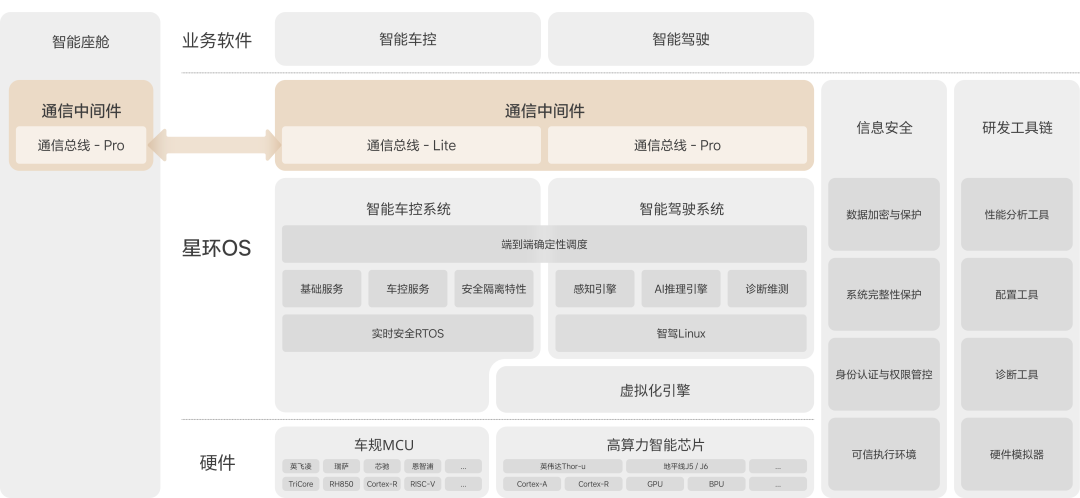
2. Background of the Communication Bus Development
With the acceleration of vehicle electrification, intelligence, and connectivity, the architecture of in-vehicle electronic systems is undergoing significant changes. The traditional distributed ECU architecture is gradually showing inadequacies in meeting new demands such as high-speed data transmission, cross-domain collaboration, and software-defined vehicles (SDV). As the core channel connecting the vehicle’s sensors and controllers, the performance and self-developed capabilities of the in-vehicle communication bus (VBS) are becoming key factors for automotive companies to enhance product competitiveness.
Specifically, the main goals of developing VBS are as follows:
(1) Improve development efficiency and reduce costs
-
Enhance development efficiency: A unified communication protocol can reduce coordination costs between different devices, solve compatibility issues among multi-vendor devices, and shorten the overall vehicle integration testing cycle. Using a single protocol to support all vehicle controllers avoids development redundancy caused by the coexistence of multiple standards.
-
Save long-term costs: By adopting self-developed technology instead of paid solutions, combined with a high-speed network architecture to replace traditional wiring harnesses, it can reduce technical usage costs while also decreasing wire weight and assembly complexity.
(2) Enhance product competitiveness through deep customization
-
Address high resource overhead issues: General-purpose protocol resource consumption is high, and configuration is complex, making it difficult to meet the stringent requirements of all embedded systems in vehicles. A communication system (such as VBS) designed specifically for in-vehicle scenarios can optimize memory usage (reducing by 50% under typical conditions) and lower communication latency (measured as low as 1ms).
-
Address long problem localization cycles: Closed-source software has low efficiency in problem resolution and does not support customization, leading to long resolution cycles for many low-probability issues. Open-source software allows for source code inspection and deep monitoring, significantly improving problem localization efficiency.
-
Meet product customization needs: Support on-demand adjustment of protocol functions, allowing flexible expansion of special function modules while retaining standard interfaces, such as adding high-priority data transmission channels for autonomous driving sensors.
(3) Enhance data sovereignty and network security
-
Meet regulatory compliance: China’s “Automotive Data Security Management Regulations” and GDPR (General Data Protection Regulation) require that vehicle data transmission be controllable. It needs to support three layers of protection: identity authentication, permission verification, and data encryption, to prevent remote attacks and sensitive information leakage.
-
Build a security defense line: Some closed-source software is limited by export controls, lacking information security and unable to withstand external attacks. Open-source software can thoroughly check for backdoor vulnerabilities and build corresponding security defenses to cope with increasingly severe in-vehicle network attacks (such as remote control risks).
3. Communication Bus Technical Architecture
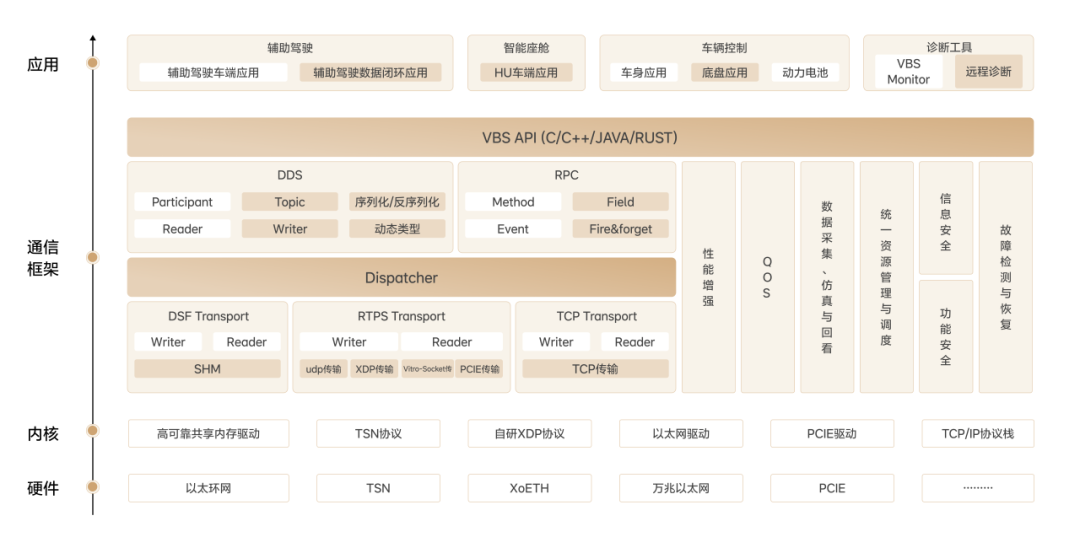
The overall architecture of VBS is as follows:
-
VBS Interface Layer: Provides multi-language SDKs (C/C++/Java/Rust) based on idlgen;
-
VBS Core Layer: Supports various communication modes such as DDS (Data Distribution Service) and RPC (Remote Procedure Call);
-
Dispatcher: Business is unaware of the physical transmission medium and autonomously selects the transmission path, achieving seamless deployment of services;
-
Transport Layer: Supports various transmission channels such as SHM, TCP, UDP, and can be extended to other physical media like PCIE in a plug-in manner.
4. Core Technical Features of the Communication Bus
4.1 Global Unified Deployment
-
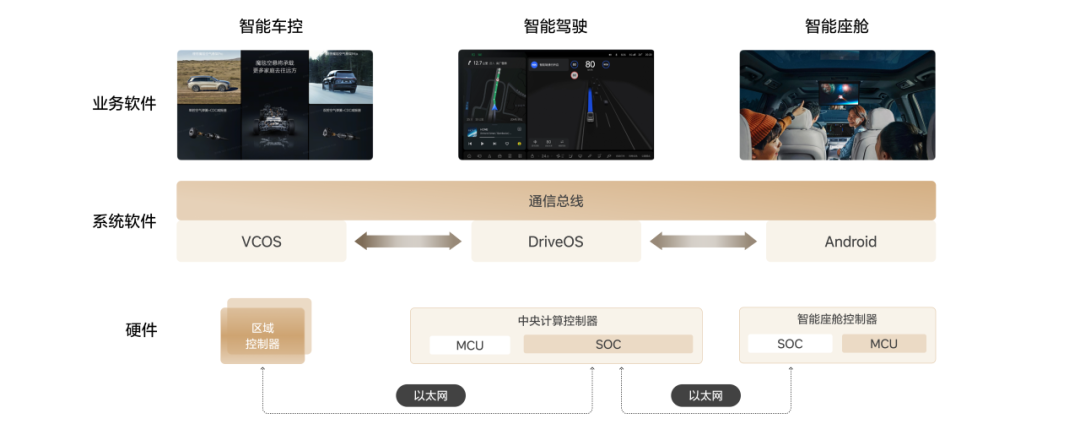
VBS adopts a “protocol unification + hardware independence” architecture, where a single protocol achieves deep collaboration across multiple domain controllers in smart cockpits, intelligent driving, and power control without the need for message translation between multiple protocols;
-
Supports deployment on various heterogeneous hardware platforms from resource-constrained MCUs (as low as 1MB RAM) to high-performance SoCs (up to 64GB RAM), meeting the full range of needs from low-speed control to high-speed data flow.
-
Supports various data transmission protocols across threads, processes, and operating systems, adapting to the best transmission protocol according to business deployment.
4.2 Self-Decision Making in Transmission
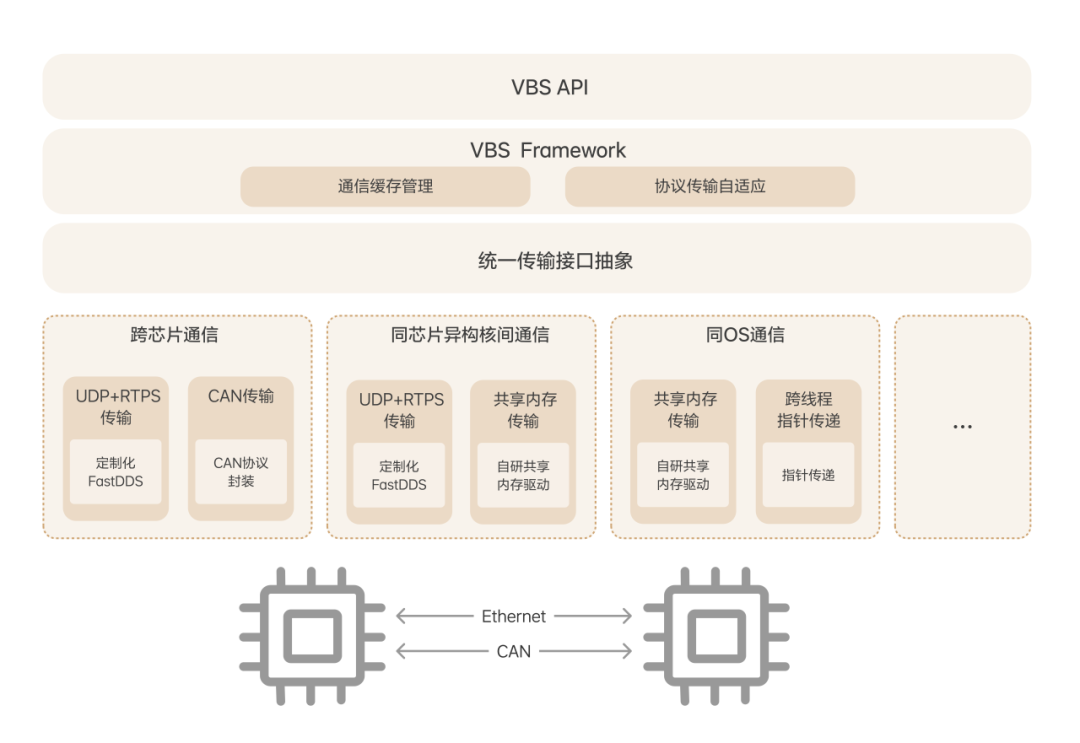
In the automotive field, the deployment of business functions is often disorderly, and the underlying medium protocols are diverse, involving various media such as Ethernet, CAN, and shared memory. In traditional solutions, a separate protocol stack must be customized for each transmission medium, and applications must adapt to different protocol stacks, significantly increasing development complexity and costs. To address these challenges, the Star Ring OS communication middleware has designed a multi-transport protocol adaptive solution, supporting business use of a unified interface layer, while the underlying can adaptively match the underlying Ethernet, CAN, shared memory, etc., across chip, heterogeneous cores within chips, and multi-processes within cores, effectively simplifying the development process, as shown in the figure below:
4.3 Enhanced Reliability Mechanisms
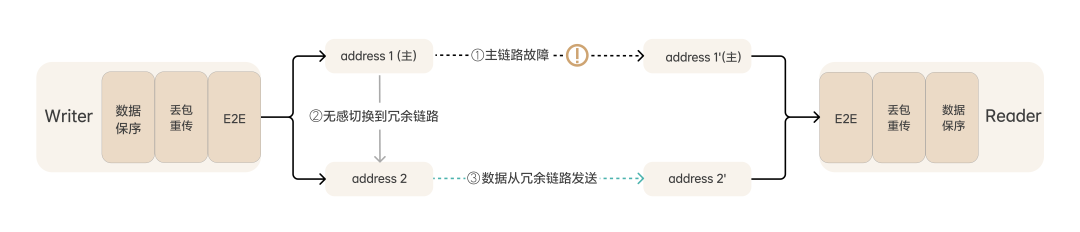
The Star Ring OS communication middleware not only supports basic transmission reliability assurance mechanisms such as E2E verification, packet retransmission, ordered delivery, and network congestion control but also implements multi-path redundant transmission schemes and shared memory exception recovery to ensure that critical instructions (such as those related to active safety) can reliably reach their destination while achieving low-latency transmission to adapt to the stringent automotive-grade environment. The principle of the multi-path redundant transmission scheme is illustrated in the figure below:
4.4 Low System Resource Overhead
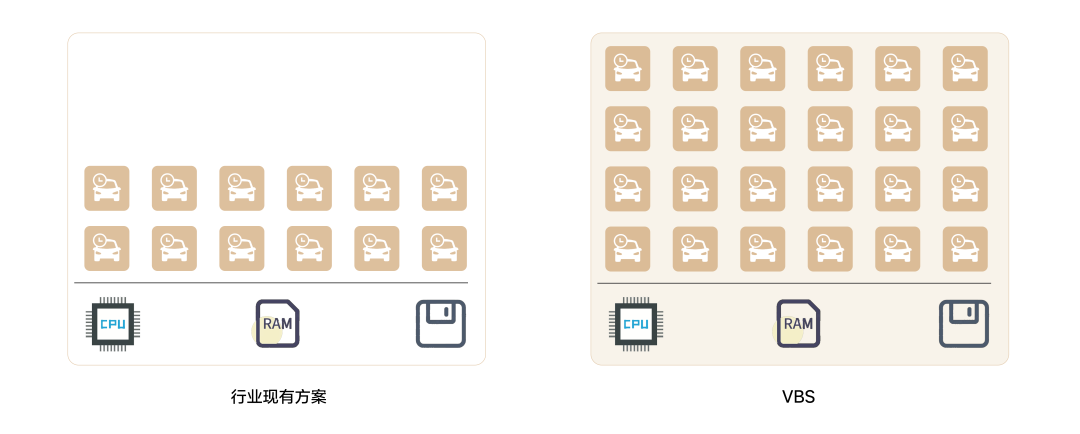
For resource-constrained devices, compared to existing industry solutions, the same CPU, RAM, and ROM resources can deploy more than double the number of SOA services (150KB can deploy over 200 communication endpoints).
4.5 Multi-Level Security Protection
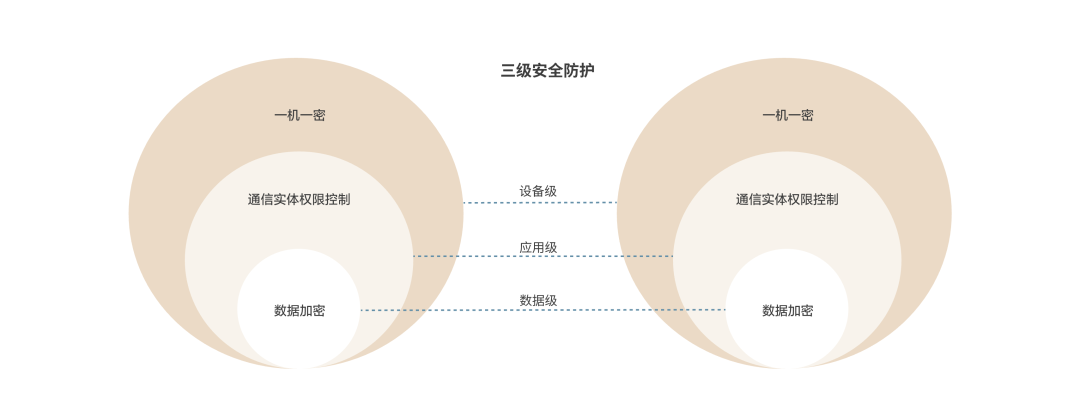
The Star Ring OS communication middleware enhances security protection based on in-vehicle scenarios, implementing a three-level security protection system, as follows:
-
Device Level: Adopts a one-device-one-key PKI identity authentication mechanism to ensure that unauthorized devices cannot detect the services provided by authorized devices, preventing unauthorized devices from accessing the network from the source and ensuring device-level security.
-
Application Level: By controlling permissions for communication entities, only signed trusted applications can establish communication, effectively preventing untrusted applications from interfering with or stealing communication data, ensuring the security and reliability of the communication process.
-
Data Level: Utilizes session-level data encryption technology, ensuring that even if messages are intercepted by a man-in-the-middle, the original content cannot be obtained due to the lack of effective decryption keys, fully protecting the confidentiality of data during transmission.
5. Typical Application Scenarios of the Communication Bus
-
Whole Vehicle Intelligence: The communication bus connects various subsystems, enabling data sharing and collaboration, which is the foundation of vehicle intelligence;
-
Assisted Driving: Multi-sensor (cameras, radar, LiDAR) data fusion for perception and decision control;
-
Smart Cockpit: Interconnectivity of in-vehicle infotainment (IVI), HUD, and smart cockpit;
-
Body Electronics: Centralized control and personalized configuration of subsystems such as doors, lights, and air conditioning.
6. Conclusion
The Star Ring OS communication bus builds an efficient, safe, and scalable data interaction platform for smart vehicles through a unified communication architecture, adaptive transmission mechanisms, enhanced reliability guarantees, and multi-level security protection. From autonomous driving to smart cockpits, from body control to whole vehicle intelligence, VBS provides solid underlying support for various applications. In the future era of software-defined vehicles, it will not only be an important pillar for the evolution of in-vehicle electronic and electrical architecture but also the core driving force for continuously upgrading vehicle intelligence and personalized experiences.
Add WeChat to join the group for in-depth discussions on ideal operational situations and long-term fundamentals. This is not a technical group, but a car enthusiasts group.