YOUTH DAY
 When programming a PLC, both beginners and experienced engineers can make the following basic errors.Because these errors are non-syntax related, they cannot be detected by programming software.Once this error occurs, it can be difficult to identify until the system is tested, at which point the controlled device fails to operate or stops at a certain position, leading to a realization that there is a problem. This requires a time-consuming and labor-intensive process of checking the PLC program line by line or executing the program step by step.So what issues lead us to make such basic errors?
The inherent thinking of relay electrical control leads to the use of physical normally closed contacts (such as stop switches or limit switches) for certain input points when programming. The programming continues to follow the relay electrical control method, using normally closed contacts as the conduction condition.
Below is a simple example of a start-stop and self-locking circuit:
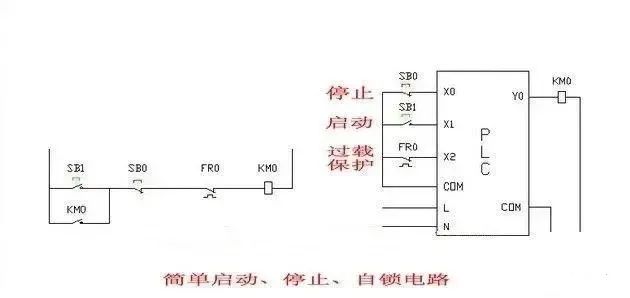
The erroneous PLC program that cannot run based on the above diagram is as follows:
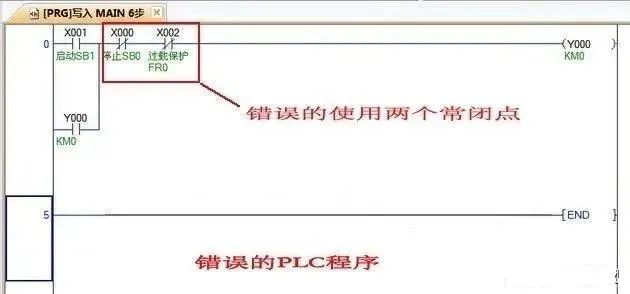
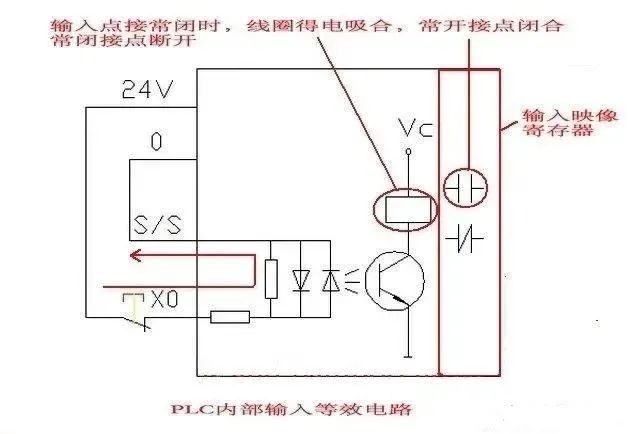
After powering the PLC, the normally closed points X000 and X002 will open. That is, the logical value is “0” Y0=(Y0+X001)×X000×X002. From the above digital logic expression, it can be seen that after pressing the start button SB1, the logical value of X001 is “1”, but the logical value of Y0 will never change and will always be “0”. The reason is related to the internal input circuit of the PLC, as shown in the following equivalent circuit:
The correct PLC program is as follows:
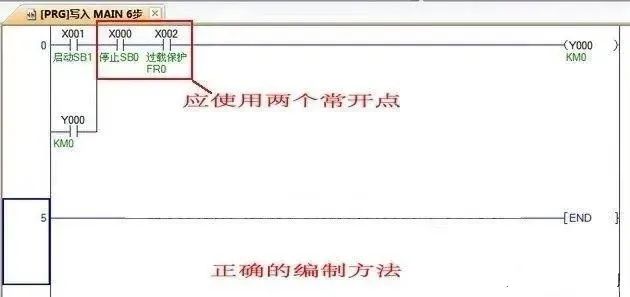
After powering the PLC, the normally open points X000 and X002 will close. That is, the logical value is “1” Y0=(Y0+X001)×X000×X002. As long as the start button SB1 is pressed, the logical value of X001 is “1”, and the logical value of Y0 will be “1”. When the start button SB1 is released, the logical value of X001 is “0”, but the logical value of Y0 remains “1”. The relationship between Y0 and X001 is an OR relationship, ensuring that the logical value of Y0 remains “1”, thus achieving self-locking. Only when the stop button is pressed or an overload occurs (FR0 action) will the logical value of Y0 change to “0”.
From the above simple example, it can be seen that beginners may not yet understand that the logical value changes to “not” after passing through the PLC’s internal input circuit when the external input is normally closed. Additionally, the inherent thinking of relay electrical control can lead to errors due to negligence among experienced engineers. Although this is a basic error, it can easily occur during the programming process.
Have you ever made such errors while programming PLCs? Feel free to leave a comment!