 Click the blue text above to follow us01
 IntroductionIn the world of PLC programming, addresses are like the “house numbers” of devices. In traditional programming, these “house numbers” are often hard-coded. Imagine having to write nearly identical control logic for 10 identical motors just because their addresses are different; or when a production line needs to switch product models, all associated sensor addresses must be manually modified—this “fixed address dilemma” not only makes the code bloated and redundant but also hinders the program’s adaptability in dynamic scenarios.The V/Z index registers act like an “address regulator” for PLCs. They allow the originally fixed addresses to become “dynamic” by adjusting the address offset, enabling a single piece of code to control multiple similar devices in bulk, easily handling complex scenarios such as production line switching and batch data processing. This “address magician” hidden within the PLC is key to solving the pain points of traditional programming.
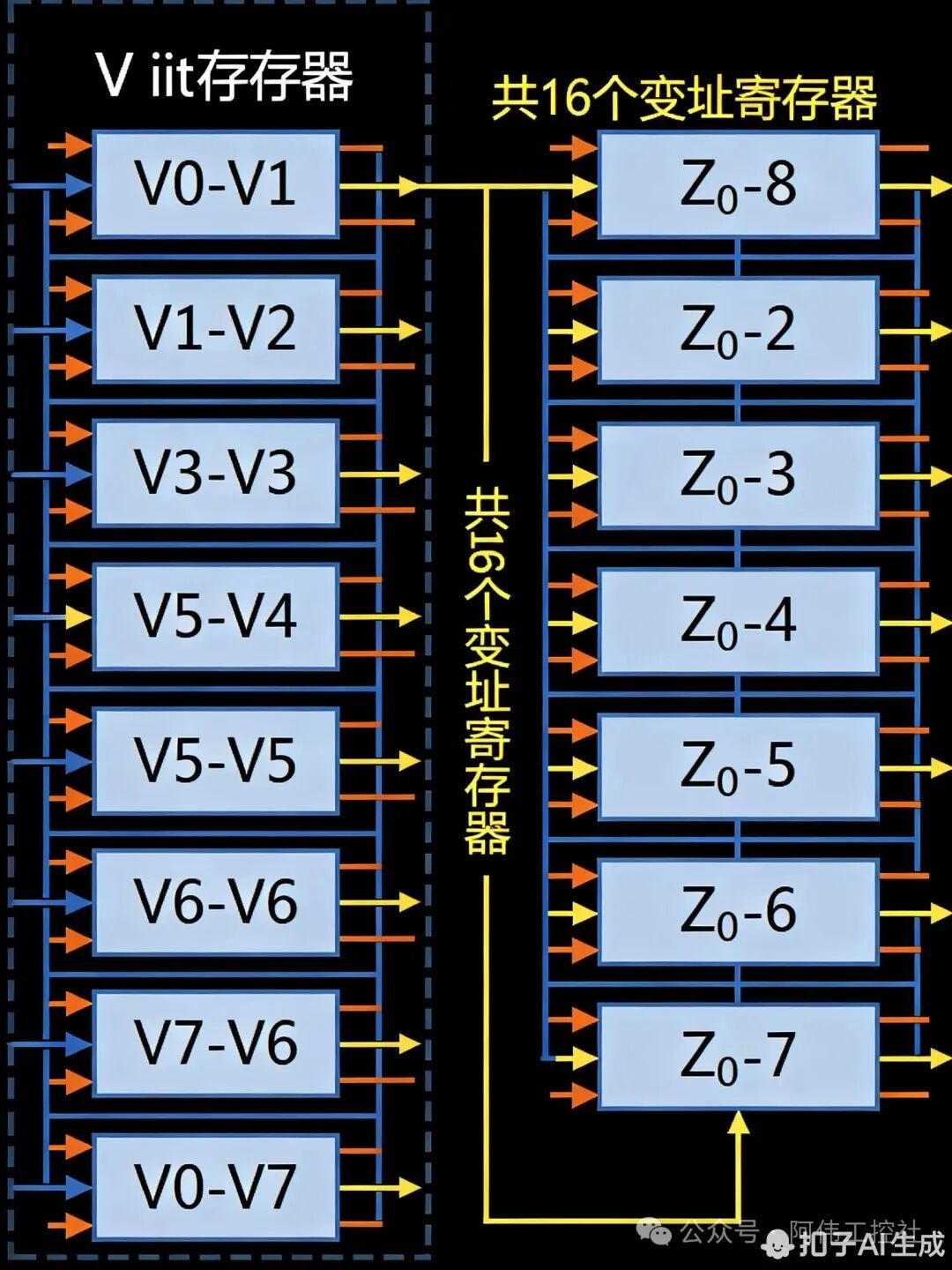
 Basic Concepts of V/Z RegistersIn the “data storage family” of PLCs, V/Z registers are like a pair of tacit twin brothers, together forming a family of index registers with 16-bit members. This family is divided into two branches: the V series and the Z series, each with 8 independent members, capable of acting independently or working together, providing core support for flexible address adjustments in programs.
 Family Member ProfilesThe V series members are numbered from V0 to V7, while the Z series ranges from Z0 to Z7, totaling 16 registers. Each member is a 16-bit independent unit, like each child in a family having their own room and function, not interfering with each other yet connected by blood.
 The table below provides a clearer view of the family composition:TableCopy
| Register Series | Member Number Range | Count | Key Features |
|---|---|---|---|
| V Register | V0 – V7 | 8 | 16-bit independent use |
| Z Register | Z0 – Z7 | 8 | 16-bit independent use |
| Total | – | 16 | Supports individual or combined indexing |
Core Features Summary• There are a total of 16 V/Z registers, divided into V0-V7 and Z0-Z7• Each register is a 16-bit independent unit that can be called individually• Family members are both independent and collaborative, serving as the “key to flexible address adjustments”This structural design allows PLC programs to handle batch data or dynamic addresses with ease—there’s no need to write code for each address individually; by calling V/Z family members, dynamic address “jumps” can be achieved, greatly simplifying programming logic.03 Differences Between 16-bit and 32-bit ApplicationsIn PLC programming, the 16-bit and 32-bit applications of V/Z index registers are like two sizes of wrenches in a toolbox—each has clear applicable scenarios, and using them together can tackle more complex tasks.When V/Z registers are used in 16-bit mode independently, their functionality is identical to that of ordinary data registers. At this time, each register can store integers in the range of 0 to 65535, whether for temporary data caching or simple logical operations, meeting conventional control needs. This “solo” mode is easy to operate, requires no additional configuration, and is suitable for handling small to medium numerical processing scenarios.Key Points for 16-bit Independent Use
-
Storage Range: 0~65535 (2¹⁶-1)
-
Functionality Equivalent: Identical to ordinary data registers (e.g., D registers)
-
Applicable Scenarios: Single-axis positioning control, short-cycle counters, etc. for small to medium numerical processing
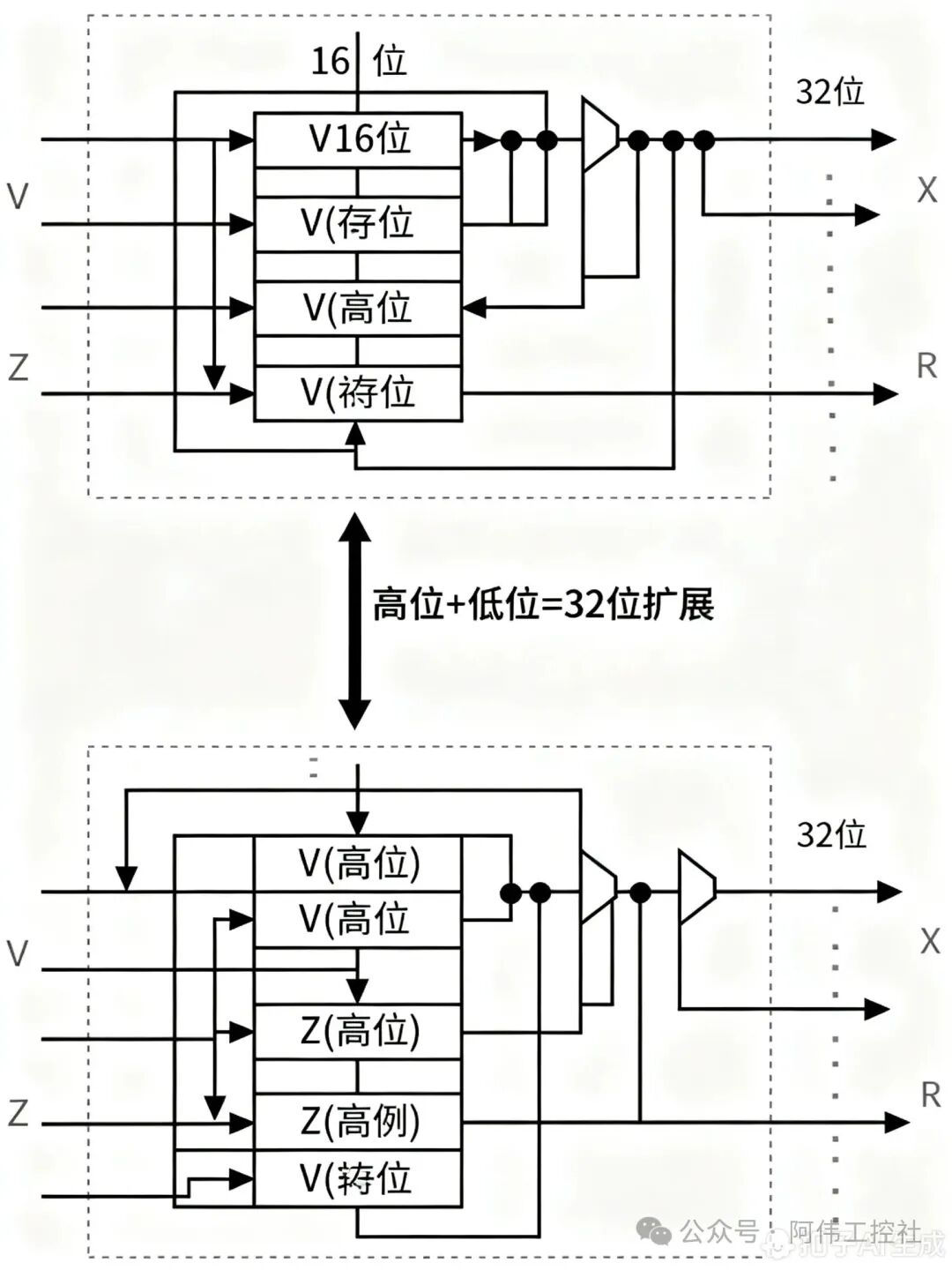
However, when the system needs to handle large values exceeding 65535, the 32-bit combined mode becomes a “necessity”. In this case, the V register automatically serves as the high 16-bit container, while the Z register acts as the low 16-bit container, combining to form a complete 32-bit data storage space. For example, V0 stores the high 16-bit value, and Z0 stores the low 16-bit value, which together can represent integers from 0 to 4294967295 (2³²-1). This “high-low pairing” design perfectly resolves the capacity bottleneck of 16-bit registers.Typical applications includeMotor Cumulative Running Time Statistics: If a device times in seconds, a 16-bit register can only record up to 18 hours (65535 seconds), while the 32-bit combination can support approximately 136 years of continuous timing, fully meeting the data recording needs of industrial equipment for long-term operation. Additionally, in high-precision temperature control (e.g., floating-point operations from -273.15 to 3000℃) and large-scale warehouse logistics positioning (coordinates exceeding 65535mm), the 32-bit mode is indispensable.Key Logic for 32-bit Combined Use
-
The V register is responsible for high 16-bit data storage
-
The Z register is responsible for low 16-bit data storage
-
Combination Formula: 32-bit value = (V value × 65536) + Z value
-
Maximum Storage Range: 0~4294967295 (approximately 4.3 billion)
 By flexibly switching between 16-bit independent and 32-bit combined modes, V/Z index registers can handle both basic control tasks and break through numerical capacity limitations, becoming “flexible storage units” for complex data processing in PLC programs.04
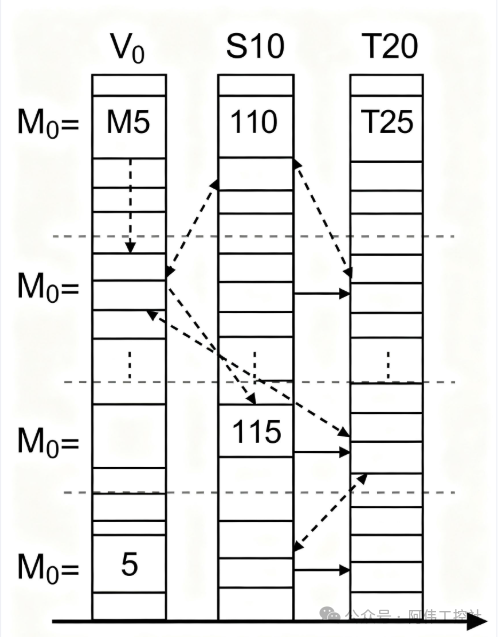
 Soft Element Modification FunctionThe soft element modification function acts like an “address offsetter” in PLC programs, allowing fixed soft element addresses to be flexibly adjusted as needed. When we assign a value to the index register V0, the originally fixed addresses for M (auxiliary relays), S (status relays), and T (timers) will magically “move”. This flexible address adjustment capability is key to freeing the program from the constraints of hard coding.Specifically, when V0=5, the address offset effect will be immediately apparent: the auxiliary relay originally pointing to M0 will change to M0+5=M5; the status relay S20 will adjust to S20+5=S25; and the timer T3 will offset to T3+5=T8. Whether for intermediate state storage in control logic, step switching in sequential control, or batch management of timed tasks, this address offset allows a single instruction to achieve multi-address control.Core Calculation Logic: New Address = Original Address + Offset Value (the value of V0). This simple addition rule allows M, S, and T types of soft elements to achieve address “relocation”; for example, when V0=5, M0→M5, S20→S25, T3→T8, making address adjustments as intuitive as 1+1=2.If you find the address offset in PLC too abstract, think of it like adjusting the “delivery locker number”: suppose you want to pick up a package from locker number 1 (original address M0), but the delivery system prompts “all packages have moved back 5 lockers” (offset value V0=5), you would naturally go to locker 1+5=6 (new address M5). The soft element modification function does something similar—by using a preset “offset”, the program automatically locates the adjusted target address, saving the hassle of rewriting code and making address management flexible and controllable.
 Through this “address magic”, PLC programs are no longer limited to fixed hard-coded addresses but can dynamically adjust operational targets based on variable values, marking a key step in transforming programs from “rigid” to “flexible”.05
 Handling Different Number BasesIn PLC programming, base conversion is often a “roadblock” for beginners—accustomed to intuitive decimal counting, they face the hexadecimal representation commonly used for addresses, and a small mistake can lead to incorrect offset calculations. The V/Z index registers are precisely the “base bridge” that addresses this pain point, acting like a flexible “numerical translator” that allows values in different bases to collaborate seamlessly in calculations.The core capability of V/Z registers lies in their compatibility with multiple base inputs. Whether it’s the decimal values we are most familiar with (like 10) or the hexadecimal values commonly used for PLC addresses (like 0A), they can accurately recognize and incorporate them into calculations. When performing index operations (such as simple addition), the registers automatically complete the base conversion, directly outputting the target base address result, eliminating the hassle of manual conversion.Practical Scenario Example: Suppose you need to offset a data block starting at VD100 by 5 units. If you directly input “+5” using decimal thinking, the V/Z register will automatically calculate 100 + 5 = 105, then convert the result to hexadecimal 69, ultimately locating the address VD69. The entire process requires no manual “decimal to hexadecimal” conversion by the programmer, significantly reducing the risk of operational errors.This “input decimal value → execute index operation → output hexadecimal address” model perfectly aligns with engineers’ thinking habits and the underlying needs of PLC systems. Especially when batch adjusting addresses, such as modifying the storage addresses of multiple sensors or adjusting array indices, simply inputting an intuitive decimal offset allows the V/Z register to quickly generate the corresponding hexadecimal target address, greatly enhancing programming efficiency.
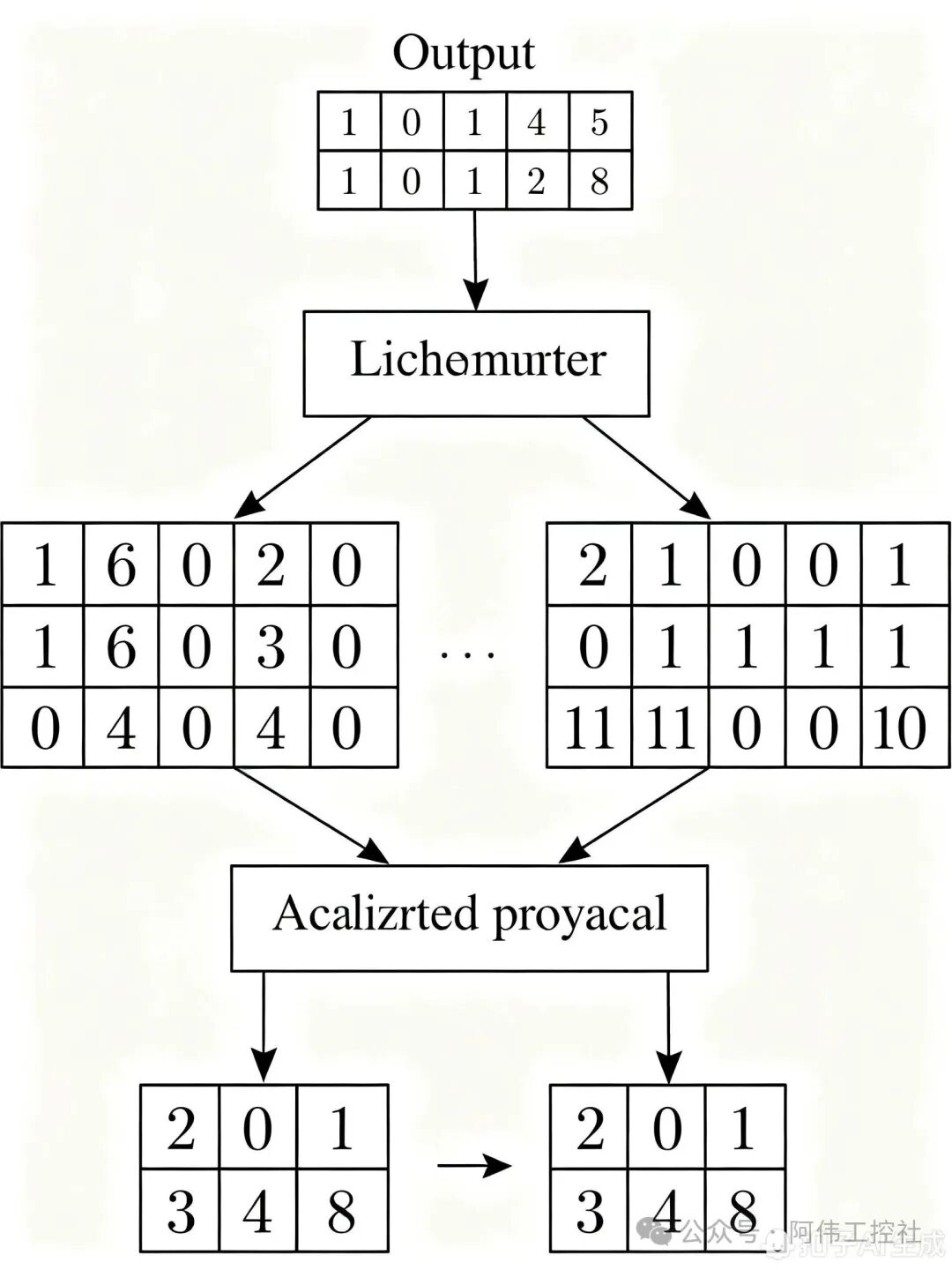 By encapsulating the complex base conversion logic within index operations, the V/Z registers not only simplify programming steps but also become a key link connecting human thinking with machine language, allowing flexible programming to no longer be constrained by base differences.06
 Application CasesIn PLC programming, batch processing of continuous address data is a common requirement. For example, if you need to write the value 100 into data registers D10 to D15, the traditional method requires repeating 6 MOV instructions (like MOV K100 D10, MOV K100 D11, etc.), which not only results in redundant code but also requires subsequent modifications to be adjusted one by one. However, with the help of the V0 index register, only one core instruction is needed to complete the batch operation, making the program more concise and efficient.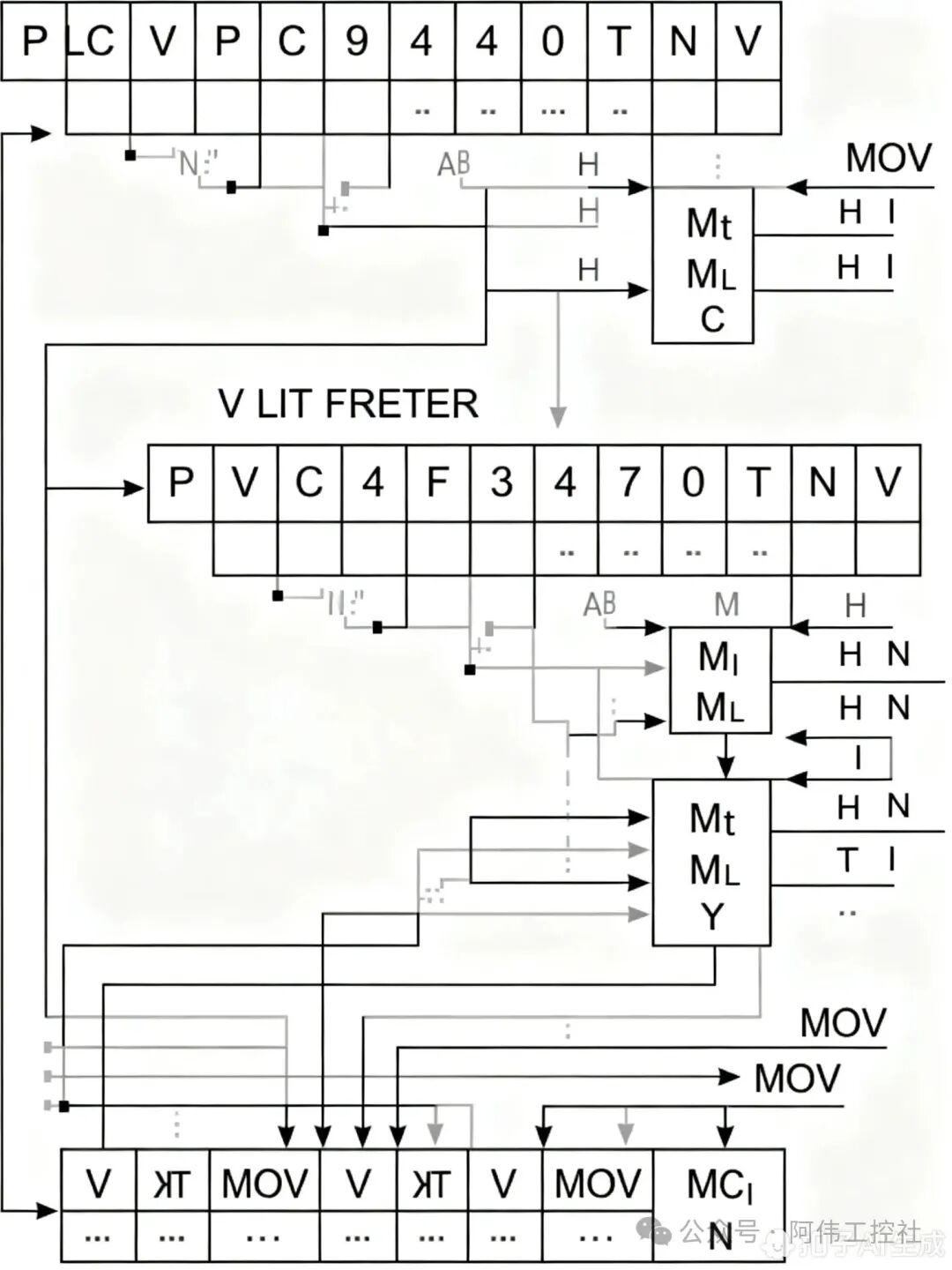
 Core Program and Execution ProcessUsing “MOV K100 D10V0” as the core instruction, along with the self-increment control of V0, allows for batch assignment to D10~D15. Here, V0 is the index register, initially set to 0, and controlled to increment from 0 to 5 through an increment instruction (like INC V0). The specific execution process is as follows:Four-Step Batch Assignment Method
-
Instruction Execution: When V0=0, D10V0 is equivalent to D10, and the instruction actually writes 100 into D10
-
V0 Self-Increment: After executing INC V0, V0 changes from 0 to 1
-
Address Offset: At this point, D10V0 points to D11, and the instruction writes 100 into D11
-
Loop Completion: Repeat the above steps until V0=5, completing the assignment for D15, processing all 6 registers
 Advantages Comparison: Traditional Method vs. Index RegisterTableCopy
| Dimension | Traditional Repeated Instruction Method | V0 Index Register Method |
|---|---|---|
| Number of Instructions | 6 MOV instructions | 1 MOV + 1 increment instruction |
| Code Length | Approximately 30 lines (including comments) | Approximately 8 lines (including loop control) |
| Modification Maintainability | Requires modifying target addresses one by one | Only needs to adjust the range of V0 |
| Execution Efficiency | Multiple instruction dispatches | Single loop efficiently completed |
With the index register, the code that originally needed to be repeatedly written is compressed into a concise loop structure, reducing the code volume by over 70% and lowering the debugging costs caused by address writing errors. This “one-to-many” characteristic is the core reason why the V0 index register is called the “address magician”—transforming PLC programs from mechanical repetitive “manual labor” into flexible and efficient “intellectual design”.07 ConclusionThe V/Z index registers are like the “address magicians” in PLC programming, injecting dynamic vitality into programs through three core values: breaking fixed addressing limitations with dynamic address adjustments, compressing repetitive logic into modular designs to significantly enhance programming efficiency with reduced code volume, and easily handling complex control needs such as batch data processing and flexible production line switching with multi-scenario adaptability.Usage Reminder: When performing 32-bit operations, strictly adhere to the “V high Z low” pairing principle to ensure precise overlay of high 8-bit and low 8-bit address offsets; also, be sure to keep soft element addresses within the PLC’s allowable range to avoid addressing errors that could lead to program anomalies.
The true charm of this “magician” can only be fully unleashed in practice. Why not start today by trying to call the V/Z registers in your PLC programs, making your code lighter and your control smarter, and experience the programming new experience brought by “address magic”!
 Phone Number: 13147077956 Scan the QR code Get the materials