
In 2025, Edge Artificial Intelligence (Edge AI) is transitioning from a technological trend to an application explosion, especially with the support of Generative Artificial Intelligence (Gen AI). Edge devices are no longer just perception terminals; they are gradually evolving into intelligent nodes with capabilities for “understanding,” “interaction,” and “reasoning.” From AI toys and wearable health devices to smart homes and intelligent transportation systems, low-power, high-performance, real-time inference chip solutions have become the new favorites in the market. In this game balancing performance and energy efficiency, Alif Semiconductor has taken the lead in the performance upgrade battle for edge AI generative applications with its new generation Ensemble MCU series—E4, E6, and E8.
The New Demand for Computational Power in Edge AI Emerges
With the diversified development of edge intelligent devices, performance bottlenecks are gradually surfacing. Whether it is wearable health monitoring, AI pets, smart toys, or micro-robots, these battery-powered devices have high demands for “high inference capability + low power consumption + local operation.” Traditional MCU products often struggle to support the efficient deployment of generative AI models at the terminal.
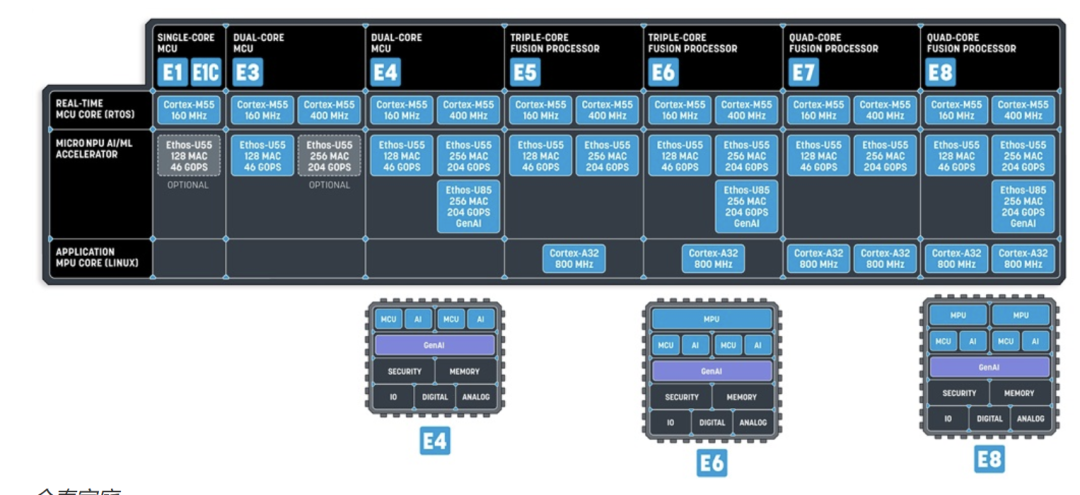
Alif Semiconductor precisely addresses this “performance-power consumption” contradiction, focusing on the implementation of generative AI at the edge. Its newly released E4, E6, and E8 series MCUs feature flexible configurations from dual-core to quad-core and fully support the integration of Neural Processing Units (NPU), allowing generative AI to no longer rely on cloud computing. This local inference capability greatly enhances response speed and privacy protection, providing a “zero-latency” experience for intelligent interactions.
Ethos-U85 and Cortex Architecture Integration Unleashes Model Potential
Alif’s E series MCUs are among the first edge AI chips to integrate the Arm Ethos-U85 NPU, designed specifically for running neural networks based on the Transformer architecture, capable of efficiently executing complex tasks such as language generation, voice interaction, and image recognition locally.
For example, the E4 integrates two Cortex-M55 cores, each paired with an Ethos-U55 NPU, while also being able to call upon the Ethos-U85 for heavy generative tasks. Coupled with up to 9.75MB of SRAM and 5.5MB of MRAM storage configuration, it allows small language models (SLM) to run without bottlenecks. For instance, AI toys can generate interactive stories in real-time tailored to different ages, emotions, and scenarios, with power consumption as low as 36mW, achieving an intelligent upgrade in personalized education and entertainment.
The E6 and E8 go further by introducing Cortex-A32 cores, providing a higher performance platform for multimodal generative AI tasks involving images, videos, and voice, covering a wide range of scenarios from AI wearables to edge industrial devices.
Accelerating the Implementation of Image and Voice AI Tasks
In addition to language models, image and video AI tasks are also important scenarios for edge intelligent devices. Alif’s new generation MCUs support up to 2 MIPI-CSI image sensors, equipped with dedicated hardware-accelerated Image Signal Processors (ISP), capable of capturing 60 frames per second of high-definition video streams, and compressing image classification inference latency to within 2-8 milliseconds.
This latency advantage is crucial in scenarios such as robotic navigation, AR glasses, and intelligent monitoring. Additionally, due to the use of ultra-low-power MRAM architecture, energy consumption during the inference process is significantly reduced, supporting continuous operation without frequent recharging, laying a solid foundation for battery-powered devices.
In terms of voice interaction, the E series chips also perform excellently, supporting local voice recognition and response, helping to build a “speak and echo” human-computer interaction experience.
Full-Scene Support from AI Toys to Smart Healthcare
Alif Semiconductor is not just a chip manufacturer but also a builder of the edge intelligent ecosystem. With the comprehensive layout of the Ensemble MCU series, its products cover the entire lifecycle scenarios from smart toys, children’s education, AI pets, to smartwatches, health monitoring, and assistive medical robots.
More importantly, these devices can now support multimodal inputs (voice + image + text), leveraging the local inference capabilities of generative AI to provide users with a more natural, immersive, and personalized intelligent experience. In the future, as the demand for low-power edge inference in large systems such as intelligent transportation and smart cities surges, Alif’s chip platform is expected to play a greater role, becoming the “invisible engine” for the democratization of computational power.
(Image and text source: Google and online compilation, please delete if infringing))
Contact Us
Service Hotline: 010-8622 9776
Brand Cooperation: [email protected]
Business Cooperation: [email protected]
Official Website:www.fitodata.com
#GPU #AIGC #LLM #Intelligent Computing Services #Computational Power Leasing #Intelligent Computing Center #Computational Power Scale #Computational Power Platform #IB Networking #Large Models #Algorithm Optimization Services #Computational Power Networking Services #Computational Power Platform Planning Services #Training Platform #NVIDIA #NVIDIA #CUDA