Introduction
On December 2, 2024, the U.S. Department of Commerce’s BIS released a new export control regulation spanning 210 pages, adding 140 Chinese companies to the “Entity List” and strictly limiting the export of 24 types of semiconductor equipment and HBM memory. Following this “iron curtain” upgrade, China’s semiconductor industry has finally awakened to the realization that relying on foreign support is not a viable path.
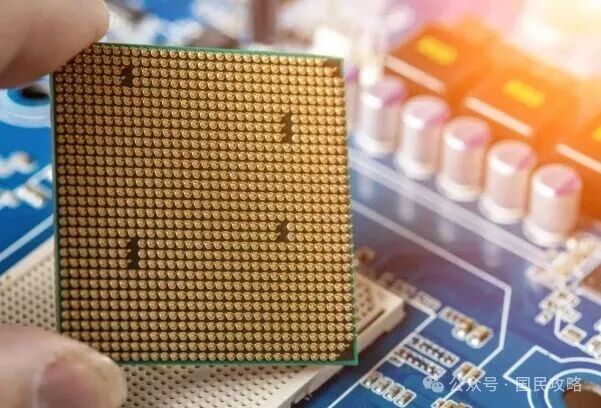
Recently, semiconductor equipment industry executive Li Hua stated that they have shifted focus to “grinding down” on mature processes of 28nm and above, leveraging the demand for 3000 chips per smart vehicle brought about by the explosion of smart cars, and accelerating the localization of lithography machines. It is expected that capital expenditure will exceed $100 billion from 2025 to 2027. Although the restrictions are painful, they serve as a “catalyst” for China’s self-reliance.
The Hammer Falls
Imagine a temporary rule of 152 pages combined with a 58-page revision of the Entity List, totaling 210 pages of a “death list.” This is the latest export control released by BIS on December 2, 2024, marking the strictest measures yet.
The main additions include an embargo on 24 types of semiconductor manufacturing equipment (including ion implanters, high aspect ratio etchers, etc.) and the first regulation of technologies such as nanoimprint lithography that represent a “leapfrog” approach. The Entity List directly targets Chinese wafer fabs and equipment manufacturers, adding 140 new entries and modifying 14, with compliance deadlines set until the end of the year.
The impact on the industry is evident, with the expansion pace of wafer fabs thrown into disarray in the short term, and projects relying on foreign equipment for core components will inevitably be delayed. Executives privately complain, “This is not just a chokehold; it’s a direct strangulation.”
However, some joke, “The more the U.S. blocks, the more China must strengthen its internal capabilities.”
Thanks to the stockpiling strategy over the past two years, China has already begun to “sweep up” supplies, resulting in a significant increase in revenue for overseas equipment manufacturers in 2024, while providing a time window of six months to a year for domestic companies.
Grinding Down on Maturity
After suffering a heavy blow, Chinese semiconductor executives have collectively “broken defense” and quickly shifted to a pragmatic approach: abandoning the fantasy of advanced processes below 7nm and focusing their main efforts on mature processes of 28nm and above.
Why? Because reality dictates strategy, and reality has also provided opportunities.
First: Realistic Pressure, global giants like TSMC and Intel are fully advancing the development of 3nm and 2nm processes, leading to a severe shortage of capacity in mature processes. China has a complete industrial foundation, and domestic equipment has already taken the lead in processes such as stripping and thermal treatment, with only a few areas like lithography and ion implantation lagging behind. Industry estimates suggest that by the end of 2025, mass production at 28nm will stabilize the situation.

Second: Explosive Dividends, 96% of chips in smart vehicles still use processes of 28nm and above. A smart vehicle requires 3000 chips, which is 4-5 times that of a gasoline vehicle and twice that of a regular electric vehicle. In 2024, China’s automobile exports are expected to exceed 5 million units, with smart driving experiencing a full explosion, leaving a golden window period.
Executives are optimistic, believing, “The restrictions make others anxious, while we can just fill the gap. By 2027, the domestic market share could reach 50%.”
Accelerating Lithography
ASML’s predicament has become a footnote in this game, with sales in mainland China reaching 47% in the third quarter of 2024, a record high. However, after the new regulations are implemented, this is expected to drop to around 20% by 2025.
The reason is simple: Chinese customers began “strategic stockpiling” two years ago, with imports of lithography machines reaching $8.7 billion, setting a record high average price.
ASML has a deep presence in China: 16 offices, 15 warehouses, 3 R&D centers, and training and maintenance points. However, under the restrictions, “localization services” have become a double-edged sword:
On one hand, it helps stabilize production in China; on the other hand, it accelerates domestic substitution.
Companies like Shanghai Micro Electronics are making significant strides in DUV lithography machines, with test versions nearing ASML’s 2008 levels, bypassing the EUV blockade. The gap still exists, but executives are confident: “In 5 to 10 years, we will not only catch up but also surpass.”
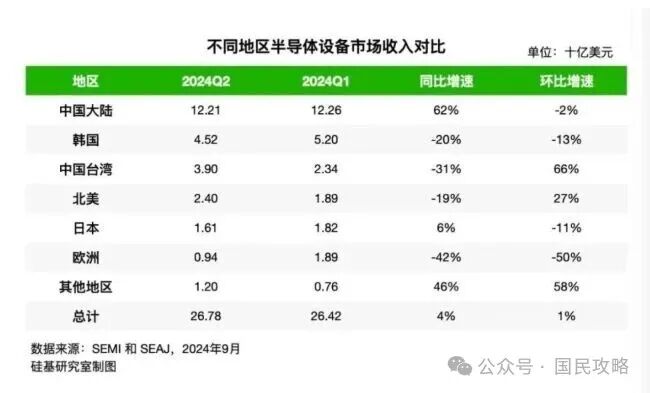
In the first half of 2024, China’s semiconductor equipment expenditure reached $25 billion, growing at 62%, making it the largest in the world. This wave of “grinding down” is not just about maintaining the status quo but also about initiating a leap forward.
Capital Surge
Looking ahead, from 2025 to 2027, total capital expenditure in China’s semiconductor industry will exceed $100 billion. The localization rate of thermal treatment in leading fields has surpassed 70%, and measurement equipment, which is a weak link, is also catching up.
Restrictions have intensified differentiation but have also stimulated innovation, moving from stockpiling → local services → full-chain autonomy.
In short: this is not a retreat but a buildup of strength.
The stricter the controls, the clearer China becomes; 28nm is not the end but a springboard.