 Click the blue text above to follow usOn November 10, 2025, at 10:41 AM, China successfully launched five satellites into their designated orbits using the Long March 12 carrier rocket at the Hainan commercial space launch site. This launch was not an isolated breakthrough but a reflection of China’s low Earth orbit satellite internet constellation development. As of August 2025, the GW constellation, led by China Star Network, has 82 satellites in orbit, with the launch frequency increasing from “monthly launches” to “a group every three days.” It is expected that by the end of 2025, a milestone of 100 satellites in orbit will be achieved.More noteworthy is the dual breakthrough in technology and cost: the Kuaizhou rocket has achieved normalized launches of “one rocket, seven satellites,” and the Li Jian No. 1 rocket’s payload capacity has increased to 1.5 tons (low Earth orbit), reducing the cost of launching a single satellite by 60% compared to 2020. The mass production technology for satellites has matured, with Chinese satellite manufacturers establishing intelligent production lines capable of producing over 200 satellites annually, reducing the manufacturing cost per satellite to the million-yuan level. Industry estimates suggest that China’s low Earth orbit satellite internet market will exceed 100 billion yuan by 2025, doubling by 2029, with a compound annual growth rate of over 20%, becoming a core growth driver of the space economy.01
Policy + Technology Dual-Drive: The Underlying Logic of a Trillion-Yuan Market
1. National Strategic Endorsement, Clear and Defined Planning
The Ministry of Industry and Information Technology issued the “Guiding Opinions on Optimizing Business Access to Promote the Development of the Satellite Communication Industry” in August 2025, clearly stating the goal of achieving over ten million satellite communication users by 2030, with new business models such as direct satellite connections for mobile phones as core development directions. China Star Network, as the main body of the GW constellation construction, plans to launch approximately 1,300 satellites by the end of 2029 and complete the global deployment of 13,000 satellites by 2035, establishing the foundational framework for a 6G network.According to the International Telecommunication Union (ITU) regulations, China has applied for 12,992 satellites, of which 10% must be deployed by 2029. This means that the average annual launch volume must exceed 300 satellites in the next four years, providing continuous order support for the industry chain.
2. Three Major Technological Breakthroughs Breaking Development Bottlenecks
-
Mass Production: Satellite manufacturing has shifted from “customized” to “industrialized,” with companies like China Satellite and Shanghai Huguang achieving modularization of core components and automation of assembly, compressing the production cycle from 18 months to 3 months;
-
Low-Cost Launch: Commercial rockets like Kuaizhou and Li Jian have matured, with recovery technology entering the verification stage, reducing the cost of launching per kilogram to below $20,000, approaching SpaceX levels;
-
High-Frequency Communication: The first mobile direct connection low Earth orbit experimental satellite successfully verified Ka-band communication capabilities, with inter-satellite laser communication costs decreasing by 50% and data transmission rates increasing tenfold.
02
🔗 Comprehensive Analysis of the Industry Chain: Four Core Investment Opportunities
The satellite internet industry chain is divided into four core segments: satellite manufacturing, rocket launching, ground equipment, and operational services. The technological breakthroughs and order volume in each segment are advancing in sync, forming a clear investment trajectory:
1. Satellite Manufacturing: Upstream Core, Mass Production Stimulating Incremental Growth
Satellite manufacturing is the core of the industry chain’s value, accounting for 40% of total investment, divided into two subfields: satellite platforms and satellite payloads:
- Satellite Platforms (Assembly and Core Systems):
-
China Satellite (600118) ✨: The only listed company in A-shares for satellite assembly, responsible for the core satellite manufacturing of the “Thousand Sails Constellation,” participating in the construction of the GW constellation, with satellite manufacturing revenue expected to exceed 5 billion yuan in 2025, a year-on-year increase of 45%;
-
Shanghai Huguang (603131): A leading private satellite manufacturer, providing 50kg-level satellite assembly services for the G60 Star Chain, with outstanding mass delivery capabilities, having received orders for 12 satellites with a contract value of 360 million yuan.
- Satellite Payloads (Core Components for Communication / Navigation):
-
Chengchang Technology (001270): The market share of satellite-based phased array T/R chips exceeds 50%, with breakthroughs in 5nm process mass production, deeply bound to the Star Network project, with satellite chip revenue expected to account for 60% in 2025;
-
Aerospace Huanyu (688523): A supplier of high-end microwave communication modules for satellites, participating in the research and development of the “Thousand Sails Constellation” control and telemetry ground system, with product gross margins maintained above 40%;
-
Zhenlei Technology (688270): Satellite power management chips certified by Star Network, with a market share of over 30% for military RF chips, and satellite-related revenue expected to grow by over 80% in 2025.
2. Rocket Launch: Midstream Key, Continuous Growth in Launch Demand
Rocket launching is the “throat” of constellation networking. As launch density increases, rocket manufacturing and launch service companies directly benefit:
-
Aerospace Electronics (600879): A core supplier of measurement and control communication systems, the only listed entity for inter-satellite laser communication payloads, providing support for Kuaizhou rockets, with aerospace support revenue expected to grow by 38% in 2025;
-
Zhontian Rocket (003009): A leading small solid rocket manufacturer, responsible for commercial launch replenishment tasks, a supplier for Li Jian No. 1 rockets, with launch service revenue share increasing from 15% to 30%;
-
Xice Testing (301306): A leading provider of satellite launch environmental adaptability testing, covering launch sites such as Jiuquan and Wenchang, with a market share of over 40% in testing services, benefiting from increased launch frequency.
Please open in the WeChat client
3. Ground Equipment: Downstream Entry, Terminals and Infrastructure Working Together
Ground equipment is the key to connecting satellites with users, including terminal devices, ground stations, and core networks. With the implementation of direct satellite connections for mobile phones, demand is accelerating:
- Terminal Devices:
-
Huali Chuangtong (300045): The market share of Tiantong satellite terminals exceeds 60%, the only commercial solution provider for Beidou + Tiantong dual-mode chips, already adapted to Huawei, Xiaomi, and other mobile phone manufacturers, with terminal revenue expected to exceed 2 billion yuan in 2025;
-
Haige Communication (002465): A leading provider of military navigation, laying out integrated communication and navigation equipment for low-altitude economic applications, with satellite communication terminals entering the supply chains of the three major telecom operators.
- Ground Stations and Core Networks:
-
Zhenyou Technology (688418): A core supplier of satellite communication core networks, winning the bid for the telecom high-throughput satellite ground network project, with a market share of over 25% in core network equipment;
-
Xinke Mobile (688387): The world’s first to complete the NR-NTN satellite-based station development, promoting the formulation of 6G standards, with ground gateway station equipment already delivered to China Star Network.
4. Operational Services: Commercialization Realization, Core of Long-Term Value
Operational services are the long-term beneficial segment of the industry chain, controlling spectrum resources and user access, gradually releasing value as the constellation takes shape:
-
China Satellite Communications (601698) ✨: The second-largest fixed communication satellite operator in Asia, exclusively operating broadcast satellite resources, laying out a satellite + 5G integrated network, with satellite communication service revenue expected to reach 30 billion yuan by 2030;
-
Aerospace Hongtu (688066): A remote sensing data service provider, laying out an integrated platform of “satellite + cloud” to provide data services for emergency management, agriculture, and other fields, with remote sensing service revenue expected to grow by 55% in 2025;
-
Beidou Xingtong (002151): A leader in high-precision positioning, with a penetration rate of over 70% for Beidou third-generation terminals, integrating satellite communication and navigation technology, entering the vehicle networking sector.
03
📅 Investment Strategy: Layout by “Stages” to Capture Three Core Opportunities
Please open in the WeChat client
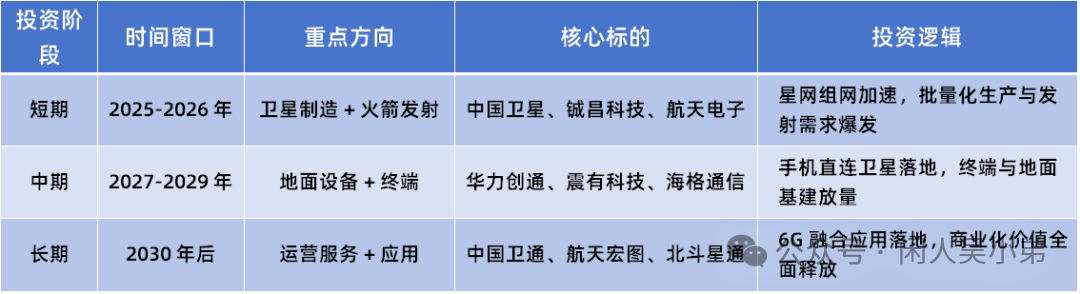 China’s low Earth orbit satellite internet has entered a golden development period characterized by “policy support + technological breakthroughs + order volume increase.” The plan for a network of 13,000 satellites is generating a trillion-yuan market space, with the industry chain benefiting comprehensively from upstream manufacturing to downstream operations. In the short term, satellite manufacturing (China Satellite, Chengchang Technology) and rocket launching (Aerospace Electronics, Zhontian Rocket) are the most certain main lines for orders; in the medium term, focus on the terminal landing opportunities in ground equipment (Huali Chuangtong, Zhenyou Technology); in the long term, layout operational service companies (China Satellite Communications) that control core resources. As the space economy becomes a national strategic priority, satellite internet, as the core carrier of 6G and integrated space-ground-air systems, will continue to enjoy policy and technological dividends. Early layout of core targets in the industry chain is expected to share in the long-term benefits of industrial upgrades. What are your thoughts? Let’s discuss in the comments section!
Warm reminder: The market has risks, and investment requires caution. All real investment shares in this article are equity investments, which are essentially medium to high-risk investments, and do not guarantee returns or capital preservation.
✨”What uncertainties do you have on the investment road? Feel free to ask in the comments! Valuable insights, pitfall guides, and real-time updates are all here! Like and follow so you don’t miss out, let’s understand financial management together! 💬💰”Read more:The Third Wave is Coming! The Localization Rate of Core Components for Humanoid Robots Exceeds 70%, Clear Investment Opportunities in the Industry ChainFive Departments’ Policies Ignite Medical AI! A Comprehensive Analysis of Seven Core Tracks and 12 A-Share TargetsThe Turning Point of Power Digitalization Has Arrived: Five Major Track Leaders Exposed