When selecting gold wire for semiconductor packaging, are you often confused by the types, purity, and dopants? Unsure which gold wire is suitable for BGA/LED/QFP? Why do some gold wires fail after just six months while others can withstand 8000 hours of high-temperature cycling? This guide from Sumitomo Metal breaks down the selection logic, production process, and key technologies clearly, allowing you to directly copy the homework and achieve a bonding yield rate exceeding 98%!
1. First, understand: Why is gold wire the “darling” of packaging? 5 Core Advantages
Gold wire occupies a significant share of semiconductor bonding materials, thanks to these hard strengths, making it more suitable for high-end scenarios compared to aluminum and copper wires:
- Non-oxidizing and highly reliable: It does not rust in air or water, and will not fail after long-term use post-encapsulation, ensuring maximum reliability;
- Strong conductivity: The resistivity is only 2.4μΩcm, better than aluminum wire (2.7μΩcm) and nickel (6.8μΩcm), ensuring lossless transmission of electrical signals;
- Excellent ductility: Easily drawn into ultra-fine specifications (20-50μm), can easily form complex wire arcs during bonding without damaging the pads;
- Good chemical resistance: Can resist the erosion of impurities in encapsulation resins, especially suitable for brominated resin scenarios;
- Perfect ball formation: Low gas solubility allows for uniform spherical solder joints after EFO discharge, resulting in more stable bonding strength.
Key Point: The core competitiveness of gold wire is “reliability + adaptability”; it is the first choice for automotive electronics, military industry, and high-end consumer electronics!
2. Collectible: Quick Reference Table for 7 Major Gold Wire Types (Directly Match Your Needs)
Different types of gold wire are suitable for different packaging scenarios, and the dopants and heat treatment processes determine their characteristics, so don’t use them incorrectly!
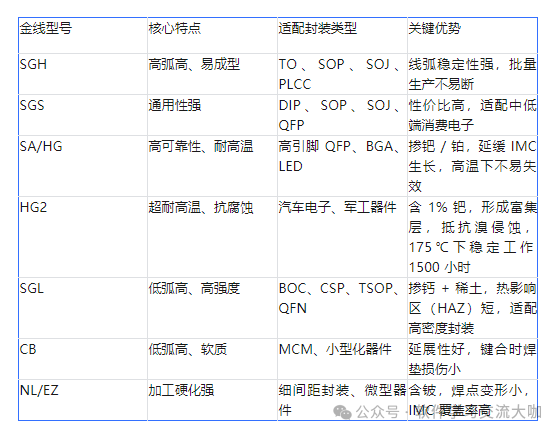
Pitfall Alert: For high-density packaging (such as CSP, QFN), do not use high-arc high types (such as SGH), as this will cause wire arc interference; for high-temperature scenarios (such as automotive electronics), prioritize HG2, while SGS offers the best cost-performance ratio for ordinary consumer electronics!
3. Revealing the Gold Wire Production Process: 5 Steps to Create “Reliable Gold Wire”
A seemingly simple gold wire undergoes 5 strict processes during production, each affecting the final performance:
- Melting and Casting: High-purity gold (4N=99.99%) + precise dopants (beryllium, palladium, calcium, etc.) are melted in a high-frequency induction furnace and cast into gold bars;
- Wire Drawing: Using a diamond drawing die (smooth surface to avoid scratching the gold wire), the gold bar is drawn into ultra-fine specifications of 20-50μm, with multiple drawing and heat treatment processes in between;
- Intermediate Heat Treatment: Adjusts the mechanical properties of the gold wire, eliminates lattice defects caused by stretching, and enhances strength and ductility;
- Final Drawing + Winding: After reaching the target wire diameter, it is wound into spools under tension control, managing spacing and layers to avoid tangling of the gold wire;
- Strict Inspection: 20x microscope inspection of the surface (no scratches, no contaminants), testing MG value (weight of 20cm gold wire, precise control of diameter).
Key Point: The diamond drawing die is crucial! It ensures a smooth surface of the gold wire, preventing breakage during bonding due to scratches.
4. Key Technologies: Dopants + Heat Treatment Determine the “Lifespan Limit” of Gold Wire
The performance of gold wire relies heavily on the “combination of dopants + heat treatment process”; remember the roles of these 4 dopants:
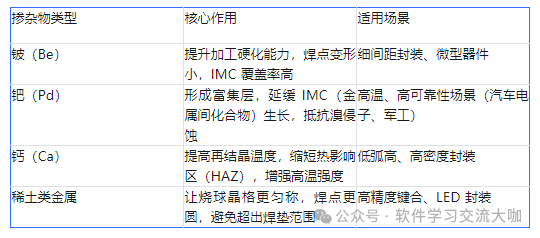
The little secrets of heat treatment:
- Low-temperature heat treatment (recombination): Eliminates voids, rearranges atoms, enhancing ductility;
- Medium-temperature heat treatment (recrystallization): Generates new grains, balancing strength and ductility;
- High-temperature heat treatment (grain growth): Enlarges grains, softening the gold wire, suitable for soft bonding requirements.
5. Reliability Pitfalls: 2 Key Points (90% of People Have Fallen Into This Trap)
- Prioritize high-purity gold wire: 4N gold wire (99.99%) is much more reliable than 2N (99%) and 3N (99.9%)! In a 175℃ environment, 2N gold wire in brominated resin shows a 15% increase in resistance after 1200 hours, while 4N gold wire only shows a 15% increase after 1500 hours;
- Avoid brominated resins: Brominated resins accelerate the oxidation of gold wire, leading to a spike in resistance; try to choose green resins (bromine-free) to extend the lifespan of gold wire.
6. Three-Step Selection Technique (Directly Copy This Homework)
- Look at the packaging type: For high-density (CSP/QFN), choose low-arc high types (SGL/CB); for high pin counts (BGA/LED), choose high-reliability types (HG2/SA);
- Look at the arc height requirements: High arc height choose SGH, low arc height choose SGL/CB, general type choose SGS;
- Look at reliability requirements: For automotive electronics/military, choose HG2 (with palladium) + 4N purity; for consumer electronics, choose SGS (3N/4N).
Interaction Time
When selecting gold wire, are you struggling with model compatibility or worried about reliability? Have you encountered cases of gold wire failure? Share your scenarios and challenges in the comments!
#GoldWireSelection #SemiconductorPackaging #BondingMaterials #SemiconductorManufacturing #PackagingProcess #GoldWireReliability #BondingTechnology #SemiconductorInsights