The DB25 serial port generally only uses three pins: 2 (RXD), 3 (TXD), and 7 (GND). With the continuous improvement of devices, the DB25 connector is rarely seen today, and it has been replaced by the DB9 interface. The pins used in DB9 differ from those in DB25, specifically 2 (RXD), 3 (TXD), and 5 (GND). Therefore, the RS232 interface is now commonly referred to as DB9.
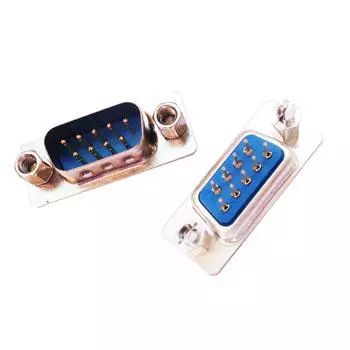 The male connectors in the market are called DRXX, while the female connectors are called DBXX. For example, the serial port on our computers is referred to as DR9 in the market, not DB9. Many people mistakenly call it DB9; in fact, DB9 is the interface that connects two DR9 connectors together. In textbooks or articles, all serial device interfaces are often uniformly referred to as RS232 interfaces.
Due to the early emergence of the RS232 interface standard, it inevitably has some shortcomings, primarily the following four points:
(1) The signal voltage levels of the interface are relatively high, which can damage the chips in the interface circuit. Additionally, since it is not compatible with TTL levels, a level conversion circuit is required to connect with TTL circuits. (2) The transmission rate is relatively low, with a baud rate of 20Kbps during asynchronous transmission. (3) The interface uses one signal line and one signal return line, forming a common ground transmission method, which is susceptible to common-mode interference, resulting in poor noise immunity. (4) The transmission distance is limited, with a maximum standard transmission distance of 50 feet, and in reality, it can only be used over about 50 meters.
To address the shortcomings of the RS232 interface, new interface standards have emerged, one of which is RS-485, which has the following characteristics:
(1) The electrical characteristics of RS-485: Logic “1” is represented by a voltage difference of +(2-6) V between the two wires; Logic “0” is represented by a voltage difference of -(2-6)V. The signal voltage levels of RS-485 are lower than those of RS-232, making it less likely to damage the interface circuit chips, and this level is compatible with TTL levels, facilitating connections with TTL circuits. (2) The maximum data transmission rate of RS-485 is 10Mbps. (3) The RS-485 interface uses a combination of balanced drivers and differential receivers, enhancing common-mode rejection capability, thus improving noise immunity. (4) The maximum standard transmission distance for RS-485 is 4000 feet, which can actually reach 3000 meters. Additionally, the RS-232 interface only allows one transceiver to be connected on the bus, indicating single-station capability, while the RS-485 interface allows up to 128 transceivers to be connected on the bus, indicating multi-station capability, allowing users to easily establish a device network using a single RS-485 interface. Because the RS485 interface forms a half-duplex network, it generally requires only two wires (commonly referred to as A and B lines), so RS485 interfaces use shielded twisted pairs for transmission. Since some devices have RS232 interfaces while others have RS485 interfaces, if a device with an RS232 interface needs to communicate with a device with an RS485 interface, an RS232/RS485 converter is required to convert the RS232 signal to RS485 before communication can occur. If two devices with RS232 interfaces need to communicate over long distances, two RS232/RS485 conversion circuits are sufficient. The so-called “passive RS232/RS485 converters” in the market utilize power-stealing technology from the computer’s serial port, while “active RS232/RS485 converters” have similar circuit diagrams to the former, with only the power supply section altered.
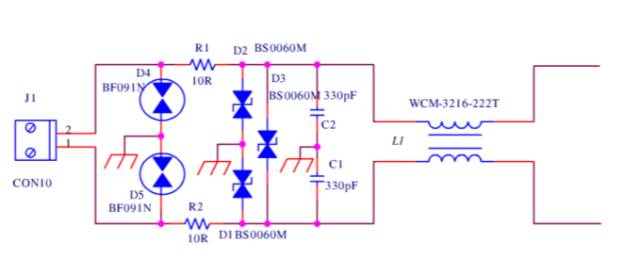
RS485 interface EMC design reference
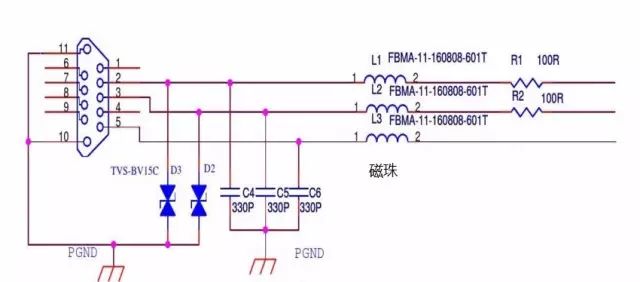
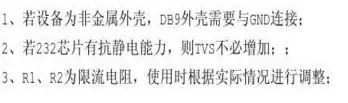
RS232 interface EMC design reference
 Differences Between RS485 and RS232 Protocols:
1. The electrical characteristics of RS-485: Logic “1” is represented by a voltage difference of +(2—6) V between the two wires; Logic “0” is represented by a voltage difference of -(2—6)V. The signal voltage levels are lower than those of RS-232-C, making it less likely to damage the interface circuit chips, and this level is compatible with TTL levels, facilitating connections with TTL circuits. 2. The maximum data transmission rate of RS-485 is 10Mbps. 3. The RS-485 interface uses a combination of balanced drivers and differential receivers, enhancing common-mode rejection capability, thus improving noise immunity. 4. The maximum standard transmission distance for RS-485 is 4000 feet, which can actually reach 3000 meters. Additionally, the RS-232-C interface only allows one transceiver to be connected on the bus, indicating single-station capability, while the RS-485 interface allows up to 128 transceivers to be connected on the bus, indicating multi-station capability. This allows users to easily establish a device network using a single RS-485 interface. Due to its good noise immunity, long transmission distance, and multi-station capability, the RS-485 interface has become the preferred serial interface. Since the RS-485 interface forms a half-duplex network, it generally requires only two wires, so RS-485 interfaces use shielded twisted pairs for transmission. The RS-485 connector uses a DB-9 9-pin plug, with the intelligent terminal RS-485 interface using DB-9 (female), and the keyboard connection using DB-9 (male).
This article is reprinted from the Internet, copyright belongs to the original author. If you find it unsatisfactory, please contact us for deletion!
Advertisement
About Lichuang Mall
Lichuang Mall (WWW.SZLCSC.COM) was established in 2011, dedicated to providing customers with one-stop online procurement services for electronic components, leading the country in transaction volume. It has over 10,000 square meters of modern component warehouse, with over 100,000 types of stock inventory. The group’s electronic full industry chain self-operated services include: online EDA (LCEDA) + industry-leading PCB prototyping/small batch + component mall + stencil manufacturing + SMT patch + electronic design education and solutions. As a vertical mall with a complete variety of self-operated inventory and guaranteed quality, all components at Lichuang Mall are sourced from original manufacturers or authorized distributors, ensuring original quality and providing you with professional one-stop procurement services for components.