Click the blue text
Follow us
Robots are becoming increasingly intelligent, but they have always had a “flaw”—they cannot smell. Now, this flaw has been addressed. A domestic technological breakthrough has given machines the ability to smell, allowing them to detect dangers that you cannot perceive, potentially redefining our sense of safety in the future.
We have long anticipated that robots could better integrate into our lives, but current robots are largely still “smell blind.” They can see and hear, yet they cannot perceive the crucial odor information in the air, such as a hint of gas leakage or signs of food spoilage.
Now, this limitation is being broken.
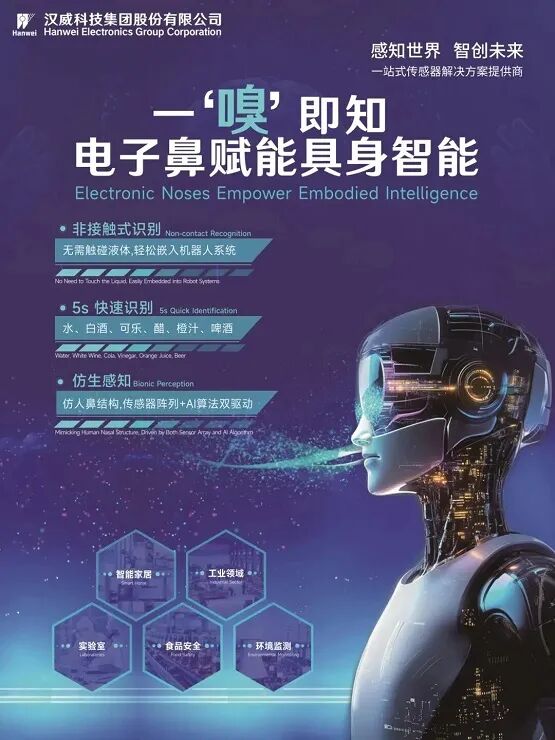
A domestic company that has been dedicated to sensor research for nearly thirty years—Hanwei Technology—has introduced a solution: the electronic nose. Note that it is not a rudimentary alarm that can only beep for a single gas.Its core is a complex bionic olfactory system that works through multiple sensors in coordination, combined with algorithms for learning and judgment, enabling it to distinguish different, even mixed, odors like a biological entity.
The changes this brings are revolutionary.In the industrial sector, this means robots can replace humans, acting as “sniffer dogs” in high-risk chemical environments, capturing abnormal chemical molecules in the air before accidents occur. In our homes, a service robot equipped with an “electronic nose” will no longer just be a moving tool; it can proactively detect gas hazards and remind you to address spoiled food, becoming a true household safety steward.
The core competitiveness of this technology lies in the long-term technological accumulation and continuous investment behind it, creating a barrier that is difficult to replicate. Equipping robots with a “nose” may seem like merely adding a function, but in reality, it closes the perception loop of machines in the physical world, marking a key step towards more advanced human-machine interaction, with its value just beginning to emerge.