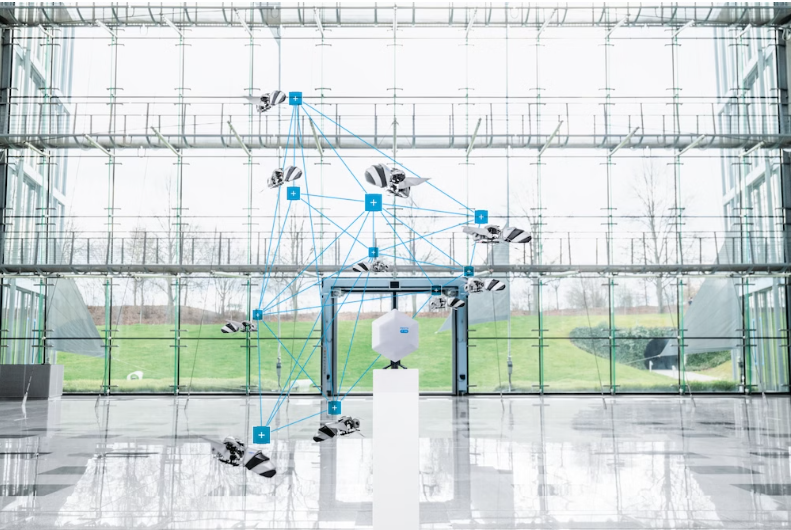
BionicBeeBionicBee is a micro drone characterized by its autonomous flight capability, allowing it to navigate flexibly in narrow and complex spaces, and it can operate collaboratively as part of a swarm. The wingspan of this drone is 240 millimeters, and it weighs only 34 grams, making it the smallest drone in Festo’s bionic learning network. This is made possible by EOS’s Fine Detail Resolution (FDR) technology.
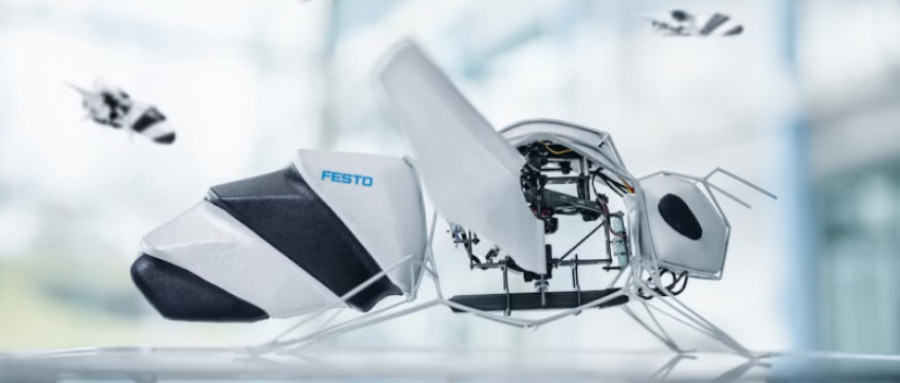
BionicBee has become a model of the potential applications of high-resolution additive manufacturing technology in lightweight design.
1. Concept Design of “BionicBee”
Mattias Speckle explained: “BionicBee was born from Festo’s bionic learning network, which aims to explore nature-inspired engineering solutions to address real-world challenges.”In this project, our idea was to rethink autonomous flight by studying the extraordinary agility and efficiency of bees in nature.”
Source: VoxelMatters
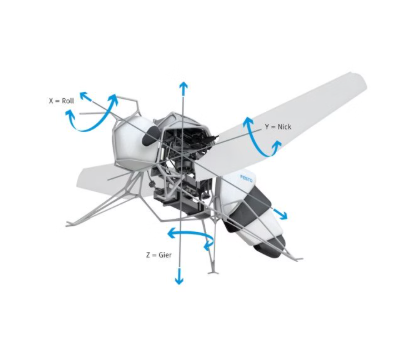
Bees have a unique flying method that allows them to quickly navigate between flowers to collect nectar and pollen. Their flight characteristics include short, rapid wing beats, while their wings also rotate. Coupled with strong flight muscles, this flying method enables bees to fly efficiently with relatively small wings compared to their body size.
Mattias continued: “The team chose not to develop a traditional drone but instead focused on designing a micro drone that mimics the lightweight and highly agile body structure of bees—the goal is to enable these drones to exhibit swarm behavior in complex environments for relevant applications.”“This project is also a way to explore the limits of design and manufacturing, aiming to demonstrate the possibilities that arise when biological principles are combined with advanced engineering.”
2. Exclusively 3D Printed
In designing this autonomous micro drone, the Festo team had to balance achieving a compact and lightweight structure with durability and functionality. Additionally, the team needed to design a compact structure that could accommodate multiple components, including brushless motors, three servos, a gearbox, a battery, and several circuit boards, while ensuring the overall structure remained compact and not bulky.
“Early in the development process, we realized that additive manufacturing would be crucial,”Mattias added, “The design requirements for BionicBee—an ultra-light yet sturdy frame with extremely fine and complex geometries—could not be achieved through traditional manufacturing methods. Integrating multiple electronic components within an extremely compact and lightweight body requires an optimized lattice structure, which would be nearly impossible to produce without additive manufacturing technology.”
However, in the early stages of the project, the team struggled to achieve ideal metrics in strength, flexibility, and resolution using traditional Selective Laser Sintering (SLS) technology.“Traditional SLS technology cannot produce ultra-thin, high-resolution structures, which are crucial for achieving minimal weight while ensuring sufficient strength. These limitations indicated that alternative solutions must be sought.”The team members stated.
Source: VoxelMatters
This solution involved using the EOS FORMIGA P 110 FDR machine, which is based on the company’s Fine Detail Resolution technology. This powder-based polymer 3D printer is equipped with a CO2 laser, whose beam is extremely fine (only half the diameter of the laser beam used in standard SLS technology), allowing it to print strong nylon parts with dimensional accuracy of ±40 microns and a minimum wall thickness of 0.22 millimeters.
3. 3D Printing Brings Swarms to Life Quickly
By closely collaborating with Austrian manufacturing partner 1zu1 and leveraging EOS’s Fine Detail Resolution (FDR) solutions, Festo successfully printed the frame of BionicBee, meeting the required standards in strength, load capacity, and minimal weight.
The drone frame was 3D printed using PA 1101 material, a nylon material derived from castor oil, known for its high impact resistance and thermal stability. The Festo bionic team also utilized algorithm-driven modeling to optimize the structure, reducing the weight of components from an astonishing 20 grams to just 3 grams, achieving a reduction of 85%.
Moreover, the use of additive manufacturing technology during the project development allowed the Festo team to stay on schedule and test multiple versions of the drone frame without extending the delivery timeline.“3D printing enabled rapid iteration cycles, which was crucial given the tight project timeline,”Mattias said, “From the beginning, Festo viewed additive manufacturing as a key driver for realizing the entire concept, not just an option.”
Ultimately, Festo successfully developed a micro drone inspired by bees, capable of wingbeat frequencies of 15 to 20 Hertz, with four degrees of freedom in wing flapping. This allows the drone to navigate flexibly in confined spaces and exhibit the agility of swarm flight—Festo has demonstrated this with a synchronized swarm flight of 20 devices.
The success of this project opens up opportunities in many other fields—from advanced aerial robotics and micro drones to any application requiring stringent demands for weight reduction, complex structures, and rapid iteration. In particular, the achievement of reducing the frame weight by 85% while maintaining structural integrity indicates significant potential in other fields such as aerospace, automotive, and even medical applications, where there is an urgent need for precise, durable, and ultra-light components.
“This collaboration also demonstrates how additive manufacturing technology can shorten R&D cycles, making it highly attractive for innovation-driven industries seeking to quickly turn ideas into functional prototypes and bring them to production.
Source: VoxelMatters