Hello everyone, previously we used the Nth edge trigger function to trigger an under-amplitude signal. So, what exactly is Nth edge triggering? Today we will discuss the Nth edge triggering of the ZDS2022.
The Nth edge trigger of the oscilloscope, as the name implies, triggers on the Nth edge, but it is necessary to determine how long after the Nth edge it is triggered.
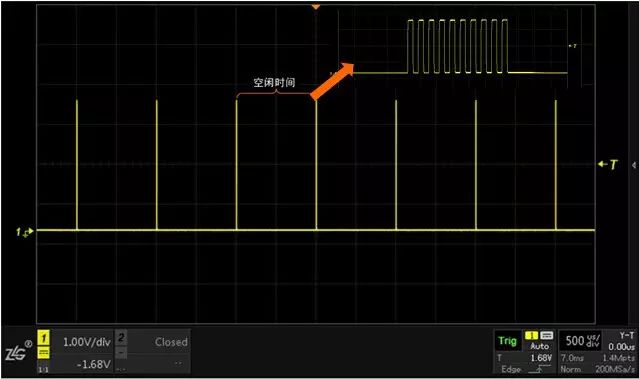
Figure 1 Idle Time
We press the 【Trigger】 key, set the trigger mode to Normal, the trigger type to Nth Edge Trigger, and the trigger source to channel 1 of the actual input signal. The Nth edge trigger includes both rising edge trigger and falling edge trigger. Select the rising edge trigger, assign a specific value to N, and set the range from 1 to 65535. We set it to 5. The key point is the setting of idle time. In the ZDS2022, the idle time for Nth edge triggering can be set from 10ns to 4s. When setting the idle time, it should be noted that it must be less than the maximum idle time and greater than the positive and negative pulse widths of the waveform.
By increasing the time base, we can see that the maximum idle time is about 1ms. When the time base is adjusted to 2us/div, the idle time should be set between 667ns and 1ms. We can set the idle time to 2us, at which point we can see that the trigger point is accurately located at the 5th edge.
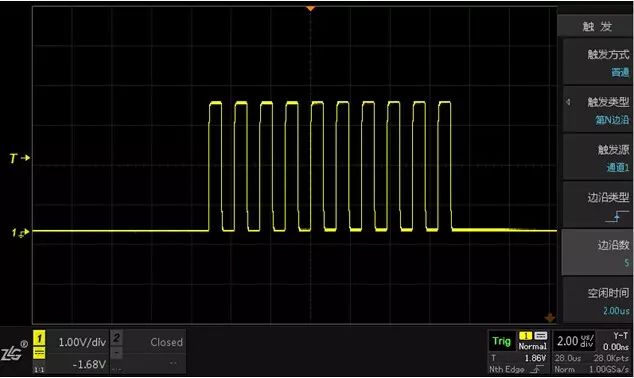
Figure 2 5th Edge Triggering
By rotating knob A to change the edge count, we can see that the waveform can quickly and accurately locate the specified edge! Of course, you can also set the edge type to falling edge trigger.