In today’s wave of digitalization, whether in smart manufacturing, enterprise networking, or IoT applications, a stable and efficient network infrastructure is essential. As the core of the network, the performance of routing devices directly affects the operational efficiency of the entire system.
Traditional routers have fixed functions and poor scalability, making it difficult to meet personalized needs; soft routing built on general-purpose servers has high power consumption and insufficient stability. Against this backdrop, embedded multi-NIC industrial computers are becoming the ideal choice for soft routing deployment due to their unique advantages.


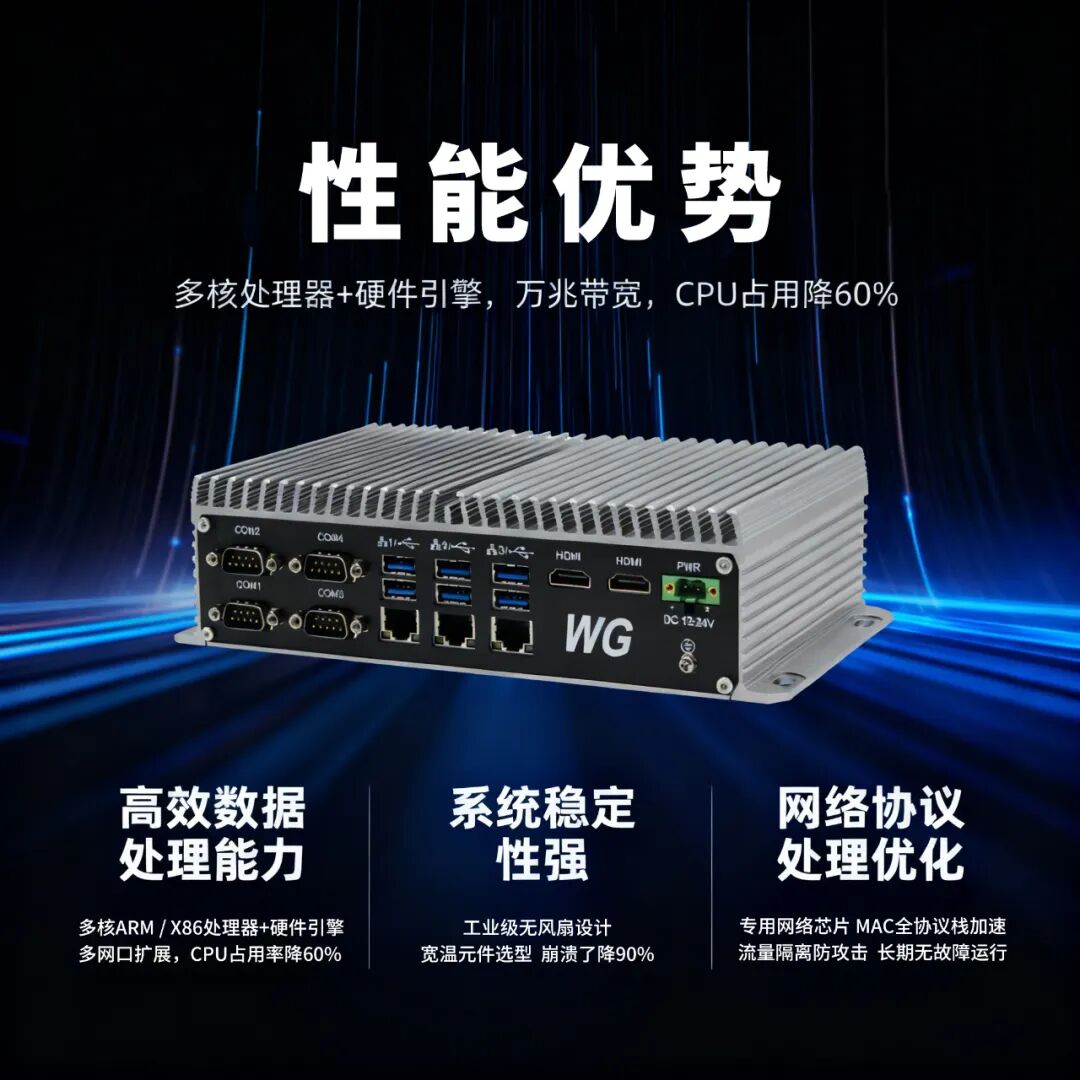
1. High Efficiency in Data Processing
-
Utilizing multi-core ARM/x86 processors combined with hardware-level packet processing engines (such as NPU) to achieve microsecond-level packet processing.
-
Multi-NIC support for link aggregation and load balancing, with bandwidth expandable to 10 Gbps.
-
Compared to traditional soft routing, CPU usage is reduced by over 60%, and forwarding latency is significantly decreased.
2. Strong System Stability
-
Industrial-grade hardware design with fanless cooling and wide-temperature components, suitable for harsh environments.
-
The embedded system features real-time task scheduling and priority preemption mechanisms to ensure critical task responsiveness.
-
Designs such as hardware watchdogs and redundant power supplies enhance fault tolerance, reducing system crash rates by over 90%.
3. Optimized Network Protocol Processing
-
Integration of dedicated network chips supporting TCP/IP protocol hardware acceleration, achieving full-stack processing from MAC to transport layer.
-
Support for dual-stack IPv4/IPv6, OSPF/BGP, and other dynamic routing protocols with short convergence times.
-
Traffic isolation between multiple NICs effectively prevents broadcast storms and inter-segment attacks.

1. Low Hardware and Deployment Costs
-
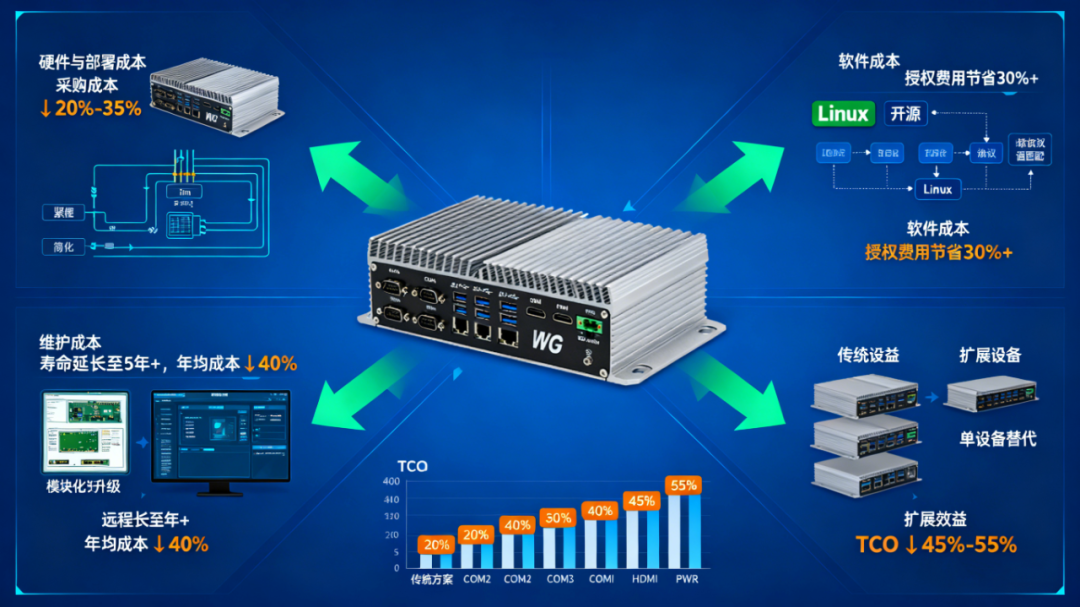
Integrated compact design reduces redundant components, lowering procurement costs by 20%-35%.
-
Simplified wiring reduces external devices, controlling deployment costs.
2. Savings in Software Licensing and Development Costs
-
Equipped with open-source systems (such as Linux), avoiding commercial licensing fees and saving over 30% in software costs.
-
The open-source ecosystem supports flexible development and protocol adaptation, reducing driver adaptation and testing investments.
3. Optimized Maintenance and Lifecycle Costs
-
Modular design supports storage and system upgrades, extending device lifespan to over 5 years, with average annual costs decreasing by 40%.
-
Remote management interfaces reduce on-site maintenance needs, lowering travel and labor costs.
4. Economic Benefits from Scalability
-
Multi-NIC support for VLANs and virtual interfaces allows a single device to replace multiple traditional devices, reducing hardware procurement costs by 60%.
-
Adapting to network expansion avoids redundant investments, lowering total cost of ownership (TCO) by 45%-55%.

1. Flexible Network Configuration
-
Multi-NIC supports multiple WAN/LAN access, VLAN segmentation, and virtual interface configuration.
-
Dynamic routing protocols (OSPF/BGP) support automatic path adjustment, enhancing network adaptability.
2. Strong Hardware and Software Scalability
-
Modular architecture supports USB, PCIe, and other interfaces for expanding storage and communication modules.
-
Based on open-source systems, functionalities such as firewalls and QoS can be implemented through plugins, supporting API integration and remote management.
3. Multi-Protocol Compatibility
-
Supports IPv4/IPv6, industrial Ethernet, PROFINET, Modbus TCP, and other protocols.
-
Built-in protocol conversion modules resolve communication barriers between new and legacy systems, supporting security protocols such as TLS/IPsec.
4. Strong Deployment Adaptability
-
In scenarios like smart manufacturing, it can quickly connect new devices, expand storage, and balance traffic, reducing the complexity and cost of network reconstruction.
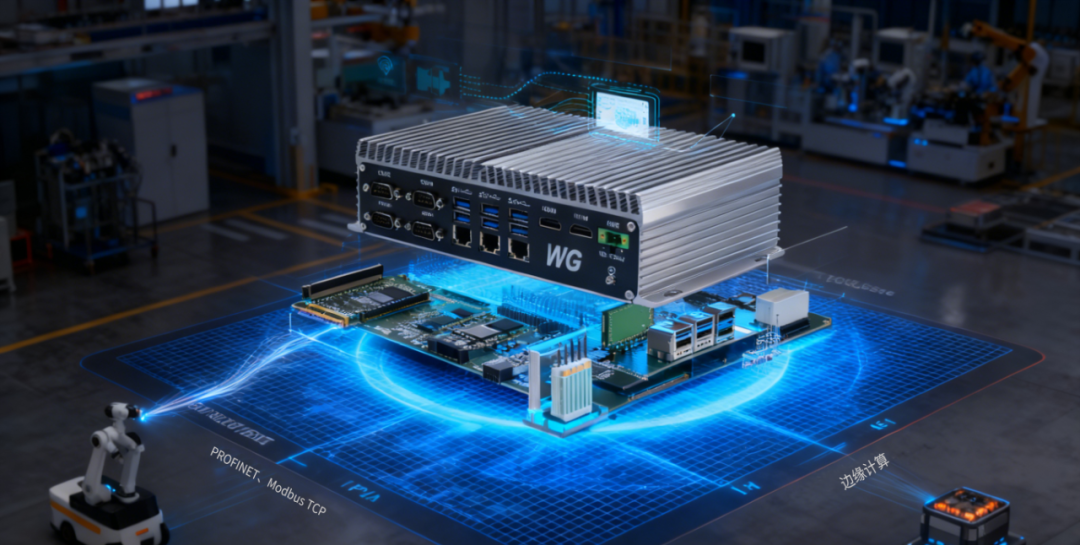


1. Testing Environment and Configuration
This experiment builds a multi-dimensional testing platform to verify the performance of embedded multi-NIC industrial computers in soft routing scenarios.
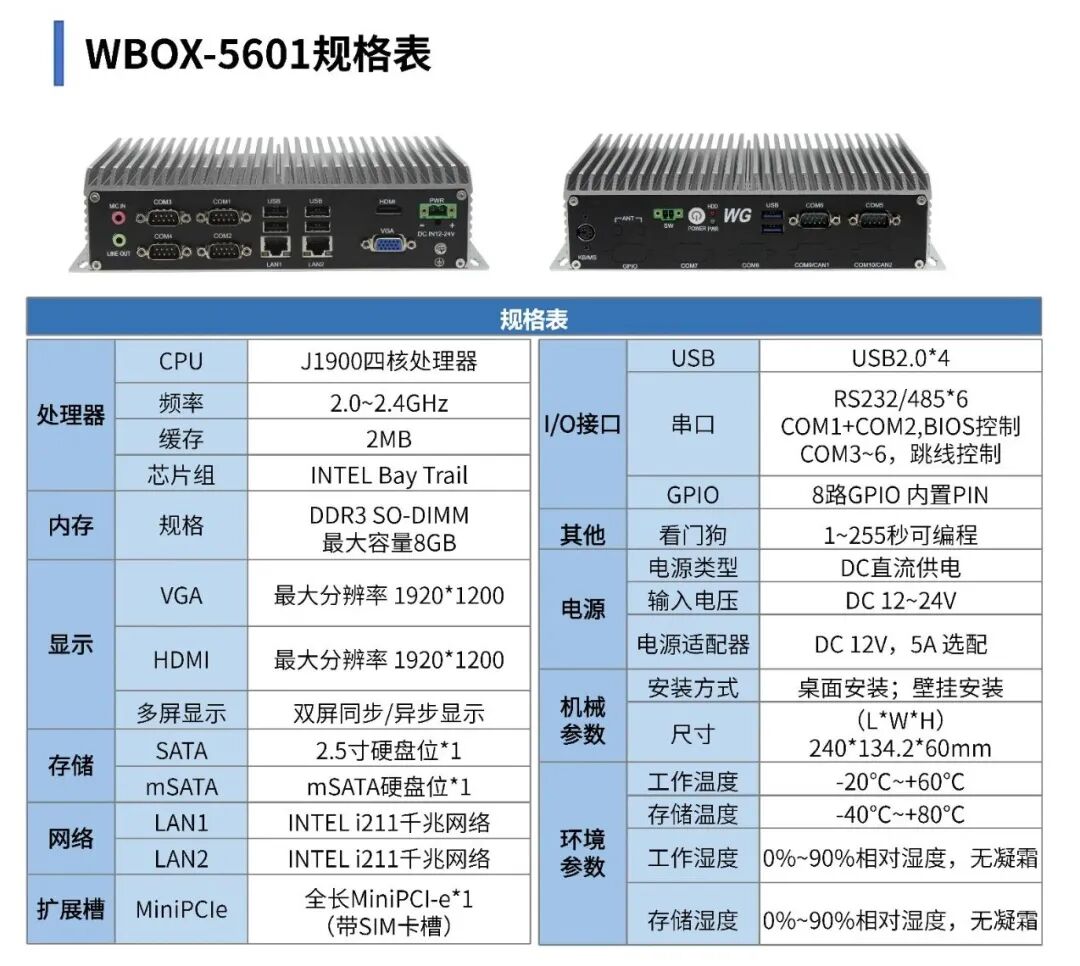
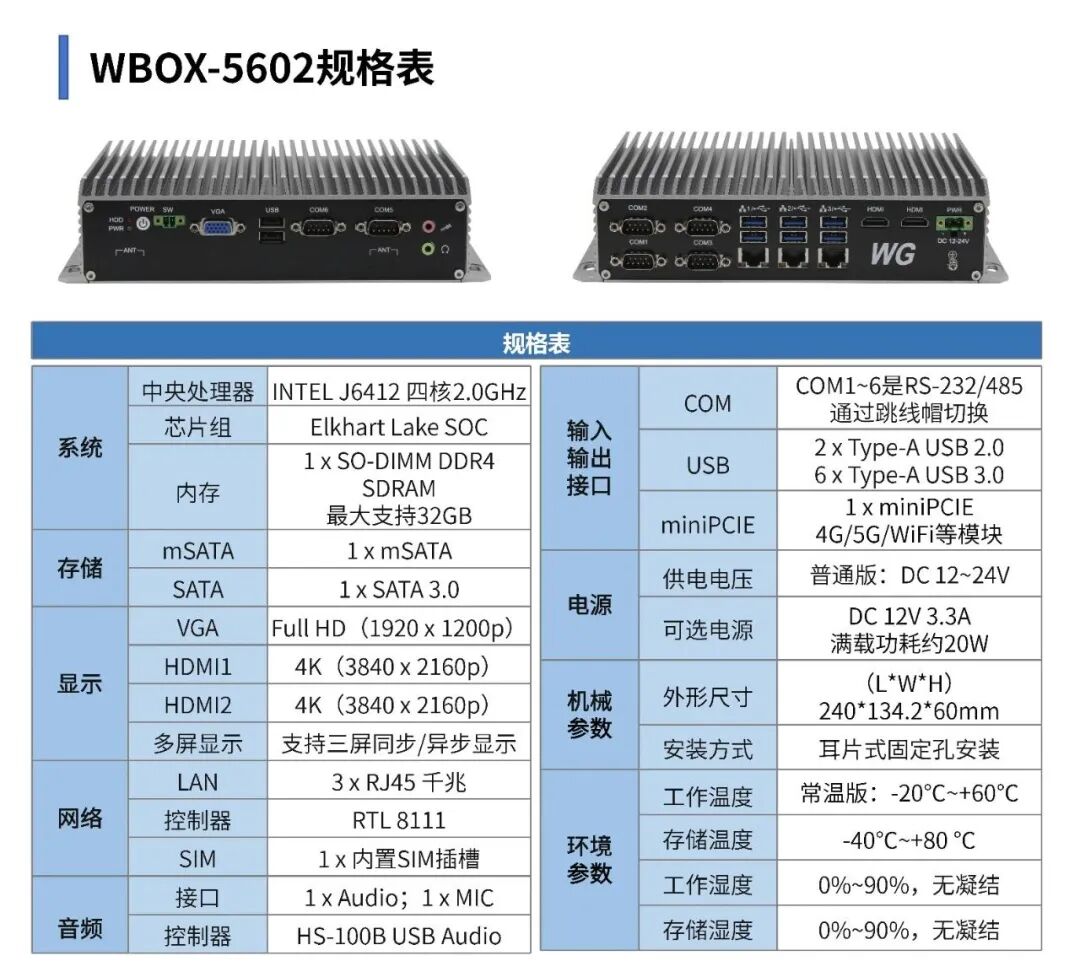
The Fusheng Weier WBOX-5601 industrial computer is equipped with an Intel Celeron J1900 quad-core processor, 4GB DDR3 memory, and a 32GB solid-state drive. This device integrates 4 gigabit Ethernet ports supporting dual-stack IPv4/IPv6 protocols; it uses a star topology connected to 8 multi-system test terminals via a D-Link DGS-1024D switch, simulating external networks through a TP-Link Archer C7, achieving 1000Mbps full-duplex mode via Cat6 cables.
On the software side, the industrial computer runs a customized OpenWrt 21.02 system (kernel 5.4.113), optimizing the network subsystem: enabling Netfilter for NAT and packet filtering, configuring QoS through tc, and adjusting TCP congestion control algorithms and buffer sizes. The test terminals deploy Ixia IXIA Network Tester 7.40 to generate multi-protocol traffic, while Zabbix 5.0 monitors CPU, memory, throughput, and latency in real-time (sampling interval of 1 second).
The network configuration is divided into three layers: external network port 192.168.1.1/24, internal network port 10.0.0.1/24, and DMZ zone 172.16.0.1/24, implementing NAT mapping through iptables, segmenting VLANs to isolate business traffic, and testing MPLS load balancing using policy routing. The bonding module is also configured to achieve link redundancy (switching < 200ms), deploying Suricata 6.0.6 intrusion detection system (3000+ rules) and Elasticsearch log cluster.
All tests are conducted in a constant temperature environment of 25°C, with Fluke DSX5000 verifying that the physical layer signal quality meets IEEE 802.3ab standards, and using eBPF technology to trace the network packet processing flow.
2. Testing Method
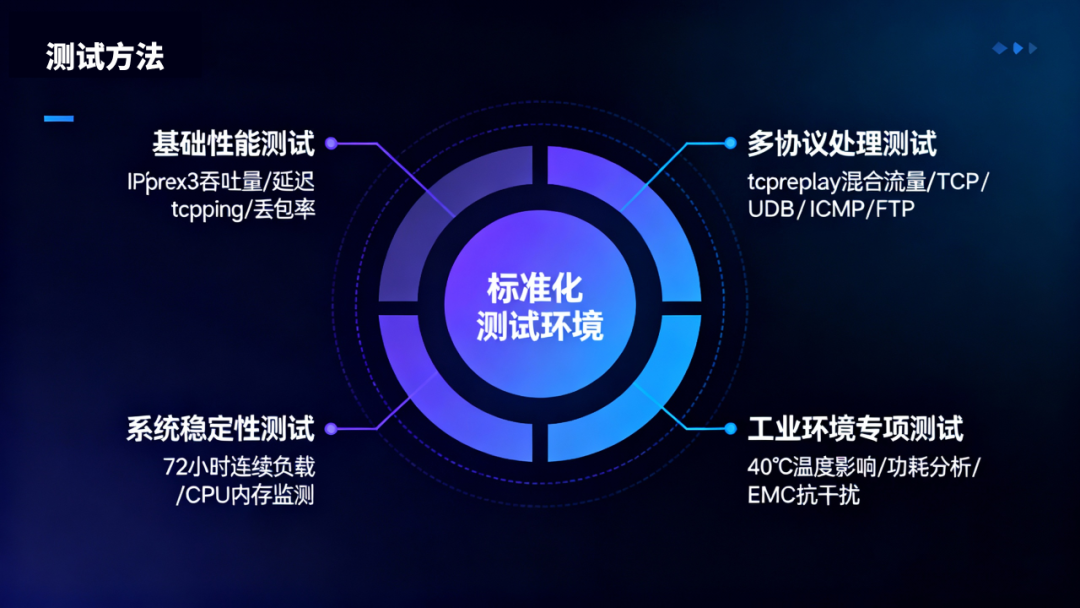
This experiment employs a standardized testing environment, combining quantitative analysis with comparative experiments to systematically evaluate the technical performance of embedded multi-NIC industrial computers in soft routing scenarios.
The testing adopts a layered strategy: for basic performance, Iperf3 is used to measure TCP/UDP bidirectional throughput and latency, tcpping checks ICMP response latency, and runs continuously for 30 minutes under 1Gbps full load to calculate packet loss rates. Multi-protocol processing tests replay real mixed traffic (TCP/UDP/ICMP/FTP) using tcpreplay, analyzing protocol processing success rates and queue scheduling. System stability testing involves 72 hours of continuous 1Gbps load, monitoring CPU usage, memory leaks, and connectivity.
For industrial scenarios, additional specialized tests are conducted: monitoring the impact of temperature on throughput in a 40°C constant temperature box; measuring power consumption at no load, 50% load, and full load using a power analyzer; and verifying anti-interference capabilities through electromagnetic pulses (3V/m, 80MHz–2GHz) and voltage drops (20% drop sustained for 100ms).
Data is collected through Prometheus+Grafana, rsyslog, and ipmitool from multiple dimensions, with all metrics averaged after three repeated experiments, excluding outliers. Comparative analysis uses traditional devices as a baseline to calculate relative improvement ratios, and t-tests are employed to verify the significance of differences (confidence level 95%). The entire testing process isolates wireless interference, unifying QoS strategies to ensure a fair environment.
3. Result Analysis
This experiment compares embedded multi-NIC industrial computers with traditional x86 soft routing under Linux systems and open-source routing software environments, demonstrating significant advantages in comprehensive performance after 72 hours of high load and multi-protocol testing.In terms of performance, the industrial computer achieves 98.6% throughput at 1Gbps, with a packet loss rate of <0.15% at 10Gbps (a 21-fold improvement over traditional devices), and a delay jitter of ±1.2ms during multi-tasking (a reduction of 67%), with hardware acceleration technology avoiding CPU resource contention. In terms of stability, core temperature remains at 45-50°C, memory leak rate is 0.02%/hour, and service availability in extreme temperature ranges (-20°C to 60°C) is 100%, far exceeding traditional devices’ throttling under overload and 47% abnormal reboot rates.In terms of scalability, NIC hot-swapping takes effect in 30 seconds, VLAN configuration delay is 150ms, and modular design reduces modification difficulty. The energy efficiency ratio is also notable, with a power consumption of 18W, only 21% of traditional devices (85W), and a 43% reduction in total cost of ownership over 5 years.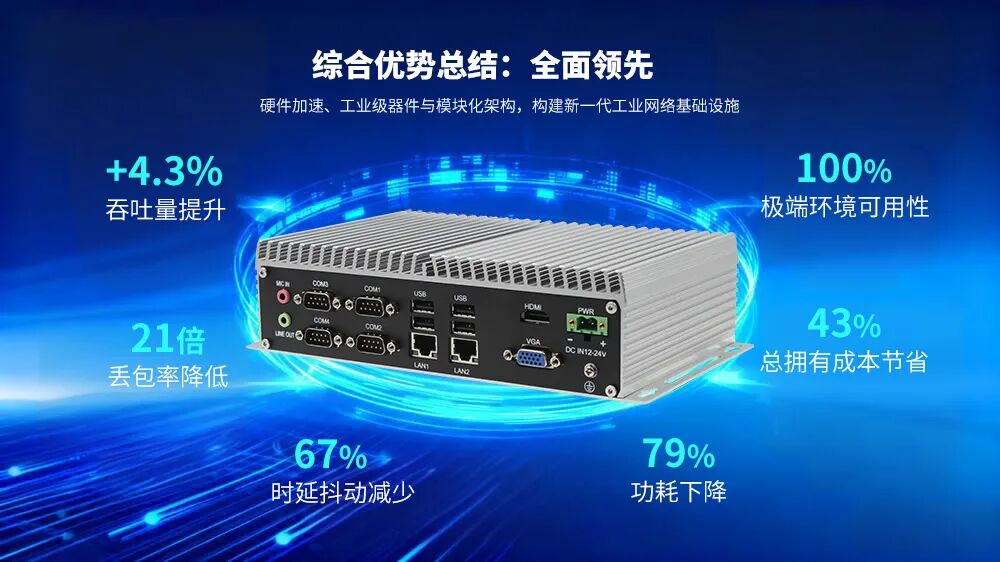 In summary, embedded multi-NIC industrial computers meet the demands for high availability, low latency, and rapid scalability in industrial IoT and smart factory scenarios through hardware acceleration, industrial-grade design, and modular architecture, providing important empirical evidence for hardware selection in soft routing.