Introduction: In an effort to counter Trump’s attempts to reclaim global manufacturing, China’s factories and ports are learning to produce and export more goods at a faster pace, lower cost, and with fewer workers.
Sam Altman hopes that artificial intelligence can cure cancer. Elon Musk claims that AI robots will eliminate poverty.
China’s focus is more practical: to manufacture better industrial products.
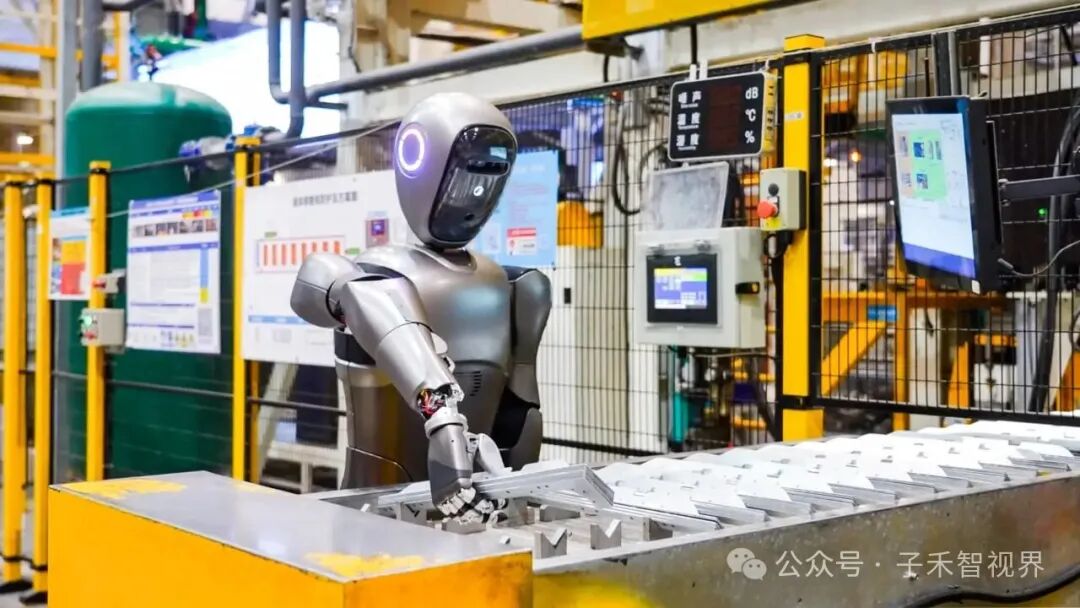
Although China’s long-term goals in artificial intelligence are not inferior to those of American tech giants, its immediate priority is to solidify its position as the world’s factory for the coming decades. However, this position is no longer secure due to the dual threats of rising domestic costs and overseas tariffs, putting exports at risk.
In this vast country, dozens of companies are driving this transformation—these companies, backed by billions of dollars in technology development from both the government and private sectors, are changing every aspect of goods manufacturing and export.
A clothing designer stated that with the help of artificial intelligence, the time to produce samples has been reduced by more than 70%. In China, washing machines are being mass-produced under the command of an AI “factory brain”.
At one of China’s largest ports, containers are racing past on driverless trucks, with hardly any workers in sight, while the port’s scheduling is controlled by artificial intelligence.
Managers involved in related work in China compare the future of factories to living organisms that can think and act autonomously, surpassing the programmed tasks of traditional automated factories. This could further drive the proliferation of “dark factories”, where operations are highly automated and can run around the clock in dim lighting.
For those worried about China losing its status as the “world’s factory”, these advancements are coming just in time. China’s population is declining, young people are reluctant to work in factories, and many countries are increasingly resisting Chinese exports.
Meanwhile, President Trump has promised to bring back a large number of manufacturing jobs to the U.S. by imposing tariffs on China.
Artificial intelligence provides a lifeline to circumvent these risks, helping China produce and transport more products faster, cheaper, and with fewer workers. Despite some global concerns about the speed at which AI will change the world, China is not sitting idle: it aims to deploy existing technologies faster than the U.S. to secure an advantage.
“Only by actively embracing change can we remain undefeated in this transformation,” said Baosteel Group, which is listed in Shanghai and has identified 125 applications of artificial intelligence as of the end of last year, with plans to develop 1,000 applications.
According to the International Federation of Robotics, China added 295,000 industrial robots last year, nearly nine times that of the U.S. and more than the total of all other countries combined. It is expected that by 2024, the number of operational robots in China will exceed 2 million, ranking first in the world.
The World Economic Forum recognized 131 factories and industrial bases globally that have enhanced productivity through cutting-edge technologies like artificial intelligence, with 45 located in mainland China and 3 in the U.S.
According to state media, in Baosteel’s “dark factory” in Shanghai, three operators sit in front of dozens of screens monitoring real-time updates. Artificial intelligence has reduced the need for human intervention from every three minutes to every thirty minutes.
Powerful factories are the cornerstone of a robust economy, and a strong economy will ultimately enhance China’s global influence to challenge the U.S. In China’s GDP, the value added by manufacturing accounts for a quarter, far exceeding the global average.
The job losses in factories that artificial intelligence may cause could be more than expected, posing certain risks and leading to worker unemployment. However, China’s population is expected to decrease by 200 million over the next thirty years, which will offset the impact of factory layoffs, thereby increasing productivity without raising the unemployment rate.
Embracing artificial intelligence is “a necessary task, not an optional one.” Since the late 1970s, China has opened up its economy, benefiting from a large pool of cheap labor. Millions of migrant workers have left their hometowns to work on assembly lines in coastal areas.
Today, the average wage in Chinese factories is much higher than in countries like India. Many young people in China are unwilling to work in factories. This year, the skilled worker shortage in key manufacturing sectors could reach 30 million.
Artificial intelligence cannot solve all of China’s economic problems. In cutting-edge technologies like artificial intelligence and chips, China still lags behind the U.S. Many American companies, such as Amazon and Walmart, are also prioritizing automation like Chinese companies.
China’s advantage lies in its ambitious scale, reflected not only in national tech hubs but also in regions like Jingzhou. Jingzhou is a city with a population of five million along the Yangtze River and is home to Midea Group, one of the world’s largest home appliance manufacturers, competing with companies like Whirlpool and LG Electronics.
Nearly a decade ago, Midea clarified its automation strategy by acquiring the German robotics expert KUKA. Today, KUKA’s robots operate in Midea’s washing machine factory in Jingzhou, controlled by an artificial intelligence system referred to as the “factory brain” by Midea. This system acts like a central nervous system, managing most of the factory’s processes.
This computer control system manages 14 virtual agents within the factory, which collaborate to find the best solutions to complete tasks and issue instructions to the workshop’s robots and other machines. This is an important step for Midea towards achieving more comprehensive automation of factory processes using artificial intelligence.
“You just need to input all the data, and the rest is up to artificial intelligence to handle,” said a humanoid robot in the Jingzhou factory, working in conjunction with the factory’s intelligent control system to transport formed parts to the inspection station, where they are checked by 3D cameras. If the parts fail inspection, the factory’s AI system identifies the problem and makes repairs.
When it is necessary to tighten screws on various models of dryers on the assembly line, the factory’s intelligent system can identify the model, allowing the robot to perform the correct task—providing human-like flexibility and increasing productivity.
In areas still requiring manual operation, some employees are equipped with AI glasses that can mark common product defects based on inspection history. A process that previously took 15 minutes can now be completed in just 30 seconds.
Midea Group reports that from 2015 to 2024, its employees’ average income has increased by nearly 40%, indicating that the company aims to leverage technology to improve efficiency.
The U.S. is fighting back, attempting to curb China’s advancements in artificial intelligence by imposing export controls to prevent China from obtaining the most advanced chips.
Even so, the emergence of DeepSeek showcases the strength of Chinese engineers in developing AI models. Most Chinese people hold an optimistic view of artificial intelligence, enabling the government to deploy this technology rapidly. A survey found that 83% of Chinese respondents believe that AI products and services are more beneficial than harmful, a rate that is twice that of the U.S.
More than 500 miles east of Midea’s washing machine factory, a down jacket manufacturer founded by a billionaire is using artificial intelligence to accelerate product development cycles. Bosideng, which started in the mid-1970s with a sewing team of 11 villagers, now has annual revenues nearly four times that of the well-known Western brand Canada Goose.
Bosideng has partnered with Zhejiang University, a prestigious Chinese institution, to launch a self-developed AI model for concept design and virtual clothing production. The company launched its first AI-designed jacket last year and stated that it has reduced the time to produce clothing samples from 100 days to 27 days, while also cutting development costs by 60%.
In addition to DeepSeek, the tech giant Huawei, which is under U.S. sanctions, is also a core force in China’s AI research and development. The company has launched a series of large language models called Pangu, along with other AI services for factories to enhance their business capabilities.
Huawei’s engineers have settled in the giant cement manufacturer Conch Group, located about 200 miles west of Shanghai, whose cement has been used in projects like the Three Gorges Dam and the Burj Khalifa in Dubai.
Facing a surplus in China’s cement production, Conch hopes to gain an edge over competitors by rapidly adopting AI technology, including in the production of clinker. Clinker is a key component of cement, made by heating limestone and other raw materials at high temperatures.
Conch is collaborating with Huawei to develop AI tools for more accurately predicting clinker strength and controlling energy consumption in kilns. The conveyor belts at the Wuhu factory are currently monitored by AI, helping Conch respond more efficiently when issues arise on the conveyor belts.
During a recent visit, workers monitored the process of AI models automatically adjusting production in Conch’s large clinker production facility. Conch and Huawei stated that with the help of AI technology, they can now predict clinker strength with over 85% accuracy, compared to only 70% accuracy with human estimates. This allows them to adjust raw material ratios to avoid producing substandard clinker.
According to Conch, the application of AI models has reduced coal consumption by 1%, which means nearly $300,000 can be saved annually per production line. The company plans to reduce coal consumption by 2% through AI by the end of 2026, which could save tens of millions of dollars annually if this goal is applied across all its operations.
Reaching this point is not easy, requiring repeated trials to get the models to function properly. This experience highlights that global AI capabilities remain limited, and its impact—including in China—may only gradually become apparent.
Particularly emphasizing the enhancement of national port capabilities is a key step in solidifying China’s position as a global manufacturing powerhouse. One of China’s largest ports, Tianjin Port, has partnered with Huawei to launch a fleet of driverless trucks and a system called OptVerse AI Solver, which can optimize millions of variables and constraints, such as ship arrival times and crane capacities, to manage scheduling.
Planning that previously took 24 hours can now be completed in just 10 minutes.
Last year, the port also launched an AI model called PortGPT, developed in collaboration with Huawei, which can analyze on-site videos and images and may eventually replace human security personnel.
Similar situations are unfolding across China. According to data from the World Bank and S&P Global Market Intelligence, half of the top 20 ports in the world by vessel turnaround time are located in mainland China, including Tianjin Port.
Among the 10 large U.S. container ports investigated by the Government Accountability Office, as of mid-2023, only 1 had deployed driverless vehicles, and only 5 had utilized AI and machine learning technologies.
The automation level of large container handling equipment at Tianjin Port has exceeded 88%. A video aimed at port visitors summarizes China’s growing confidence in AI: “We are the future.”
If you want to stay updated with the latest financial news,
it’s recommended to visit the following news websites directly:
The Wall Street Journal, The Financial Times, Bloomberg, Reuters.
If you cannot access these websites
but still want to read the latest news or financial weekly magazines,
please chat with kingmember_sf (+VX) for more information.