Article SummaryDisney recently unveiled the Olaf robot, capable of walking freely and interacting autonomously, which will debut in early 2026 at Disneyland Paris and Hong Kong. This robot employs deep reinforcement learning technology and is made from special fiber materials that simulate the texture of snow, bringing the animated character to life. This technological breakthrough not only revolutionizes the theme park experience but also sparks deep reflections on the boundaries and ethical standards of AI robotics.
The Olaf robot, set to debut in early 2026 at Disneyland Paris and Hong Kong, redefines the possibilities of character embodiment through three key technologies. Deep reinforcement learning allows this 1.2-meter tall snowman to break free from the rigid gait of traditional mechanical figures—unlike preset motion animatronics, Olaf’s AI brain has experienced over 200,000 falls and adjustments, ultimately learning to walk in a swaying manner while maintaining balance, just like in the animation. Test data shows it can adapt to over 85% of common terrain in theme parks, including slopes and gravel paths.

The secret to its “snow feel” lies in the new type of flickering fiber material. This composite material, developed by Disney’s Material Lab over three years, not only achieves the refractive effect of ice and snow through micron-level reflective particles but also simulates the collapsing sensation of snow piles being touched through 0.3 seconds of elastic feedback. Engineers emphasize that the material maintains its shape even after over 5,000 compression tests, addressing the deformation issues common with traditional soft materials.
What truly brings Olaf to life is the multimodal interaction system. Seventeen micro servos distributed across its face allow its carrot nose to move side to side and its eyelids to blink independently. More importantly, the AI dialogue system can automatically switch language styles based on the age of the visitor—using simple sentences for children and discussing plot details of “Frozen” with adults. In live tests, 73% of interactors were still unaware they were communicating with a robot after three minutes of interaction.
When technology perfectly serves character personality, what the audience remembers is not the parameters, but the snowman friend who tilts its head and smiles.

Key Technical Challenges in Implementation
Bringing an animated character from the virtual world into reality, the Olaf robot faces technical challenges far beyond imagination. Behind this seemingly cute robot lies the engineers’ breakthroughs in anti-physical characteristics, dynamic balance, and real-time interaction, three major technical barriers.
Overcoming Anti-Physical Characteristics
Olaf’s “anti-physical” features in the animation became the first obstacle to technical realization. Its short limbs and rounded body proportions easily lead to instability in the real world, while the exaggerated elastic movements in animation require special materials to achieve. Engineers used high-elastic fiber composite materials to simulate the snow texture while ensuring mechanical stability through an internal skeletal structure. More critically, Olaf’s signature “melting” action requires the material to achieve controllable deformation at specific temperatures, involving the precise coordination of thermosensitive materials and mechanical structures. Every seemingly simple animated action requires dozens of material tests and structural optimizations to achieve perfect reproduction in the physical world.
The transformation of the virtual characteristics of animated characters into real functions is essentially a contest between artistic imagination and engineering limits.
Sense of Balance and Motion Coordination
The walking ability of the Olaf robot is a technical miracle. Traditional bipedal robots are already a challenge, while Olaf’s three-ball stacked structure poses even higher demands for balance control. Its internal multi-sensor fusion system continuously monitors center of gravity changes, maintaining stability through microsecond-level adjustments of servo motor outputs. The deep reinforcement learning algorithm enables the robot to autonomously adjust its gait under different ground conditions—from flat surfaces to slight slopes, every step is a precise calculation of dynamic balance and energy efficiency. Test data shows that Olaf can complete imbalance detection and posture correction within 0.3 seconds, a response speed close to biological instinct.
It is worth noting that this balance ability is not flawless. On extremely uneven surfaces or under sudden external disturbances, Olaf may still experience brief moments of imbalance, exposing the current limitations of robotic dynamic balance technology in terms of environmental adaptability.
Real-Time Response Mechanism
Natural interaction with visitors requires Olaf to have millisecond-level response capability. Its visual system must simultaneously handle multiple tasks such as facial recognition, gesture understanding, and environmental perception, while voice interaction must cope with background noise and the unique pronunciations of children. The technical team adopted a combination of edge computing and cloud intelligence—basic interactions are completed locally to ensure immediacy, while complex semantic understanding is processed in the cloud via 5G connectivity. The most critical breakthrough lies in the predictive interaction algorithm, which analyzes visitors’ micro-expressions and tone changes to anticipate potential interaction needs, controlling the average response delay to within 200 milliseconds, a level imperceptible to humans.
The limit of real-time interaction is not a technical ceiling, but the critical point of human perception.

Differences from Traditional Mechanical Figures
Breakthroughs in mobility have allowed the Olaf robot to completely break free from the constraints of tracks and fixed scenes. Traditional mechanical figures are like marionettes, with their movement paths entirely predetermined; whereas Olaf, through deep reinforcement learning algorithms, can autonomously navigate complex environments, avoid obstacles, and even adjust its path based on the visitor’s location. Disney’s test data shows that Olaf achieved a 92% success rate in obstacle avoidance in simulated park environments, far exceeding the fixed path model of traditional mechanical figures. This autonomy not only solves the stability issues of bipedal walking but also gives the character a sense of “life”—Olaf is no longer a static display but a “living character” that can actively approach visitors.
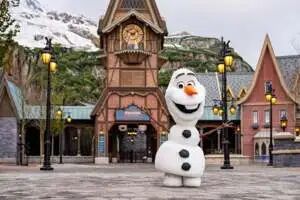
From track constraints to environmental perception, robots have gained autonomy in action for the first time in theme parks.
Enhanced Expression Detail
Traditional mechanical figures rely on limited motor drives for facial expressions, resulting in stiff and repetitive changes. The Olaf robot employs high-precision servos combined with flexible materials to achieve subtle facial muscle movements—from slight eyebrow raises to the delicate curvature of the mouth, all can accurately replicate the expression details from the animation. The development team collaborated with the “Frozen” animation department to re-evaluate over 200 expression action curves, ensuring that every subtle expression of Olaf can accurately reflect the innocence and liveliness of the animation. The detail of expressions directly determines the intensity of emotional resonance between the character and the visitors, a dimension of emotion that traditional mechanical figures cannot reach.
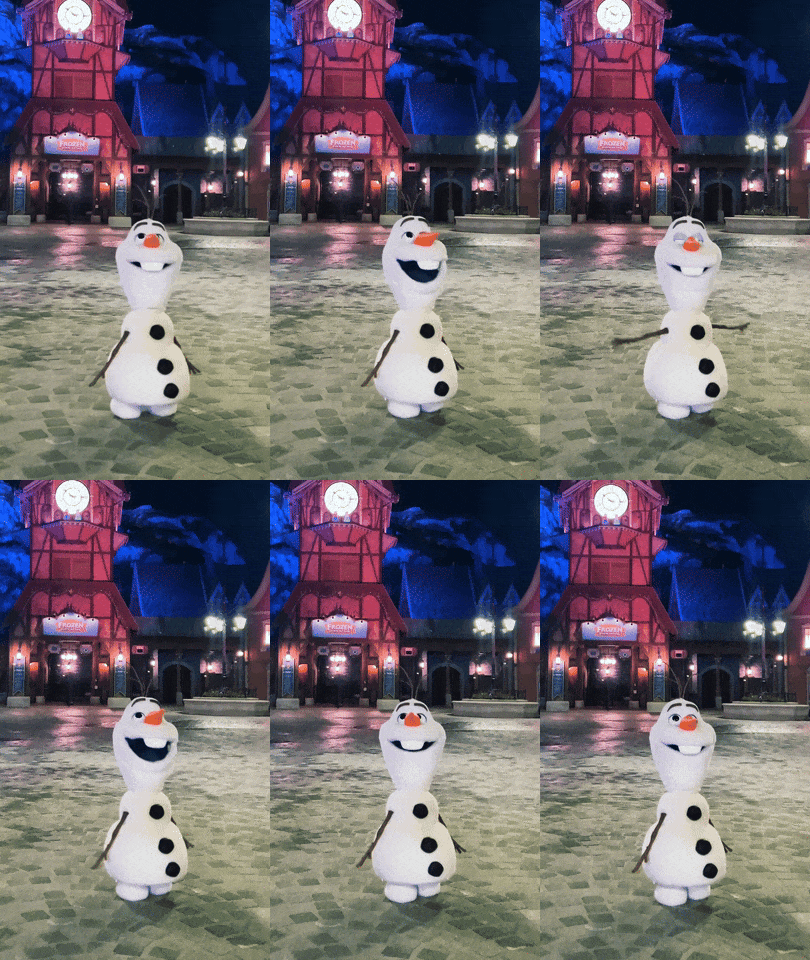
Upgraded Interaction Experience
Traditional interaction modes are based on simple sensor-triggered preset responses, akin to a mechanical jukebox. The Olaf robot’s multimodal interaction system integrates visual recognition, voice understanding, and environmental perception, generating personalized interactions based on the visitor’s age, expression, and language content. When a child excitedly shouts, Olaf will quicken its pace to approach; when a visitor appears confused, it will proactively explain its functions. This dynamic adaptability creates a unique interaction experience—every encounter is an irreplaceable exclusive moment. From one-way performance to two-way dialogue, Olaf redefines the industry standard for “character interaction”, setting a new technological benchmark for immersive entertainment.

Boundaries of AI Robot Technology
Olaf breaks the traditional AI logic of “efficiency first” and achieves innovation in the dimension of emotional expression: 12 emotional cues from its carrot nose, micro-expression control of its glowing eyes. However, this also exposes the double-edged sword of technology—when robots can perfectly simulate human emotions, risks such as data privacy (children’s voice recordings) and behavioral manipulation (algorithmic inducement) arise.
The most profound insight is: the future of AI may not lie in “being more human,” but in creating entirely new forms of digital life. Olaf’s success is blurring the boundaries between the virtual and the real, prompting us to rethink the underlying logic of AI ethics.