RK3588 vs RK3568 vs RK3368 — Comparison Table + In-Depth Analysis (For Hardware Engineers and Embedded Developers)
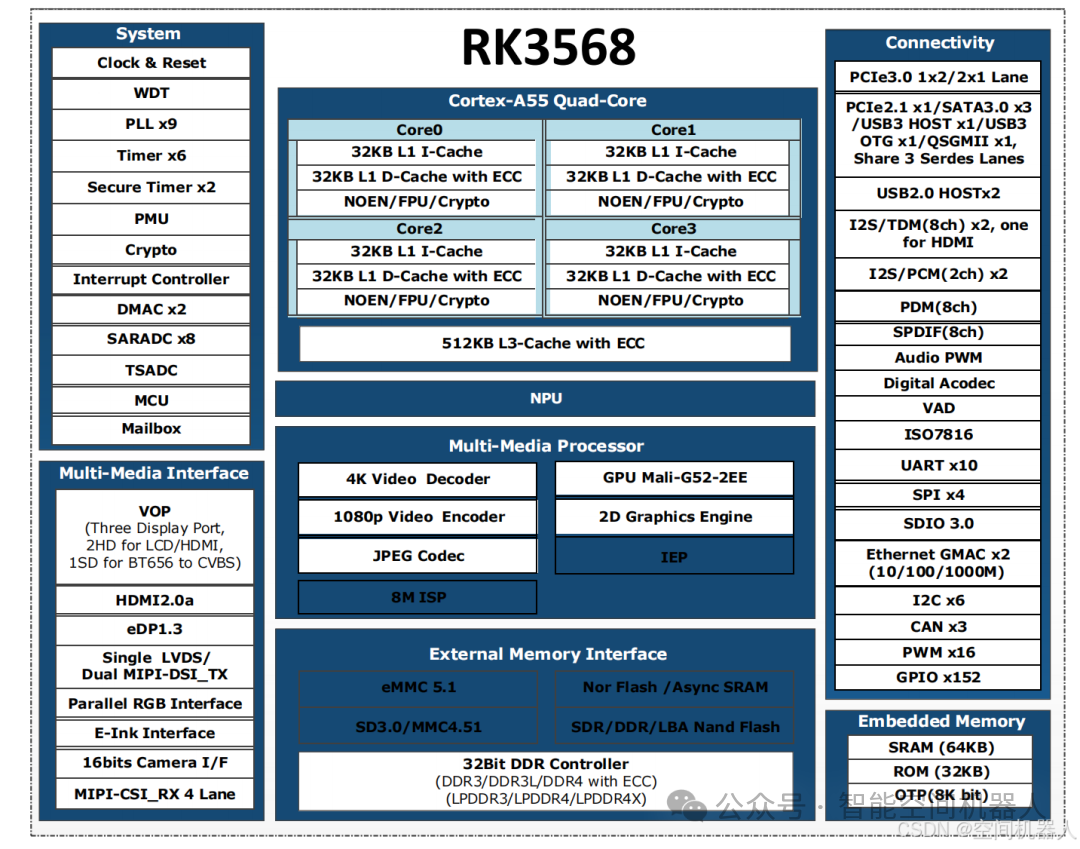
1. Comparison Table
| Item | RK3588 | RK3568 | RK3368 |
|---|---|---|---|
| Process | 8nm | Not specified (commonly 12/14/22nm class) | 28nm |
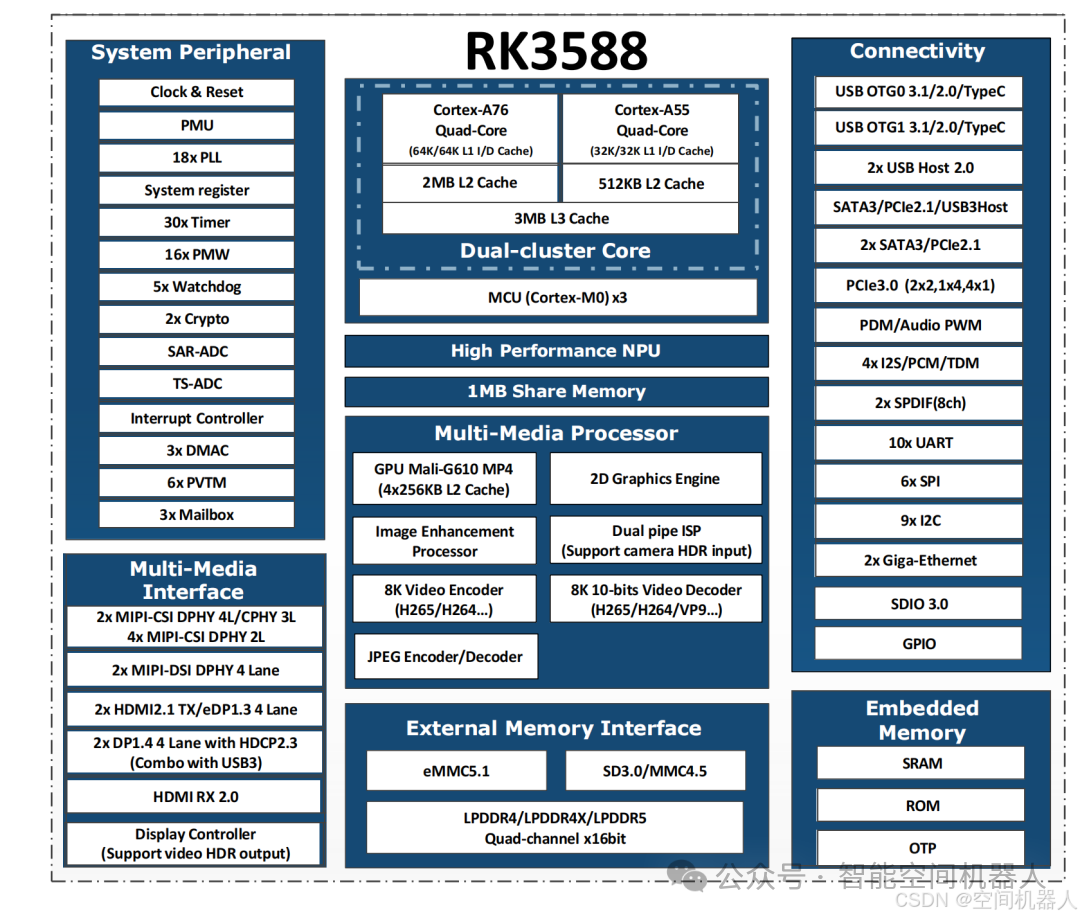
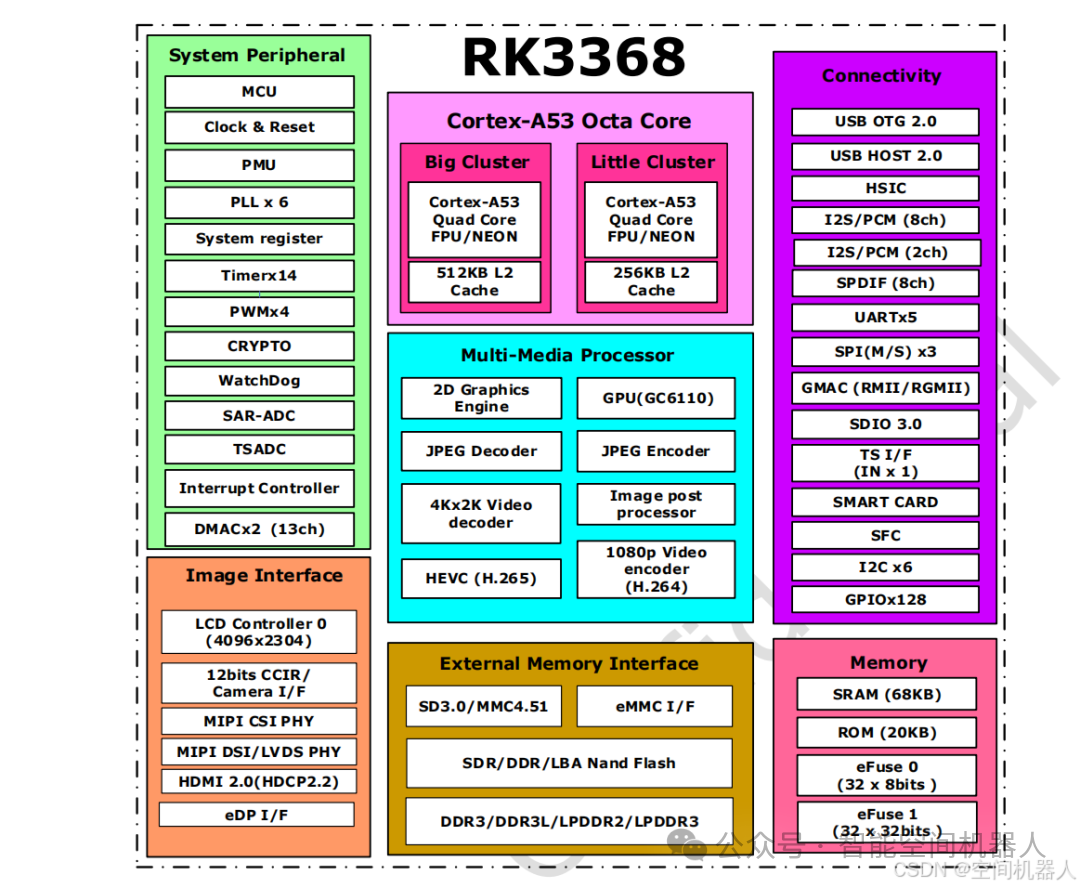
| CPU | 8-core (4×A76 + 4×A55) | 4×Cortex-A55 @ up to 2.0GHz | 8×Cortex-A53 @ up to 1.5GHz |
| GPU | Mali-G610 MC4 (High-end) | Mali-G52 2EE | PowerVR G6110 |
| NPU | 6 TOPS, supports int4/int8/int16/FP16/BF16/TF32 | 1 TOPS (or 0.8~1TOPS) | No (or very weak) |
| Video Encoding/Decoding | Decode: H.265/H.264/AV1/VP9/AVS2 up to 8K60; Encode: H.264/H.265 up to 8K30 | Decode: up to 4K60 (H.265/H.264/VP9); Encode: 1080P60 | Decode: 4K60 H.265/H.264; Encode: 1080P |
| ISP / Camera | 48MP / Multi-camera input; supports MIPI CSI-2, HDMI IN | 8MP ISP | Built-in 8M ISP |
| Display | eDP/DP/HDMI2.1/MIPI, multi-screen display, up to 8K60 | HDMI2.0/eDP/MIPI/LVDS, multi-screen | HDMI2.0/MIPI/eDP/LVDS, up to 4K |
| Memory Support | LPDDR4/4X/DDR4, up to 32GB | LPDDR4/4X/DDR4, up to 8GB | DDR3 / LPDDR2/3 (32-bit) |
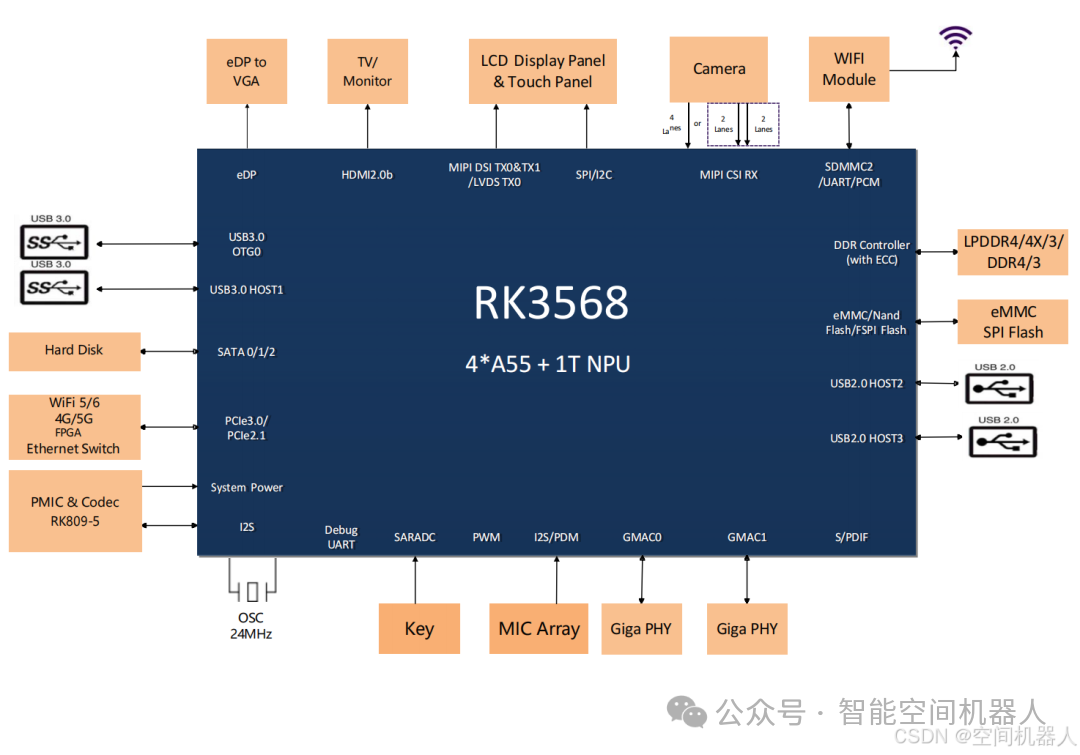
| Storage/High-speed Interfaces | PCIe3.0, USB3.1/Type-C, SATA3.0, Gigabit Ethernet | PCIe3.0/PCIe2.1, USB3.0, SATA3.0, dual Gigabit | USB2.0, SDIO, Ethernet |
| Typical Scenarios | High-end AIoT, 8K/multi-channel video, XR/VR, smart NVR | Industrial control, in-vehicle central control, edge computing, high-definition video player | Entry-level IoT, set-top box, budget smart screen |
| Feature Summary | Flagship computing power + video + multi-camera | Rich interfaces, balanced, industrial-grade | Low cost, sufficient |
2. In-Depth Analysis and Engineering Perspective
1) Process and Power Consumption
- RK3588 (8nm): A more advanced process means higher transistor density and better energy efficiency, resulting in lower power consumption for the same performance or higher performance at the same power consumption. Suitable for high-performance scenarios with controlled power consumption (e.g., in-vehicle, set-top box, edge AI inference).
- RK3568 / RK3368: Older processes (RK3368 is 28nm), which means disadvantages in power consumption/heat generation/energy efficiency, requiring more attention to thermal design and long-term thermal throttling strategies.
Recommendation: Passive cooling for RK3588 can achieve high sustained performance; for RK3568/3368, it is recommended to use heat sinks + airflow or fans (depending on power consumption limits), and design PMIC for current limiting and DVS (Dynamic Voltage Frequency Scaling).
2) CPU / Multi-core Architecture Differences (Practical Impact)
- A76 (RK3588): High IPC (Instructions Per Cycle), strong single-thread performance, suitable for diverse and latency-sensitive tasks (e.g., decoding + inference + UI running simultaneously).
- A55 (RK3568) / A53 (RK3368): Low-power cores, good baseline task performance but weak single-thread performance. Suitable for background services, control logic, and low-power tasks.
Practice: Bind latency-sensitive tasks (rendering, inference main loop) to big cores on RK3588; bind system background, network, and logging to small cores. Pay attention to CPU affinity (sched_setaffinity) and cache hotspots.
3) GPU and Graphics Acceleration
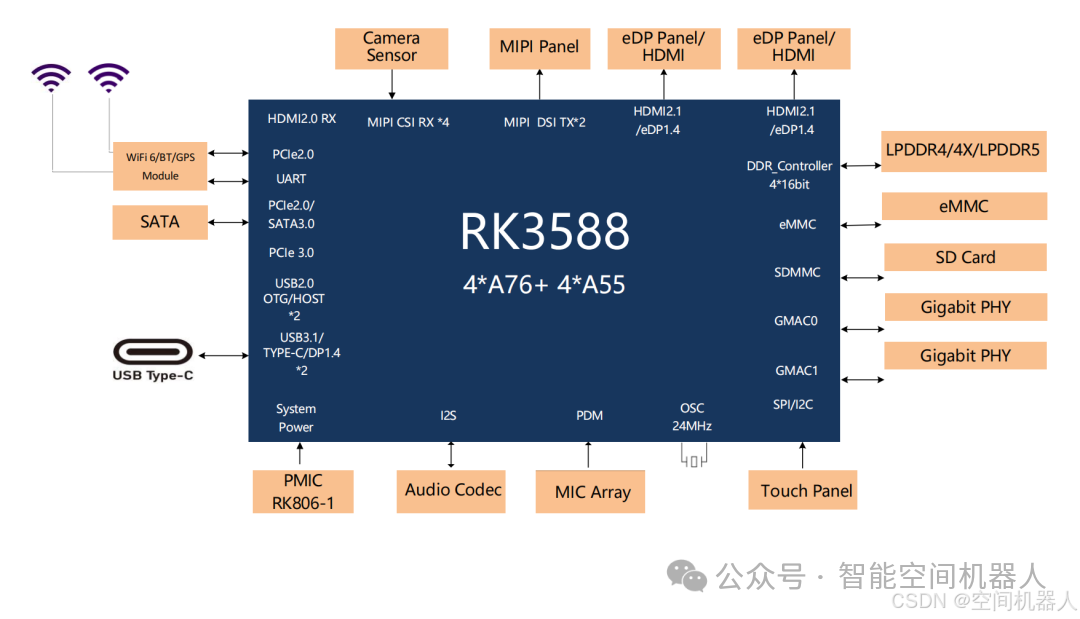
- Mali-G610 MC4 of RK3588 supports Vulkan, high graphics/computing capability, suitable for 3D rendering, GPU-accelerated inference (OpenCL / Vulkan Compute).
- RK3568 Mali-G52 is suitable for 2D/simple 3D UI, video post-processing (RGA/2D), etc.
- PowerVR of RK3368 performs adequately on older platforms, but differences in driver/ecosystem and open-source support may affect development convenience.
Recommendation: If you want to do Unity/Unreal/high-frame UI or GPU-accelerated inference, choose RK3588; if it’s just for ordinary HMI or video playback, RK3568 is completely sufficient.
4) NPU (Neural Network Accelerator)
-
RK3588: 6TOPS, supports multiple formats (INT4/INT8/INT16/FP16/BF16/TF32), which means:
- Can run larger models (detection + segmentation + tracking);
- Supports higher precision training/inference; also supports low-precision quantization for higher throughput.
-
RK3568: around 1TOPS, suitable for lightweight face/pose/classification tasks.
-
RK3368: basically no NPU, relies on CPU/GPU or external accelerators.
Key Points:
- Prioritize RK3588 for multi-model/multi-camera real-time inference.
- Use RKNN / ONNX and other runtimes on RK3588, it is recommended to do INT8 or INT4 quantization first to improve throughput and reduce memory usage.
- For RK3568, try to use lightweight models (MobileNet, Tiny-YOLO, ShuffleNet, etc.) and quantize to INT8.
 5) Multimedia and Video Stream Bandwidth (Practical Calculation)
When designing video, estimating memory bandwidth/total traffic is crucial. Common calculations (using YUV420 — 1.5 bytes/pixel as an example):
- 8K (7680×4320) @ 60 fps: Frame byte count = 7680 × 4320 × 1.5 = 2,985,984,000 bytes/sec ≈ 2.78 GB/s (continuous stream).
- 4K (3840×2160) @ 60 fps: = 3840 × 2160 × 1.5 = 746,496,000 bytes/sec ≈ 0.695 GB/s.
(The above calculation results are for raw frame-by-frame YUV data memory bandwidth, excluding compression/decoding overhead or DMA/cache efficiency losses.)
Tip:
- RK3588 can handle multiple 4K/8K data streams, but ensure DDR bandwidth and VPU/ISP DMA pipeline design are reasonable.
- Using hardware encoders/decoders (VPU, VPU MPP) can significantly reduce CPU load and memory copies. Prefer zero-copy (V4L2/dmabuf) pipelines.
6) Camera / ISP and Multi-Camera Input
- RK3588: Supports high pixel ISP (48MP / 32MP parameters may vary slightly in different materials), can connect multiple MIPI CSI-2 (e.g., 4×4lane, or 4×2lane + 2×4lane mixed), supports HDR/3DNR.
- RK3568: 8MP ISP, suitable for single/dual camera industrial and in-vehicle scenarios.
- RK3368: Built-in 8M ISP, suitable for early set-top box and smart screen cameras.
Note:
- When designing MIPI PCB, pay attention to differential line length matching (<< 1/10 wavelength), impedance control (≈ 100Ω differential), ground return, and EMI.
- Multi-camera systems need to consider CSI-2 routers or bridges (CSI mux / CSI aggregator) and evaluate whether the chip’s DPHY bandwidth is sufficient.
7) Peripherals and Expansion (PCIe/USB/SATA/Net)
- RK3588: PCIe3.0, USB3.1/Type-C, SATA3.0, Gigabit Ethernet (multiple ports) — suitable for expanding NVMe, external AI cards, multi-port NVR.
- RK3568: Rich interfaces such as PCIe3.0 / SATA3 & USB3.0, very friendly for industrial scenarios (SATA RAID/NAS, USB peripherals, multiple Ethernet ports).
- RK3368: Basic interfaces, suitable for devices that only need 1–2 peripherals.
Recommendation:
- If the system needs to connect NVMe or PCIe SSD, prioritize RK3588 (better bandwidth and control).
- RK3568 can be used for industrial NAS (multiple SATA) or multi-port routers.
8) Software Ecosystem and Acceleration Libraries (Practical Tools)
Common and practical acceleration/middleware (common on Rockchip platform):
- MPP (Media Processing Platform): Rockchip’s video encoding/decoding/post-processing middleware, recommended for zero-copy video pipelines (V4L2 + dmabuf).
- RGA (Raster Graphic Accel): 2D hardware acceleration (scaling, rotation, color space conversion), greatly reduces CPU copying and memory bandwidth.
- VDPU/VPU Drivers: Hardware decoding/encoding interfaces, must use kernel driver + userspace mpp.
- RKNN / RKDNN / ONNX Runtime: NPU inference runtime (RK3588 supports multiple precisions).
- OpenGL/Vulkan / OpenCL: GPU computing or rendering.
Recommendation: Prefer using vendor-provided hardware acceleration libraries (MPP, RGA, VPU), and follow the dmabuf pipeline to avoid memory copying bottlenecks.
9) Thermal Design, EMC, Power Supply (Hardware Implementation Key Points)
- Cooling: The high-performance SoC (RK3588) at 8nm will still generate significant heat, design heat dissipation copper columns, heat sinks, and appropriate thermal silicone; for in-vehicle or enclosed chassis, leave airflow or active fans.
- Power Domain: Core power, GPU, and power management require stable and low-noise PMIC; important power rails (DRAM VDD/VDDQ, SoC core) should have reasonable power-up sequence and soft start.
- Decoupling/Bypass: Place sufficient capacitors around the SoC to ensure power integrity (PDN simulation is recommended if conditions allow).
- EMC/Signal Integrity: High-speed differential (MIPI/PCIe/USB) routing length matching, impedance control, and ground plane continuity.
10) Selection Recommendations (by Scenario)
- Multi-channel 4K/8K + Real-time AI Inference (NVR, Smart Traffic, XR) → RK3588.
- Industrial Edge Gateway / In-vehicle Central Control / Multi-interface Devices (SATA, PCIe, Dual Gigabit) → RK3568.
- Low-cost Smart Screen, Set-top Box, Smart Appliances (only need 1080p) → RK3368.
 3. Deployment and Performance Tuning Checklist (Engineer Practical Steps)
- First, do bandwidth budgeting: Add the bandwidth of video streams, memory read/write, model loading, and UI rendering (using the above YUV420 formula) and leave a 20–30% margin.
- Prioritize using hardware acceleration: VPU decoding + RGA for color space conversion/scaling; avoid CPU processing large frame data.
- Use dmabuf zero-copy: V4L2 → dmabuf → DRM/KMS display, reducing memory copies.
- Model Quantization: Prioritize INT8/INT4 quantization on RK3588, saving both computing power and memory.
- Affinity and QoS: Bind critical threads to performance cores, set cgroups/IRQ priorities to ensure real-time performance.
- Thermal Strategy: Implement temperature monitoring and DVFS strategies to prevent long-term throttling from affecting business.
- Driver/Kernel Considerations: Enable DMA coherent, check IOMMU usage scenarios, and ensure scatter-gather support.
- Power/PMIC Verification: Verify power-up sequence, check surge current and steady-state voltage fluctuations.
- PCIe/PHY Testing: If using NVMe or camera bridge cards, perform link/train tests, eye diagram/jitter tests (if possible).
- Long-term Reliability: Conduct 72/168 hours of continuous benchmarking, thermal cycling, EMC testing, and ESD testing.
 4. Example Calculation (Bringing into Real Scenarios)
Scenario:4-channel 4K@30 YUV420 camera (stitching/detection) + UI rendering + small model inference
- Single 4K30 stream ≈ 3840×2160×30×1.5 ≈ 0.3475 GB/s
- 4 channels ≈ 1.39 GB/s (raw uncompressed)
- Adding rendering and model IO, assume total demand ~ 1.8~2.2 GB/s memory bandwidth.
- If the system enables hardware decoding + dmabuf + RGA, the actual memory bandwidth can be reduced (due to DMA to VPU/ISP, reducing CPU copies).
Conclusion:RK3588’s DDR bandwidth, NPU, and VPU combination can meet this scenario; RK3568 may not reach or can only work under the premise of compression/frame dropping/reducing the number of cameras.
5. Common Misconceptions and Points to Note
- Misconception: Is NPU TOPS the same as actual inference speed?Not entirely. TOPS is a theoretical peak value, actual speed is affected by memory bandwidth, data format, runtime implementation, and model structure.
- Misconception: Does GPU supporting Vulkan mean all inference can be offloaded to the GPU?Vulkan Compute can be used for some inference, but requires additional porting and optimization work, and efficiency may not necessarily be better than NPU.
- Note: AV1 decoding hardware support and software support are not synchronized, confirm whether the SDK/VPU driver has supported the target format (especially hardware decoding of AV1).
6. Conclusion
- If your project focuses on AI + multiple video streams online simultaneously, from a long-term maintenance and functional evolution perspective, RK3588 offers the highest return on investment.
- If you need rich external interfaces (SATA, PCIe, multiple Ethernet ports) and industrial-grade stability, prioritize RK3568, which has the best cost/power consumption and interface balance.
- If budget constraints are very strong and only basic video/Android experience is needed, RK3368 can still suffice.
✅ Recommendations
| Application Scenario | Recommended Model | Recommended Reason (Engineering Perspective) |
|---|---|---|
| Smart Rearview Mirror / 360 Surround View / DMS/OMS In-Vehicle Vision | RK3588 | 8K ISP + multi-channel MIPI + strong video encoding/decoding + 6TOPS AI + PCIe expansion, currently the strongest domestic edge vision platform |
| Mid-range Smart Cockpit (Instrument + Central Control Screen + Vehicle Control Logic) | RK3568 | High maturity, low power consumption, rich interfaces (multi-screen, strong IO), easy board-level wiring, cost-effective |
| T-Box / IoT / Low to Medium Pixel Camera / Lightweight AI Terminal | RK3568 | 1TOPS NPU + A55 performance is sufficient, good power consumption, cheap peripherals |
| High-definition Media Player / TV Box | RK3368 (old but cheap) | Very low cost, sufficient 4K decoding capability |
| Edge AI Server / Industrial AI Gateway | RK3588 | 6TOPS + PCIe3.0 x4, can connect high-speed NVMe, acceleration cards, camera arrays |
| High-end Android Tablet / 8K Decoding Terminal / AI Smart Machine | RK3588 | Strong GPU, experience close to lightweight flagship tablet |
🔥 Core Differences Summary (Key Points for Engineers)
① Performance (CPU/GPU/NPU) differences are huge
RK3588 >>> RK3568 >> RK3368
| Metric | RK3588 | RK3568 | RK3368 |
|---|---|---|---|
| CPU | 4A76 + 4A55 | 4*A55 | 8*A53 |
| GPU | Mali-G610 (Mid-range) | Mali-G52 (Entry-level) | PowerVR (Old) |
| NPU | 6TOPS | 1TOPS | No |
| AI Applications | Multi-camera, CV, Transformer edge inference | Face recognition/light CNN | Basically unsuitable |
📌
- RK3588 can run YOLOv8, MobileSAM, lightweight LLM, etc.
- RK3568 can only do face access control, gesture recognition, lightweight DMS.
- RK3368 is not recommended for AI.
② Video & Camera Capability Differences are Huge (Must Consider for Vision)
| Item | RK3588 | RK3568 | RK3368 |
|---|---|---|---|
| Encoding | 8K30 | 1080p60 | 1080p |
| Decoding | 8K60 | 4K60 | 4K60 (but old solution) |
| ISP | 48MP | 8MP | 8MP |
| Camera Pixels | Multi-channel high pixels | 1~2 channels medium pixels | 1 channel |
📌 :
🔸 For 360 surround view / DMS / OMS / front view cameras → Must use RK3588🔸 RK3568 ISP only has 8MP, in-vehicle shooting effect is average🔸 RK3368 ISP is too old, only suitable for home IPC
③ High-speed Interfaces (Core for In-Vehicle)
| Interface Capability | RK3588 | RK3568 | RK3368 |
|---|---|---|---|
| PCIe | PCIe 3.0/2.0 | PCIe 3.0/2.1 | No |
| SATA | ✔ | ✔ | ✔ (few) |
| Type-C | ✔ | ✔ | ✘ |
| USB3.x | 3.1 | 3.0 | 2.0 |
| Ethernet | Gigabit | Gigabit + QSGMII | 100M level |
📌
- RK3588 = True High Expandability, can connect:→ NVMe SSD→ GMSL/FPD-Link cameras→ FPGA→ AI acceleration cards
- RK3568 IO is very strong: Suitable for making instruments, access control, T-BOX, industrial control
- RK3368 is no longer suitable for complex IO systems
🧠 Selection Guide for Different Groups
🎥 1. Engineers working on Vision Algorithms/ADAS
Strongly recommended 👉 RK3588
Why?
- Strong ISP (48MP)
- Strong NPU (6TOPS)
- Multi-channel MIPI (sufficient for 360, DMS, OMS)
- 8K input/output (easy debugging)
- PCIe can connect high-speed vision links (GMSL)
Compatible with your previous debugging methods using CV22 / CV3 / Orin.
🧩 2. For Smart Cockpit / Central Control Screen / Vehicle Control Domain
Recommended 👉 RK3568
Why?
- Graphics performance is sufficient (G52)
- Multi-screen display
- Very low power consumption, not easy to heat (saves cooling)
- High maturity, mature peripheral solutions
- Board design is much simpler (easier than RK3588)
📡 3. Communication Gateway / T-Box / IoT
Recommended 👉 RK3568
Reason:
- Low power consumption
- Very rich peripherals (SATA, PCIe, USB, GMAC)
- 1TOPS is sufficient for AI assistance (license plate recognition, face recognition)
📺 4. TV Box / Customer Low-Cost Solutions
Recommended 👉 RK3368
Reason:
- Cheapest
- Can play 4K
- Low power consumption
But not suitable for high-performance applications.
👉 Final “Selection” Checklist
| Your Needs | Recommended Choice |
|---|---|
| Need to run AI + multiple cameras | 👉 RK3588 |
| Need to make smart cockpit (mid-range) | 👉 RK3568 |
| Need to make T-Box / Industrial Gateway | 👉 RK3568 |
| Need to make 8K video terminal | 👉 RK3588 |
| Need to make low-cost player | 👉 RK3368 |
| Need to make high-performance vision + external acceleration card | 👉 RK3588 |
| Need to make in-vehicle DMS/OMS | 👉 RK3588 (strongly recommended) |