In the rapidly developing field of liquid cooling technology, the “cold plate” is no longer the only solution. When faced with AI chips and power modules that can generate hundreds of watts, or even kilowatts of heat density, traditional cooling solutions are becoming inadequate. The challenge of how to “precisely extract” heat from the core hot spot of the chip has become a key goal for thermal management engineers.
Two liquid cooling companies, JetCool and ZutaCore, have chosen completely different technical paths: the former achieves single-phase cooling that “directly hits the heat source” through micro-jets, while the latter relies on the cooling liquid to directly evaporate on the chip surface for phase change heat dissipation. These two cooling philosophies, one pursuing local extremes and the other striving for system balance, are driving the evolution of “cold plate liquid cooling” to a higher form.
01|Why do we need “chip-level liquid cooling”?
As chip processes approach physical limits, power consumption per unit area continues to rise. In scenarios such as AI, HPC, and high-end servers, traditional air cooling and cold plate liquid cooling solutions often find themselves “unable to keep up” when faced with hot spots. Especially at heat flux densities above 1kW/cm², any additional thermal resistance can lead to frequency throttling, reduced lifespan, or even thermal failure of the chip.
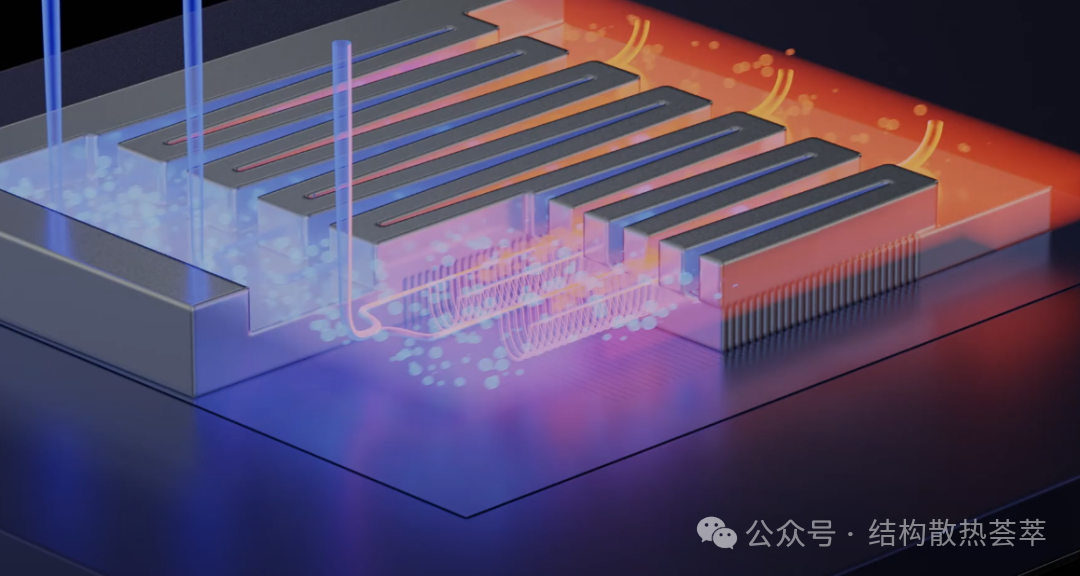
At this point, the demand for chip-level liquid cooling arises: (1) to be as close to the heat source as possible, shortening the heat flow path; (2) to improve the heat transfer efficiency of the cooling liquid, pursuing extremely low thermal resistance; (3) to allow for localized control to address different thermal distributions within the chip. JetCool and ZutaCore have provided “extreme solutions” for these three points.
02|JetCool: Single-Phase Micro-Convection Technology Based on Micro-Jet Arrays
The core concept of JetCool is Microconvective Cooling. Its cooling module consists of a metal plate densely packed with micro-nozzles, which can precisely spray the cooling liquid at high speed to the hottest areas of the chip surface, quickly removing heat.
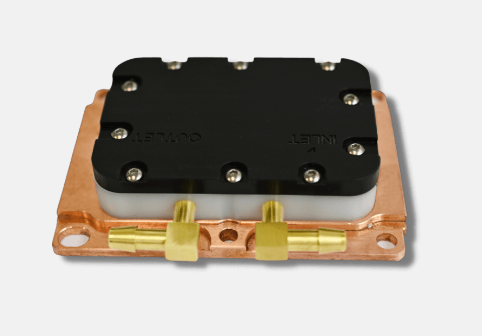
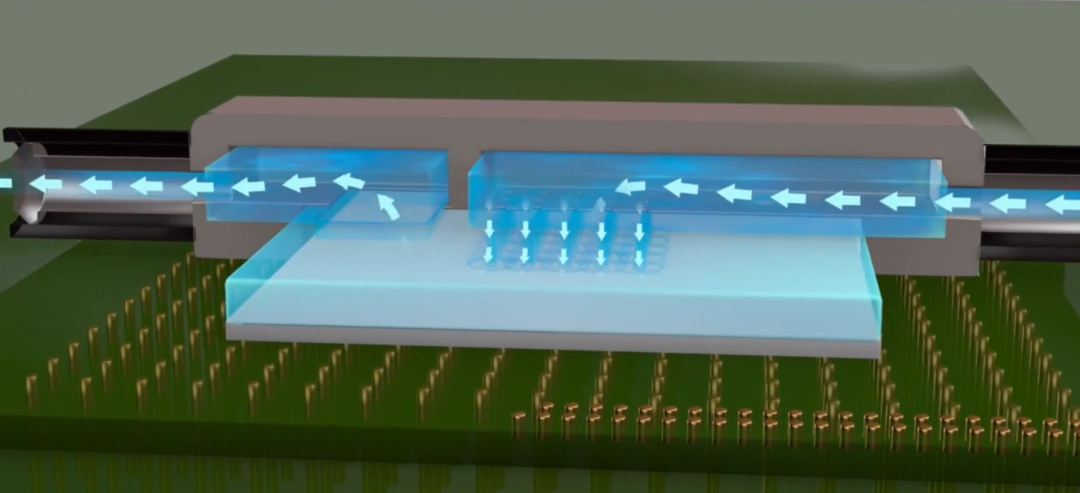
This technology was developed at the MIT Lincoln Laboratory, providing low-energy, high-performance cooling solutions that reduce carbon emissions for data center servers and high-performance computing devices.
Technical Features:
-
Extremely low thermal resistance: The nozzles reach directly to the chip’s heat source, achieving thermal resistance as low as 0.1 K/W;
-
Fast response: Spray speed is adjustable to adapt to load changes;
-
No phase change: Avoids the complexities of gas-liquid coexistence, making the single-phase system more stable;
-
High manufacturing precision required: Micro-nozzle arrays must be processed using MEMS or laser techniques.
Typical applications of JetCool include:
-
Extreme heat density devices such as AI chips and GPUs;
-
Products with significant local hot spots, such as lasers and 5G power amplifiers;
-
Scenarios requiring extremely high thermal control response times, such as edge deployments in data centers.
03|ZutaCore: Closed Two-Phase Cooling Evaporation Solution
ZutaCore takes a completely different path—two-phase evaporative cooling. Its core product is HyperCool®, a direct chip, non-water two-phase liquid cooling technology. This technology effectively removes the large amounts of heat generated by processors through efficient boiling and condensation processes.
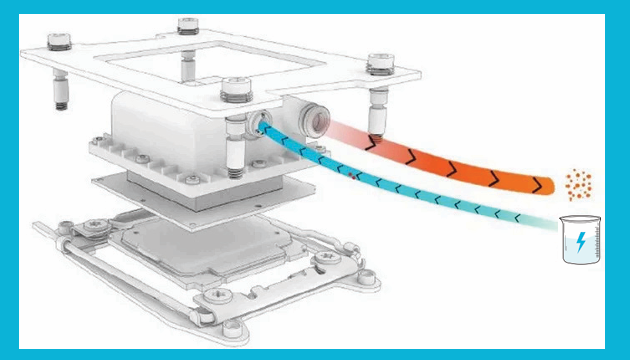
In this solution, the cooling liquid is directly fed into the cooling module through pipes, forming an “evaporation zone” at the chip contact interface. The heat causes the cooling liquid to boil, and the phase change carries away a large amount of heat, after which the vapor is cooled back to liquid in the condenser and recirculated.
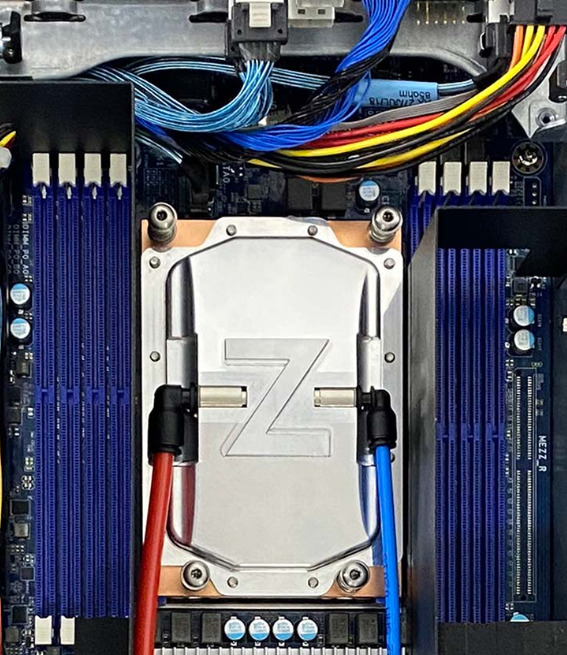
Technical Features:
-
Utilizes latent heat exchange: The latent heat of vaporization is much greater than the specific heat of the liquid, allowing for higher heat transfer densities;
-
Extremely low thermal resistance: The evaporation process occurs at the chip surface, resulting in almost no thermal resistance;
-
High system integration: ZutaCore provides a complete closed-loop system, including condenser, pump, controller, etc.;
-
Uses environmentally friendly low-boiling cooling liquids (such as Novec or self-developed fluids);
-
Compatible with standard server motherboards, friendly for deployment.
Typical applications of ZutaCore include:
-
High-density data center cluster deployments;
-
AI training platforms, HPC nodes;
-
Liquid cooling upgrade solutions for enterprise-level and large-scale cloud computing platforms.
04|Technical Comparison
| Comparison Dimension | JetCool | ZutaCore |
|---|---|---|
| Cooling Mechanism | Micro-jet cooling, single-phase flow | Evaporative cooling, two-phase flow |
| Thermal Resistance Performance | Extremely low (local) | Extremely low (system level) |
| Maintainability | Medium, requires custom components | High, modular standardized deployment |
| Manufacturing Process | High-precision micro-nozzle processing | Conventional machining and sealing control |
| Deployment Adaptability | More suitable for customized scenarios | More suitable for standardized large-scale deployment |
| Cost Structure | High cost of precision components | High cost of system integration |
| Control System Complexity | Low (single-phase stability) | Medium-high (requires control of phase change and pressure) |
The future of liquid cooling philosophy merges JetCool and ZutaCore, representing two technical directions: single-phase extreme cooling and two-phase system-level cooling. One emphasizes micro-structural control and transient response, while the other is more suitable for system-level expansion and stable operation.
They do not replace each other but rather establish the technical boundaries for the next stage of liquid cooling. In the future, we may see more explorations of hybrid paths, such as composite heat exchange modules combining micro-spray and phase change, or collaborative designs of in-package two-phase cooling and system-level liquid cooling.
For engineers, understanding the core physical logic and engineering boundaries of each liquid cooling path is a crucial step in decision-making for deployment solutions, assessing thermal design limits, and promoting technology implementation. We will invite liquid cooling technology companies, system integrators, and end-users to discuss the latest developments and future trends in this field at the upcoming “2025 Liquid Cooling Industry Innovation and Application Forum.” Please pay attention to the detailed agenda and registration information for the conference, and witness the next revolution in liquid cooling technology.
Join the Liquid Cooling Industry Chain Group by scanning to joinOnly for R&D personnel in the data center/server/chip liquid cooling industry, please add the group administrator’s WeChat at the bottom.1. “Data Center Liquid Cooling Technology Group”For data center service providers, data center operation companies, liquid cooling system suppliers, and technical personnel from related component companies, add the group keyword “data center”2. “Server Liquid Cooling Technology Exchange Group”For data center companies, server companies, liquid cooling system suppliers, and technical personnel from related component companies, add the group keyword “server”3. “Chip Cooling Technology Exchange Group”For data center companies, server companies, chip companies, liquid cooling system suppliers, and technical personnel from related component companies, add the group keyword “chip”
When adding the staff below as friends, please send a verification request according to the format below:
Company Name+Name+Data Center. For example, Huawei Qian Sanqiang Data Center , this makes it easier for us to add you to various professional groups. Group additions are unified every Saturday.
When adding the staff below as friends, please send a verification request according to the format above