Research on Learning Ability Evaluation Model Based on AHP-Entropy Weight Method-TOPSIS
1. Main Functions and Objectives
This study aims to construct a comprehensive learning ability evaluation model.
- Function: Quantitative assessment and ranking of learning ability levels for multiple evaluation objects (such as students, courses, educational institutions).
- Objective: To overcome the limitations of single weighting methods by combining the subjective experience of decision-makers (AHP) with the objective laws of the data itself (Entropy Weight Method), resulting in more scientifically reasonable indicator weights, and using the TOPSIS method to accurately reflect the proximity of each evaluation object to the ideal state, thus obtaining fair, just, and credible evaluation results.
2. Logical Connections
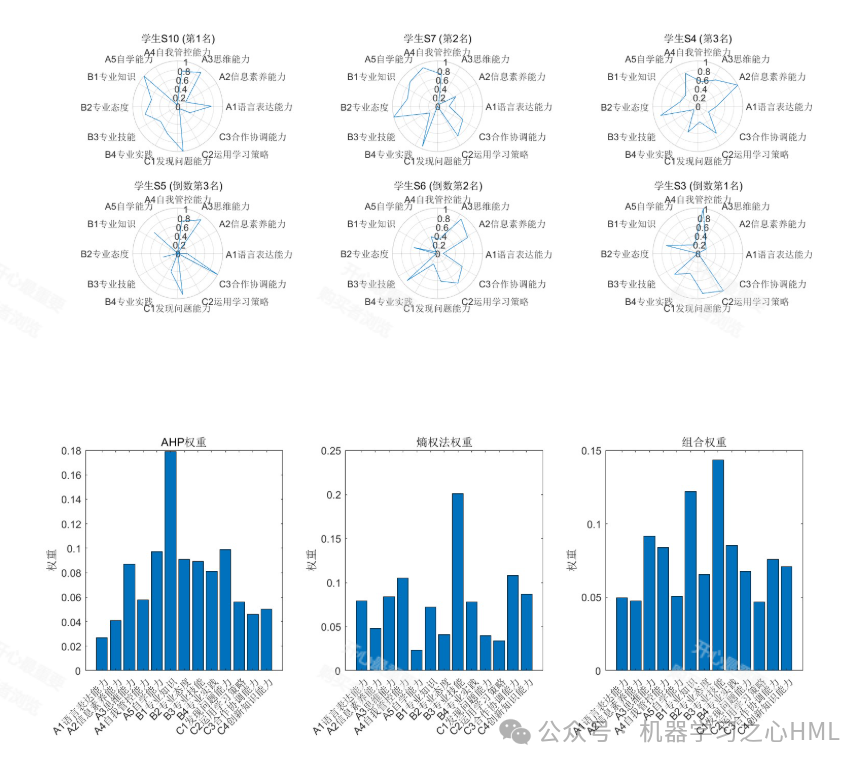
- Connection between AHP and Entropy Weight Method: Both methods calculate weights from subjective and objective perspectives, forming comprehensive weights through linear combinations (commonly weighted averages), taking into account decision intentions and data information.
- Connection between Weighting Method and TOPSIS: The comprehensive weights calculated by the AHP-Entropy Weight Method serve as the basic input for the TOPSIS algorithm. TOPSIS uses these weights to construct a weighted evaluation matrix for precise ranking.
3. Detailed Algorithm Steps
Phase One: Constructing the Evaluation Index System
- Establishing Objectives: Clarifying the specific connotation of “learning ability”.
- Selecting Indicators: Screening multi-level and multi-faceted indicators from literature and expert opinions. For example:
- Primary Indicators: Academic Performance (B1), Innovation Ability (B2), Information Literacy (B3), Collaboration Ability (B4)
- Secondary Indicators: Under B1, indicators such as “Average GPA” and “Knowledge Mastery” can be set.
Phase Two: Weight Combination Calculation (AHP + Entropy Weight Method)
Part A: AHP Method for Subjective Weight <span>ω_s</span>
- Constructing the Judgment Matrix: Invite experts to compare indicators at the same level pairwise (using the 1-9 scale method).
- Calculating the Weight Vector: Use the eigenvalue method (or geometric mean method, root method) to calculate the weights of each judgment matrix.
- Consistency Check: Calculate the consistency ratio
<span>CR</span>. If<span>CR < 0.1</span>, it passes the check; otherwise, the judgment matrix needs to be adjusted.
Part B: Entropy Weight Method for Objective Weight <span>ω_o</span>
- Data Normalization: Assume there are m evaluation objects and n indicators, forming the original data matrix
<span>X = (x_{ij})_{m×n}</span>. To eliminate dimensions, perform normalization and standardization to obtain the matrix<span>P = (p_{ij})_{m×n}</span>.
- Common Normalization: (for positive indicators)
<span>e_j</span>: (where, assuming when, )<span>g_j</span>:<span>g_j = 1 - e_j</span> (the smaller the entropy value, the larger the coefficient of variation, indicating the greater importance of the indicator)<span>ω_o</span>:Part C: Calculating Comprehensive Weight <span>W</span> using linear weighting to combine subjective and objective weights: where <span>α</span> and <span>β</span> are preference coefficients, and <span>α + β = 1</span>. Typically, to balance subjective and objective, set <span>α = β = 0.5</span>.
Phase Three: Comprehensive Evaluation Using TOPSIS
- Constructing the Weighted Normalized Matrix
<span>V</span>: - Determining the Positive Ideal Solution
<span>V⁺</span>and Negative Ideal Solution<span>V⁻</span>:
<span>V⁺</span>= ( max(v_i1), max(v_i2), …, max(v_in) )<span>V⁻</span>= ( min(v_i1), min(v_i2), …, min(v_in) )
<span>D⁺</span> and <span>D⁻</span>:<span>C_i</span>: (<span>0 ≤ C_i ≤ 1</span>, the closer <span>C_i</span> is to 1, the stronger the learning ability of the object)<span>C_i</span> from largest to smallest to obtain the order of learning ability among all evaluation objects.4. Parameter Settings and Data Processing
- AHP Parameters: 1-9 scale values, consistency check threshold
<span>CR<0.1</span>. - Entropy Weight Method Parameters: Normalization methods (range normalization, Z-score, etc.),
<span>k=1/ln(m)</span>. - Combined Weight Parameters: Subjective preference coefficient
<span>α</span>and objective preference coefficient<span>β</span>. - TOPSIS Parameters: Distance calculation method (commonly Euclidean distance).
- Data Processing: The key is normalization of indicators, which must unify dimensions and directions (transforming all indicators into maximized indicators).
Summary and Advantages
- Scientificity: Integrates the advantages of both subjective and objective weighting, resulting in more reasonable weight settings.
- Systematicness: Combines multiple indicators into a single overall score, facilitating comparison.
- Intuitiveness: The concept of “relative closeness” in the TOPSIS method is clear, and the results are easy to understand and explain.
- Universality: This model is not only applicable to learning ability evaluation but can also be widely used in various comprehensive evaluation problems, such as teaching quality assessment, employee performance evaluation, investment project selection, etc.
Code Acquisition
Code acquisition (non-public, please do not disturb)