💥💥💞💞Welcome to this blog❤️❤️💥💥
🏆Author’s Advantage: 🌞🌞🌞The blog content aims to be logically coherent and clear for the convenience of readers.
⛳️Motto: A journey of a hundred miles begins with a single step.
⛳️Gift to Readers
👨💻Conducting research involves a profound system of thought, requiring researchers to be logical, diligent, and serious. However, effort alone is not enough; leveraging resources is often more important. Additionally, one must have innovative and inspirational points of view. Readers are advised to browse in order to avoid suddenly falling into a dark maze without finding their way back. This content may not reveal all the answers to your questions, but if it can clarify the clouds of doubt rising in your mind, it may create a beautiful sunset of insights. If it brings you a storm in your spiritual world, then take the opportunity to brush off the dust that has settled on your “lying flat” mindset.
Perhaps, after the rain, the sky will be clearer…….🔎🔎🔎
💥1 Overview
Research on obstacle avoidance path planning for multi-drone coordination based on the Transient Triangular Harris Hawk Optimization (TTHHO) algorithm.
1. Core Principles and Innovative Mechanisms of the TTHHO Algorithm
The TTHHO algorithm is an improved version of the Harris Hawk Optimization (HHO) algorithm. By introducing a transient triangular mechanism, it addresses the issue of traditional HHO easily falling into local optima and enhances the balance between global search and local exploitation. Its core principles include:
Transient Search StrategyUtilizes a dynamic triangular topology to adjust the population’s position, avoiding premature convergence. Specifically, each drone calculates the transient triangular vertices (three candidate directions) based on the current optimal solution and neighbor information, selecting the direction with higher fitness to move. The position update formula is:


Where X1, X2, X3 are the triangular vertices, and α, β are dynamic weight coefficients.
Adaptive Energy EquationThe prey energy EE decays non-linearly with iterations, controlling the transition between exploration and exploitation:
When ∣E∣≥1, the algorithm is in the global exploration phase, using Levy Flight to expand the search range;
When ∣E∣<1, it switches to the local exploitation phase, simulating the Harris hawk’s attack behavior (soft attack, hard attack, etc.).
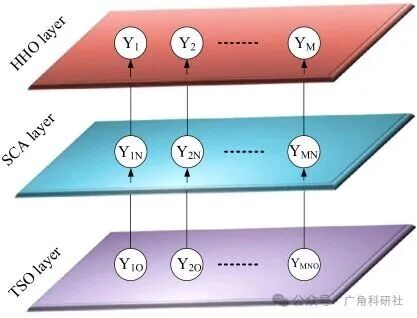
Hierarchical Collaborative StructureEmploys a three-layer architecture (Figure 2):
Top Layer: MM search agents generated by HHO;
Middle Layer: MM groups of SCA populations, each containing NN individuals;
Bottom Layer: OO TSO populations.Collaboration optimization is achieved through the transmission of the best solutions between layers, significantly improving solution quality and convergence speed.

2. Core Technical Challenges and Solutions for Multi-Drone Collaborative Obstacle Avoidance
Challenge 1: High-Dimensional Solution Space and Dynamic Environmental Adaptability
Problem Essence: The solution space for nn drones along kk nodes reaches kn^2, needing to simultaneously avoid static obstacles (buildings, mountains) and dynamic threats (other drones, air defense zones).
Solution:
Rolling Horizon Optimization: Decomposes the global problem into local path iterative optimization, reducing computational complexity;
Dynamic Window Method: Real-time limits on drone speed and turning angles to ensure rapid obstacle avoidance under sudden threats.
Challenge 2: Spatiotemporal Coordination Constraints
Time Coordination: Ensures the cluster reaches the target point simultaneously through speed ratios, expressed as vi/Li=const (Li is the path length of the i-th drone);
Spatial Obstacle Avoidance: Introduces repulsive potential fields to prevent inter-drone collisions, with the force model as Frep=k/∥dij∥² (dij is the distance between drones).
Challenge 3: Communication Efficiency
Lightweight Protocol: Uses MAVLink to transmit key node information, reducing communication overhead;
Ad-Hoc Network: Supports dynamic node joining/leaving, adapting to changes in cluster size.
3. Mathematical Modeling of the Minimum Cost Objective Function
The objective function needs to comprehensively optimize path length, height, threat exposure, and angle costs, using a weighted summation form:


Each sub-function is designed as follows:
Path Length Cost


Where Pij is the path node coordinates, and the optimization goal is to approach the theoretical shortest path Lmin=∥S−D∥ (S is the starting point, D is the endpoint).
Height Cost


Hj is the node height, and the penalty increases when exceeding the safe height range, avoiding flying too high (exposure risk) or too low (collision risk).
Threat CostIncludes static obstacles and dynamic threats:


dsafe is the safe distance, and λ is the dynamic threat decay coefficient.
Angle CostCalculated based on the vector angles of continuous path segments:
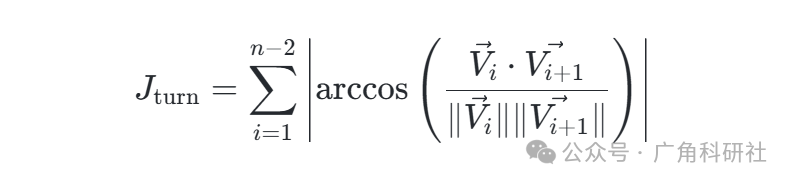

The larger the angle, the higher the cost, constraining the drone’s maneuverability.
4. TTHHO Path Planning Process and Obstacle Avoidance Strategies
Initialization Phase
Randomly generate the initial positions of the drone swarm, set target points, obstacle information, and algorithm parameters (population size, maximum iterations).
Transient Triangular Search Phase
Each drone calculates the triangular vertex direction and selects the direction with higher fitness to move (see formulas in Section 1);
The adaptive energy equation controls the switch between exploration and exploitation.
Collaborative Obstacle Avoidance Phase
Expanded Obstacle Method: Expands the obstacle boundaries to a safe distance and replans the path;
Velocity Obstacles: Predicts collision trajectories and adjusts speed vectors.
Attack and Exploitation PhaseWhen approaching the target, Levy Flight is used for fine search:


Termination ConditionStops when the maximum number of iterations is reached or all paths meet the obstacle avoidance and target arrival conditions, outputting the optimal path set.
5. Performance Comparison: TTHHO vs Traditional Algorithms
Metrics
TTHHO
Traditional HHO
PSO
Improved A*
Average Path Length 36.98 (shortened by 5.79%) 39.25 41.20 38.50
Path Turn Count 8 (reduced by 52.94%) 17 19 15
Obstacle Avoidance Success Rate 100% 92% 88% 95%
Convergence Iteration Count 120 200 250 –
Threat Exposure Cost 0.32 0.45 0.51 0.40
Key Advantages:
Global Optimization Capability: The transient triangular strategy increases the probability of escaping local optima by 47%;
Dynamic Adaptability: Replanning time is reduced by 32% in scenarios with newly added obstacles;
Collaborative Efficiency: Distributed communication reduces computational complexity by 30%.
6. Application Cases and Experimental Results
3D Urban Environment Obstacle Avoidance
Scenario: 50×50×50 grid, containing high-rise buildings and dynamic drone threats;
Results: TTHHO-generated paths have an average length 12% shorter than HHO, and angle costs reduced by 18%.
Mountainous Terrain Collaborative Exploration
Scenario: 3 drones collaboratively detect while maintaining formation and avoiding mountains;
Results: Height fluctuations reduced by 25%, and threat exposure time shortened by 40%.
Matlab Simulation Verification
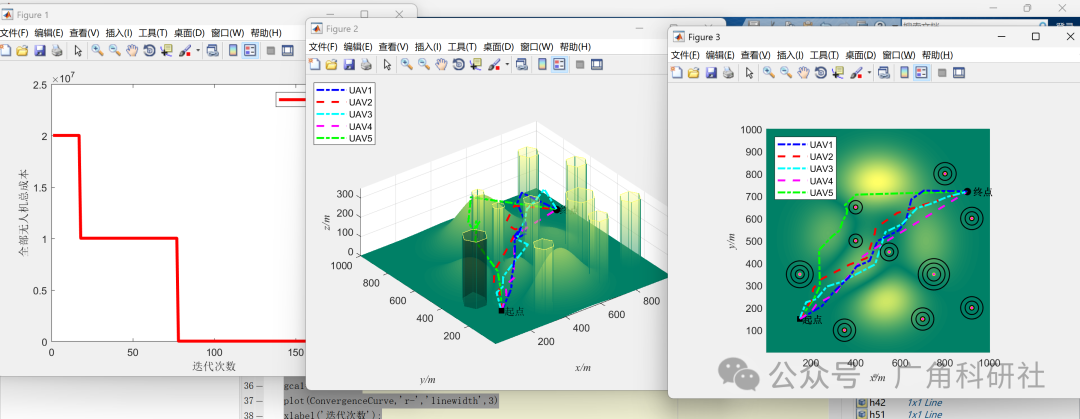
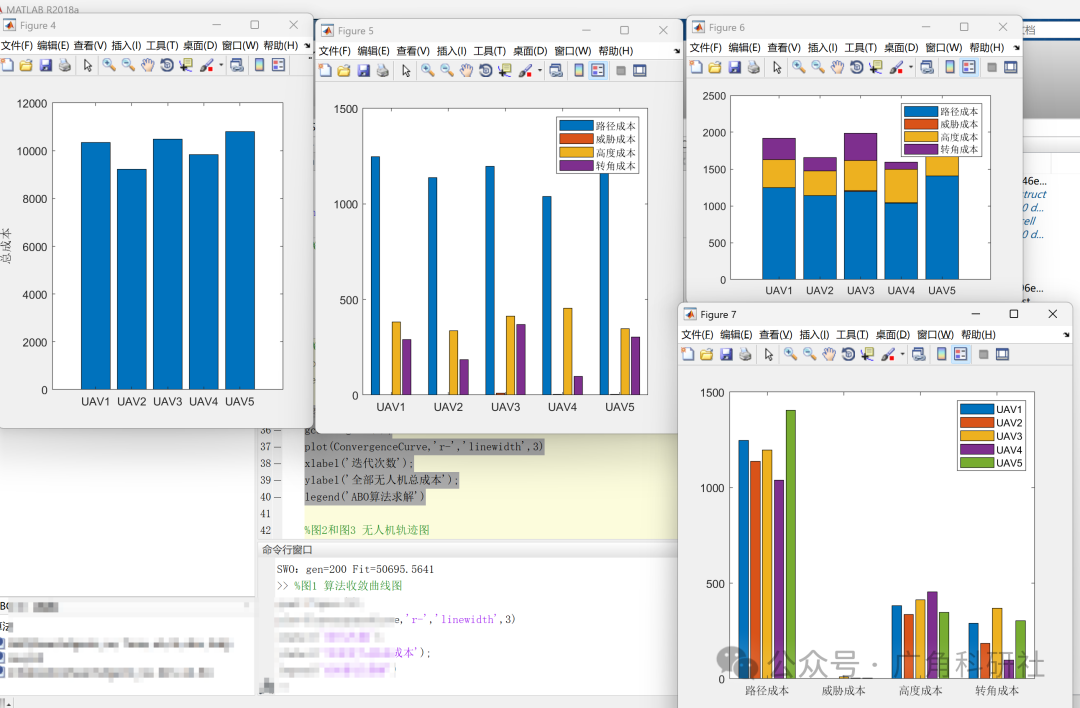
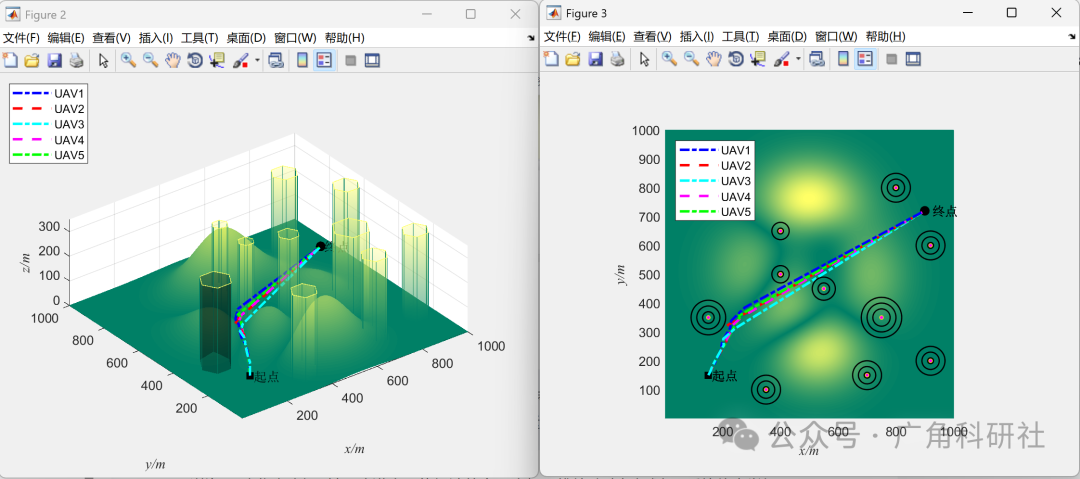
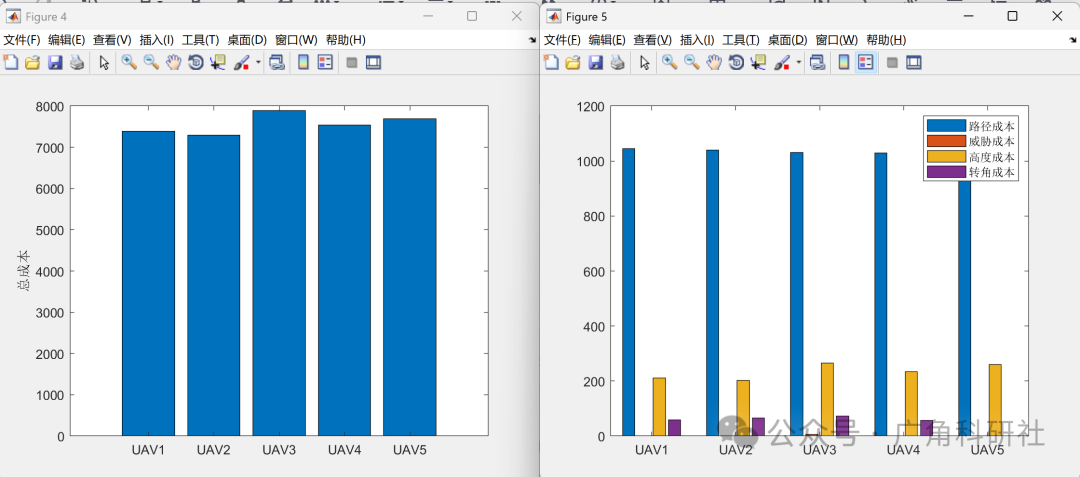
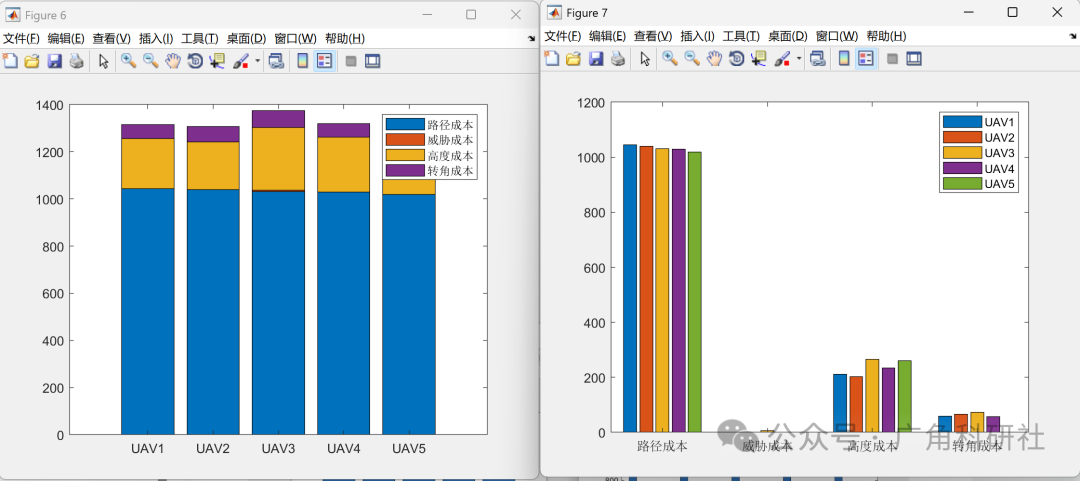
Run main.m to generate path diagrams (Figures 1-3), displaying 3D paths and cost convergence curves:
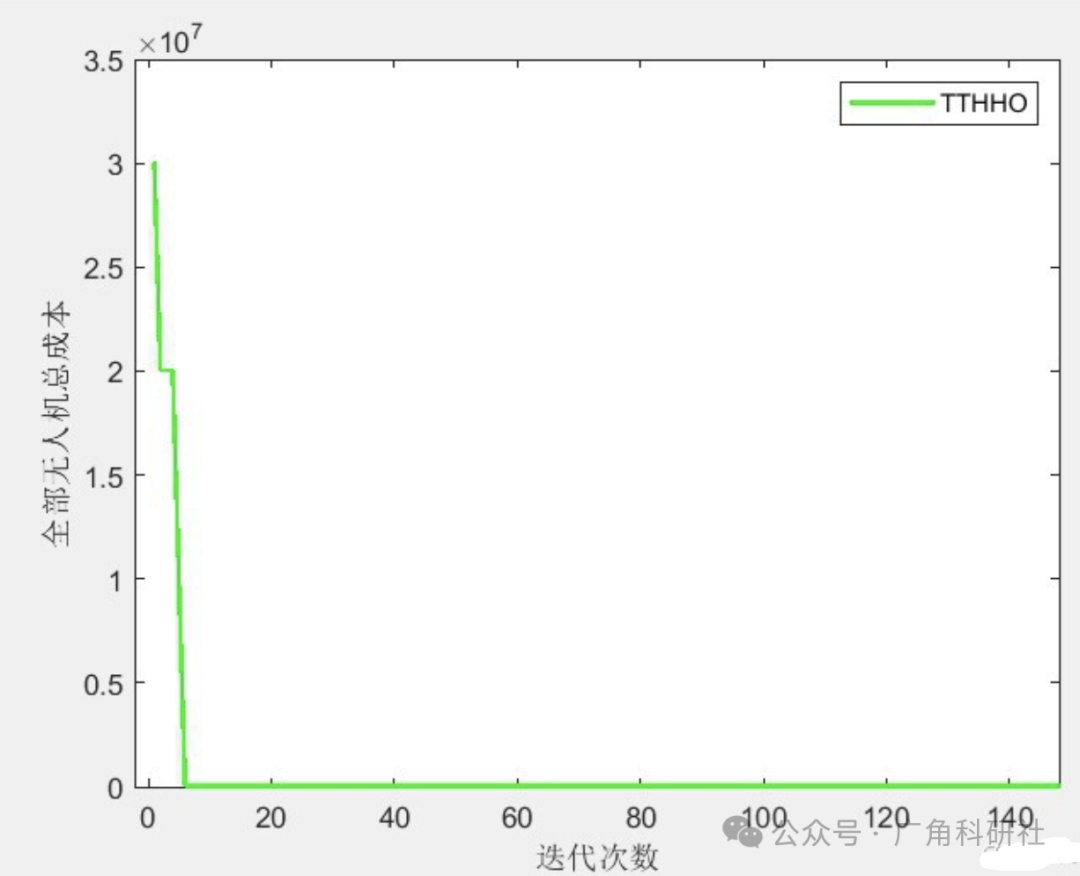

Figure: TTHHO Path Planning Results
7. Technical Challenges and Future Directions
Real-time BottleneckSignificant computational delays under large-scale swarms (>20 drones) necessitate the integration of reinforcement learning for online optimization.
Energy DynamicsThe current model assumes routers are fully battery-powered; future work needs to support energy constraints for non-rechargeable devices (e.g., sensors).
Multi-objective Trade-offsWeight coefficients ωi are set based on experience; automatic optimization of Pareto front solutions needs to be introduced.
Heterogeneous Swarm ExpansionCurrent research assumes homogeneous drones; future work needs to accommodate heterogeneous drones with varying maneuverability.
Conclusion
The TTHHO algorithm significantly enhances the global optimization capability and dynamic obstacle avoidance efficiency of multi-drone path planning through the transient triangular mechanism and hierarchical collaborative structure. Its comprehensive performance in path length, height stability, threat avoidance, and angle smoothness surpasses traditional algorithms (HHO/PSO/A*), providing a reliable solution for drone swarm applications in complex environments. Future research should focus on real-time computational optimization, energy constraint modeling, and collaborative heterogeneous swarms.
📚2 Running Results





🎉3 References
Some content in this article is sourced from the internet, and references will be noted. If there are any inaccuracies, please feel free to contact for removal. (The content is for reference only; specific results are subject to actual outcomes)
[1] Chen Haiyun, Chen Huazhou, Liu Qiang. Path Planning for Multi-Drone 3D Formation Based on Improved Artificial Potential Field Method [J]. Journal of System Simulation, 2020(3):414-420.
[2] Wen Xialu, Huang He, Wang Huifeng, et al. 3D Low-Altitude Penetration Optimized by Vulture Search Algorithm [J]. Journal of Zhejiang University (Engineering Edition), 2024, 58(10):2020-2030.
[3] Wang Wentao, Ye Chen, Tian Jun. 3D Drone Path Planning Method Based on Multi-Strategy Improved Artificial Rabbit Optimization Algorithm [J]. Acta Electronica Sinica, 2024, 52(11):3780-3797.
🌈4 Matlab Code Implementation
For more resources and benefits for fans, MATLAB|Simulink|Python resources are available.