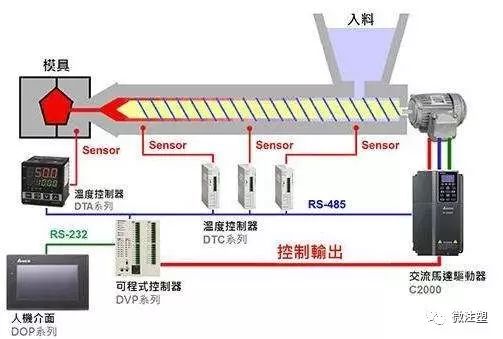
1. Basic Actions
1. The first injection of plastic is done at low speed, moving the nozzle away from the cold material head before increasing the second-stage injection speed to fill the mold cavity. This shortens the time for the plastic to flow to the end of the gate, maintaining the lowest viscosity of the plastic during filling to minimize solidification. However, controlling the correct pressure holding switch point during high-speed injection is difficult, so multi-stage deceleration must be utilized to effectively control and grasp the pressure holding switch point.
2. The principle of segmented injection action:
Utilizing electro-optical control to command the flow proportional valve in the hydraulic system to instantaneously obtain the injection speed at a specific position to achieve segmented injection speed.
2. The relationship between segmented injection speed and pressure:
1. In the segmented injection molding process, regardless of how many segments there are in the filling process, the injection pressure remains constant, while during the pressure holding phase, regardless of how many segments there are, the speed only needs to maintain one.
2. Examples of segmented injection:
(1) The same finished product can be molded using a smaller clamping force, thereby extending the lifespan of machines and molds;
(2) Mastering the correct pressure holding switch point through segmented deceleration can effectively ensure quality stability;
(3) When the flow of the molded plastic is too good, low-speed injection is used to prevent flash, but it must not allow the raw material to cool and solidify. After the molten resin passes through the thicker sections, the injection speed can be increased to quickly fill the mold cavity. Flow marks (which appear as streaks centered around the gate) are caused by the rapid cooling of the resin that first flows into the cavity and the boundary formed with the subsequent resin that flows in.
(4) In cases where the injection point (i.e., the gate) forms thicker sections, injecting too quickly can cause turbulence, and cold material may remain in the channel, forming flow marks. Therefore, low-speed, low-pressure injection should be used to push open the cold material head, allowing the plastic behind to enter smoothly.
(5) In injection molding processes, the nozzle contacts the mold, and due to the cooling water in the mold, the mold temperature is lower than that of the nozzle. Some heat is taken away by the mold, causing the nozzle to easily form a cold material head. These cold material heads injected into the mold can block the gate, causing flow lines or silver streaks. Using segmented injection can improve this issue.
(6) For precise small parts with fine gate sizes, balancing the gates of multiple cavities is extremely difficult. By making the gates the same size and utilizing multi-stage injection technology, this can be overcome.
(7) Changing the switching position between the first low-speed injection and the second high-speed injection can correct the local position of the weld line, moving it from a prominent location (such as a label area) to a less noticeable position.
Micro-injection molding organization, reposting requires citation; failure to cite will be considered infringement.
Feel free to share in your circle of friends, forwarding supports! You can share your thoughts on this article at the bottom by clicking “Write a message”!


——Still haven’t found a group? The micro-injection molding WeChat group is the largest injection molding WeChat group in China. Join quickly and chat with your friends! How to join: First, add the micro-injection editor as a friend (WeChat ID 6683014 Chen Lijun), send a message saying “Join group”