
Click the blue text above to follow us

📋📋📋 The contents of this article are as follows: 🎁🎁🎁
Contents
💥1 Overview
1.1 Analysis of the Principle of Energy Storage Assisting Grid Peak Shaving
1.2 System Peak Shaving Optimization Index Model
1.3 Energy Storage System Capacity Configuration Model
📚2 Operating Results
2.1 Mode Settings
2.2 New Energy Consumption Curve (Mode 1 – Mode 3)
2.3 Operating Results under Scenario 3
2.4 Energy Storage Configuration Results
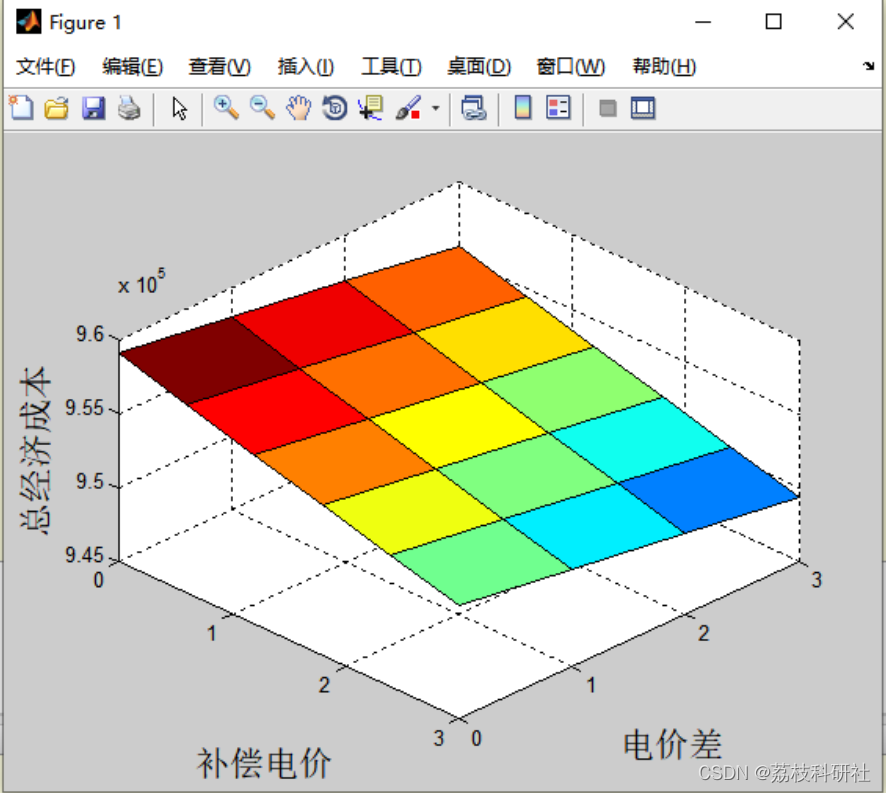
2.5 Two Sensitivity Analyses
🎉3 References
🌈4 Matlab Code, Data, Article Explanation



1 Overview
Source of Literature:

Abstract: Configuring energy storage systems is an effective means to reduce the peak load burden on units and increase the acceptance capacity of wind power. This article proposes a configuration scheme for energy storage assisting grid peak shaving. The outer model is an optimization configuration model, consisting of a multi-factor optimization model based on the net profit of the energy storage system, the improvement of the standard deviation of thermal power unit output, and the newly added wind power acceptance capacity. An iterative calculation method is used to obtain multi-factor indicators for all schemes within the configuration alternatives, selecting the optimal value as the configuration result of the energy storage system that balances technical and economic aspects. The indicators of the outer model rely on parameters output from the inner model for calculation, where the inner model is an optimization scheduling model that comprehensively considers the operating costs of the energy storage system, the operating costs of thermal power units, and the penalty costs for wind curtailment, aiming to minimize the system’s peak shaving operating costs, optimize the wind power acceptance capacity, and obtain the charging and discharging power of the energy storage system and the output of thermal power units. Finally, based on measured data from a local power grid, the effectiveness of the configuration scheme is verified, and the economic analysis of the energy storage system over its entire life cycle is conducted.
Keywords: Energy storage peak shaving; Deep peak shaving of thermal power; Configuration scheme; Scheduling strategy; Economic analysis;
 1.1 Analysis of the Principle of Energy Storage Assisting Grid Peak Shaving
Currently, the peak shaving situation of the power grid is that there is sufficient spinning reserve during peak load periods, but during low load periods, the downward adjustment flexibility of units is severely insufficient, leading to a large amount of wind curtailment. The basic principle of energy storage assisting thermal power unit peak shaving is shown in Figure 1.
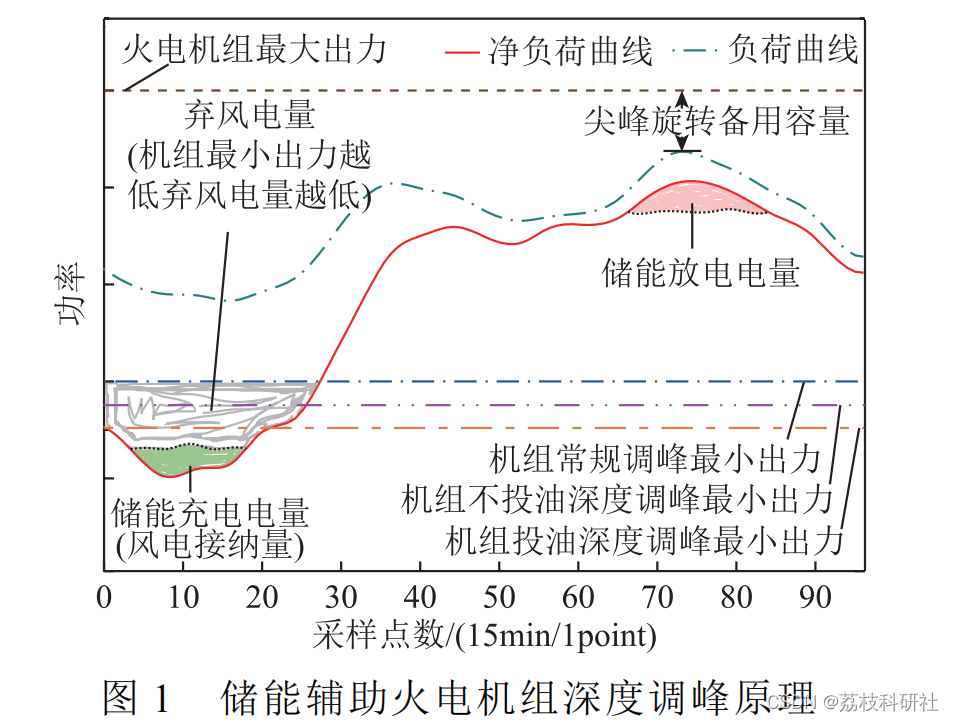
As shown in Figure 1, the deep peak shaving of energy storage assisting thermal power units can effectively alleviate the peak shaving pressure on the power grid and reduce wind curtailment. The peak shaving effect produced by the energy storage system mainly depends on its configuration scheme; the higher the configuration, the better the peak shaving effect, but the cost also increases significantly. The configuration of the energy storage system should balance economic indicators and technical indicators.
 1.2 System Peak Shaving Optimization Index Model
 1.3 Energy Storage System Capacity Configuration Model
For detailed mathematical models and explanations, see Section 4.
2 Operating Results
 2.1 Mode Settings
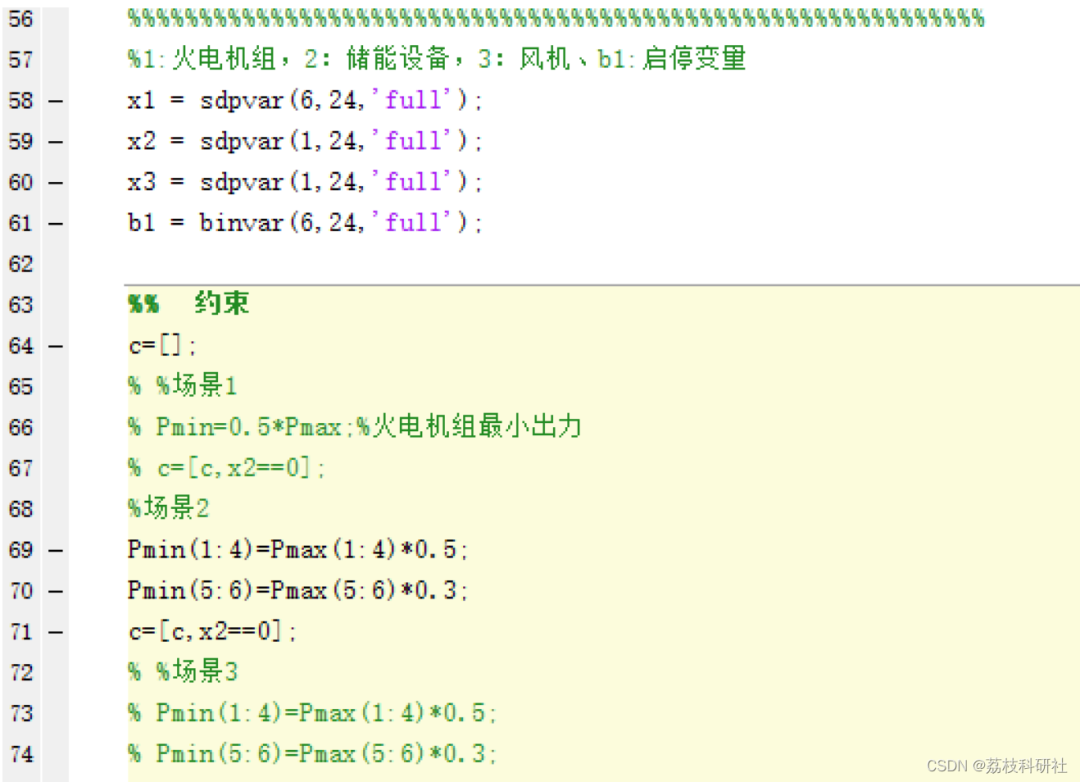
Basic Peak Shaving: 50% output, Pmin=0.5*Pmax
Deep Peak Shaving: 40% output, Pmin=0.4*Pmax, 600MW can perform deep peak shaving, 200-300 cannot (50% output). Oil injection, 30% output. Scenario settings
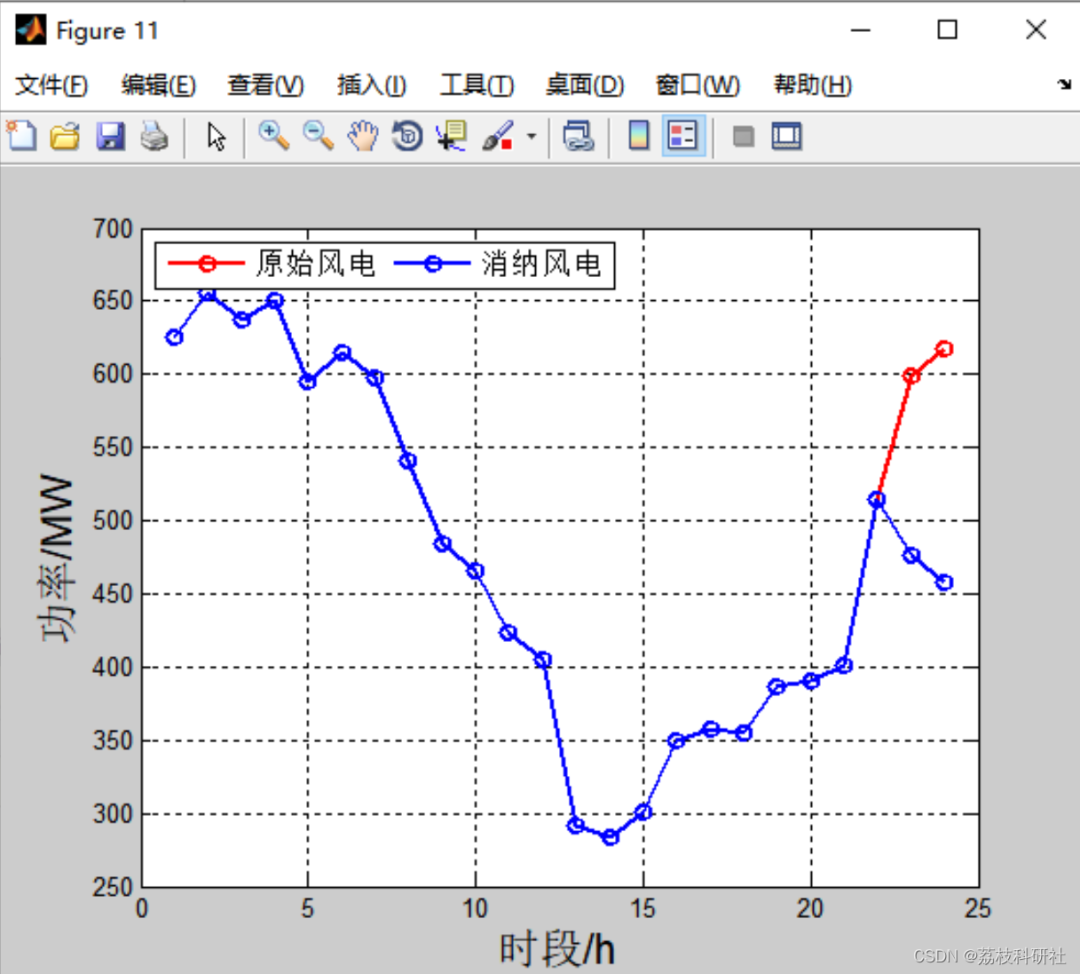
 2.2 New Energy Consumption Curve: (Mode 1 – Mode 3)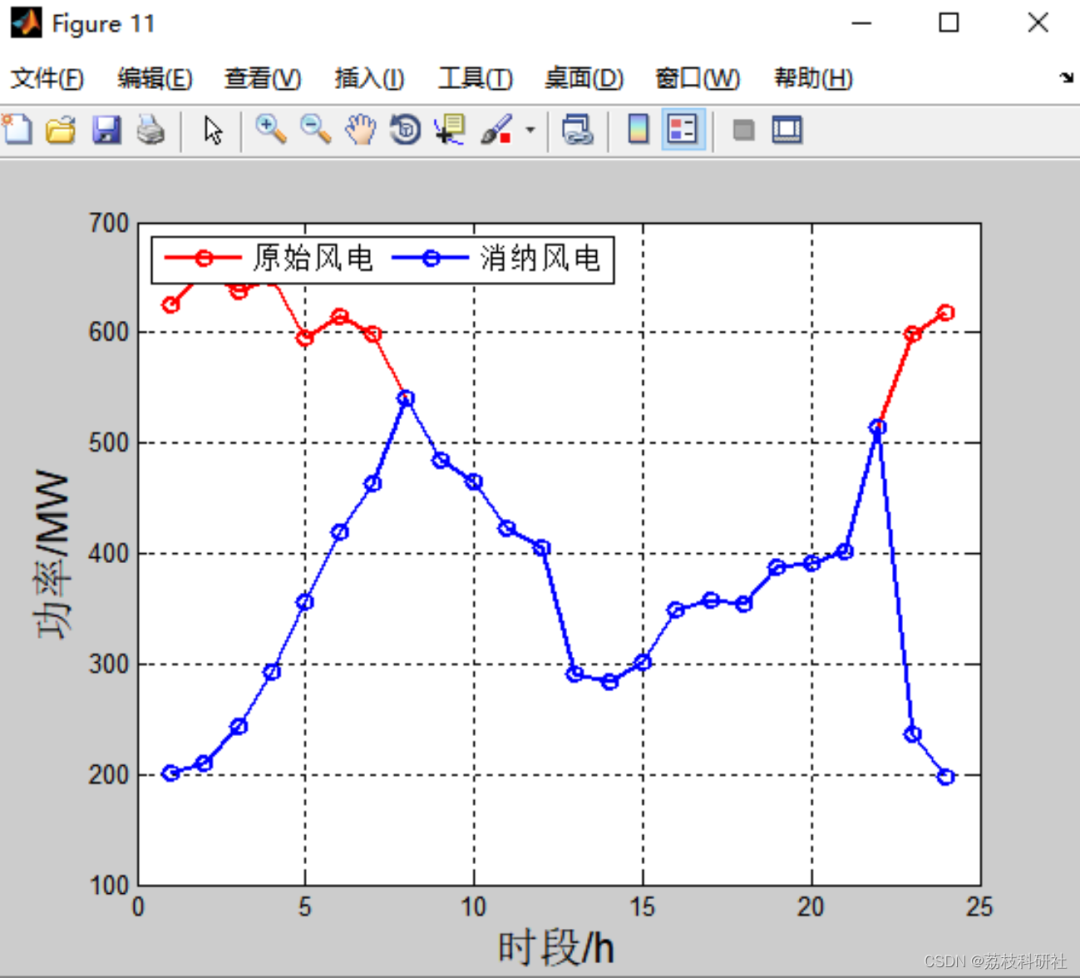
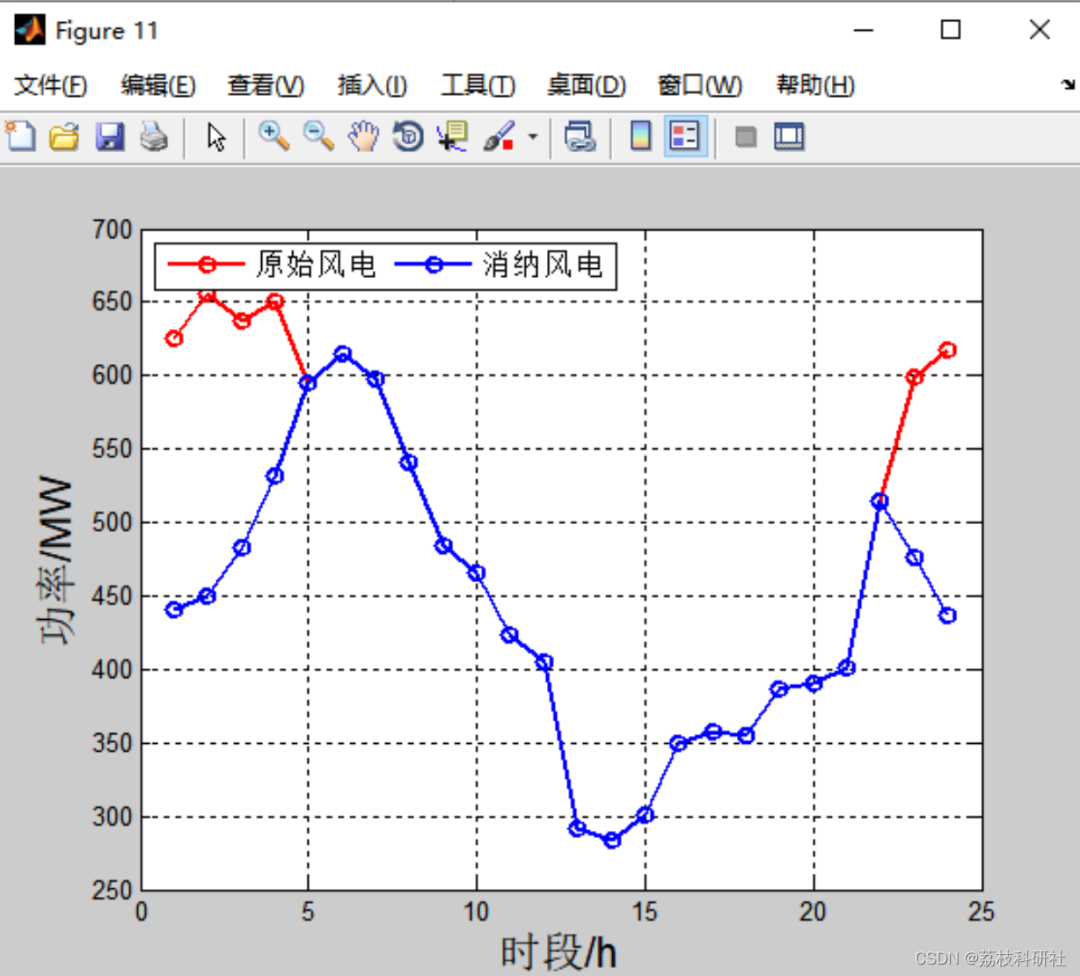
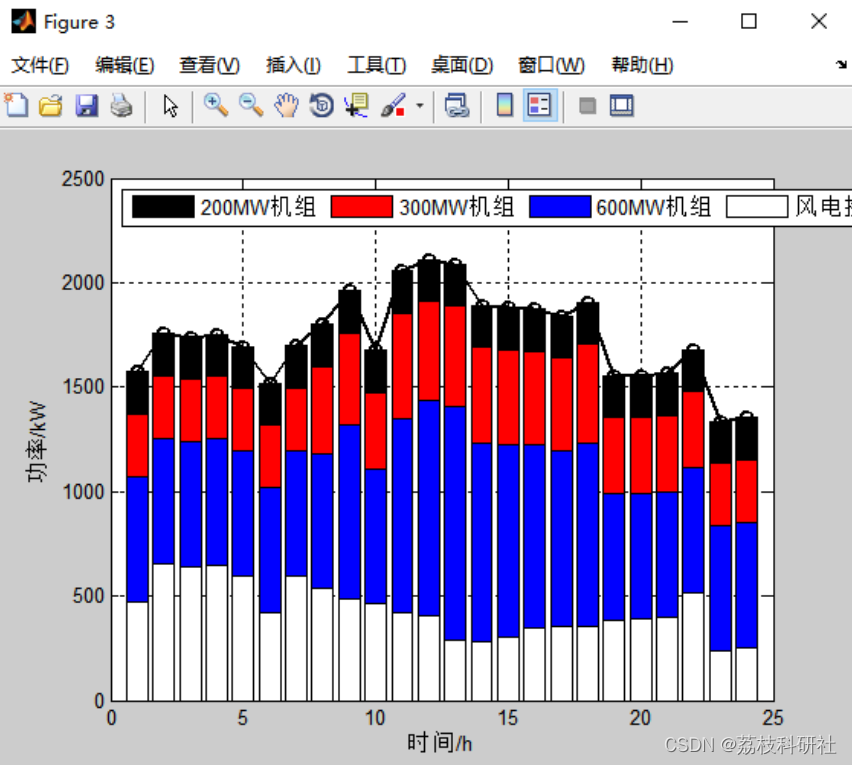
 2.3 Operating Results under Scenario 3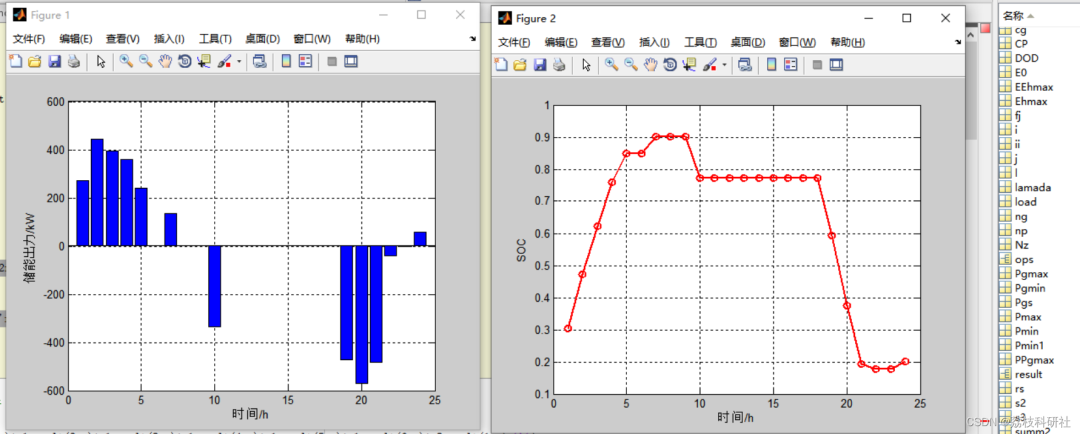
 2.4 Energy Storage Configuration Results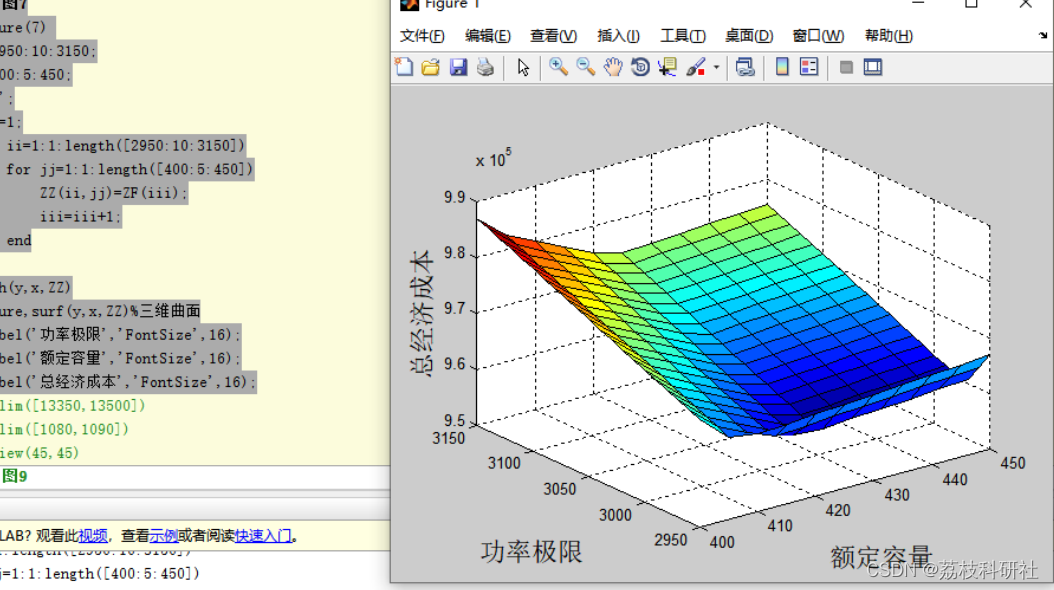
 2.5 Two Sensitivity Analyses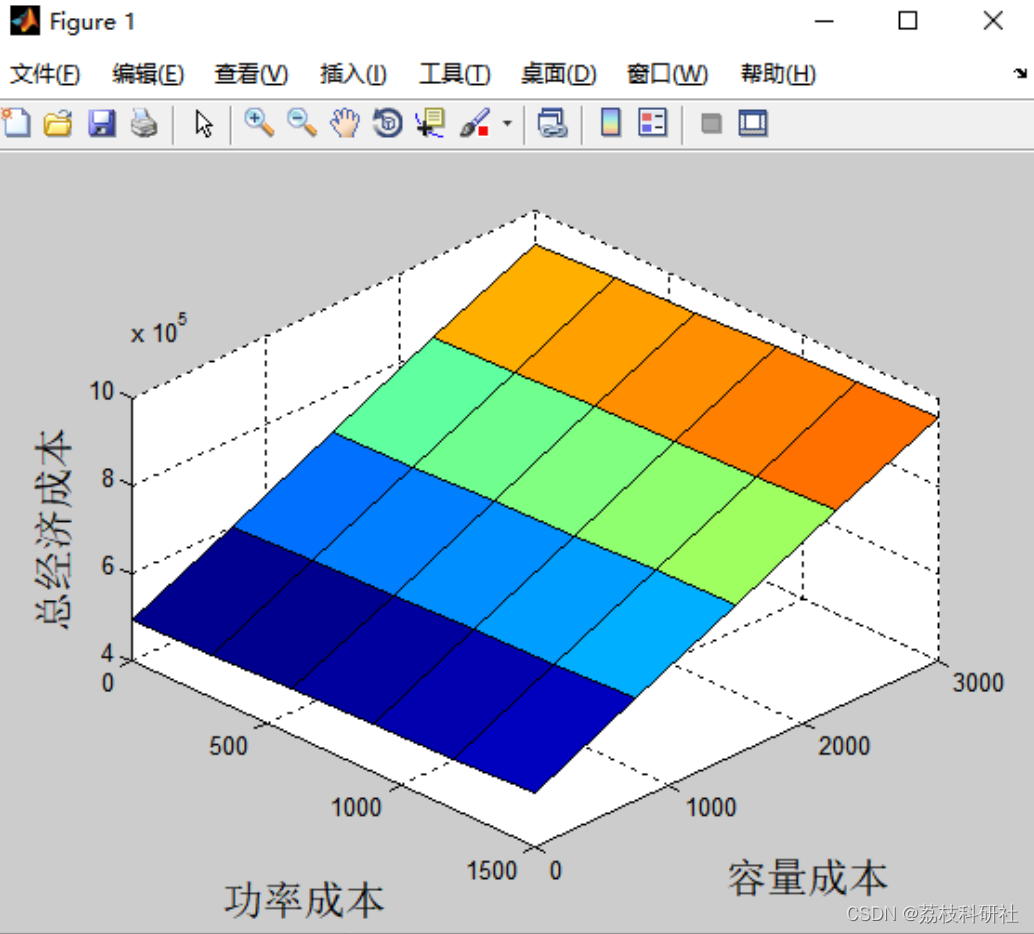
1
部分代码:
2


3
% Energy storage battery (corresponding to formula 30)
4
summ2=0;
5
for l=1:1:24
6
summ2=summ2+max(x2(1,l),0)*ng+min(x2(1,l),0)/np;
7
end
8
c =[c,summ2==0];% Capacity balance constraint
9
summ4=E0;
10
for l=1:1:24
11
summ4=summ4+max(x2(1,l),0)*ng+np*min(x2(1,l),0);
12
c =[c,Ehmax*0.1<=summ4<=Ehmax*0.9];% Capacity upper and lower limit constraints
13
end
14
for l=1:1:24
15
summ9=max(x2(1,l),0)*ng+np*min(x2(1,l),0);
16
c =[c,-Pgmax<=summ9<=Pgmax];% Power upper and lower limit constraints
17
end
18
% Wind turbine
19
c =[c,0<=x3<=fj];% Renewable energy consumption constraint
20
% Daily load balance constraint
21


22
c =[c,sum(x1(:,i))-sum(x2(:,i))+sum(x3(:,i))==load(i)];%
23
end
24


25
%% Objective function
26


27
% Energy storage device (formula 1)


3 References
Some theoretical sources are from the internet; if there is any infringement, please contact for deletion.

[1] Li Junhui, Zhang Jiahui, Li Cuiping, et al. Configuration scheme and economic analysis of energy storage systems participating in peak shaving. Journal of Electrical Engineering Technology, 2021, 36(19): 4148-4160. DOI:10.19595/j.cnki.1000-6753.tces.200678.

4 Matlab Code, Data, Article Explanation
Previous Recommendations
[CSP with Solar Thermal Power Plant] Optimization scheduling of a thermal-electric integrated energy system with solar thermal power plant (Matlab code implementation)
[State Estimation] Kalman filtering, extended Kalman filtering, unscented Kalman filtering, cubature Kalman filtering, M-estimation, robust cubic Kalman filter (Matlab code implementation)
[SVR-SVDD] Research on anomaly detection based on Support Vector-SVDD (Matlab code implementation)
[Drones] Research on task scheduling path planning for drones based on ant optimization algorithm (Matlab code implementation)
Research on the unified model of fault recovery and island partitioning in active distribution networks (Matlab code implementation)
Research on the operation scheduling and capacity configuration optimization of integrated energy production units considering source-load uncertainty (Matlab code implementation)
Method for ship motion planning based on model predictive artificial potential field, considering complex encounter scenarios under COLREG (Matlab code implementation)
[Robust Optimization, Big M Method, C&CG Algorithm] Two-stage robust optimization considering wind, solar, and load uncertainty (Matlab code implementation)
[Simulink] Tuning of DC motors using fuzzy logic and PID controllers
[Drones] Simulation of drone cruising based on PID control (Matlab code implementation)
Robust optimization scheduling of micro-energy networks with multi-energy complementarity (Matlab code implementation)
[Drones] Control, path planning, and trajectory optimization of quadrotor aircraft (Matlab code implementation)
Path optimization with time windows for electric vehicles (Python code implementation)
[Decentralized Optimization of Electric Vehicle Charging Station Scheduling] Electric vehicle optimization scheduling based on Monte Carlo and Lagrangian (time-of-use pricing scheduling) (Matlab code implementation)
MATLAB| Multi-objective optimization configuration of microgrid systems based on improved radar chart model
Python| [Robust Optimization] Two-stage robust optimization economic scheduling method for microgrids
MATLAB| [Robust Optimization] Two-stage robust optimization economic scheduling method for microgrids
MATLAB| [Workshop Scheduling] Two-stage algorithm for flexible job shop scheduling problem based on convolutional neural networks
Planning of electric vehicle charging stations considering traffic network flow【IEEE 33 nodes】 (Matlab code implementation)
[GMDH] Forecasting monthly rainfall in southeastern Pará (Matlab code implementation)
[Copula] Copula scenario generation considering joint output and correlation of wind and solar (Matlab code implementation)
[Workshop Scheduling] Parallel machine optimization scheduling based on simulated annealing optimization algorithm (Matlab code implementation)
Joint configuration method of distributed power sources and electric vehicle charging stations considering the dispatchable characteristics of charging loads (Matlab code implementation)
Research on the application of blind deconvolution methods such as minimum entropy deconvolution, maximum correlation kurtosis deconvolution, and maximum second-order ring stationary blind deconvolution in mechanical fault diagnosis (Matlab code implementation)