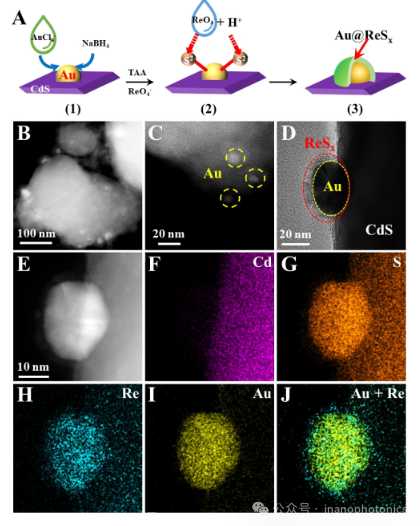
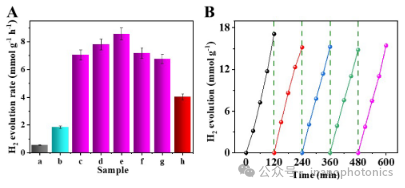
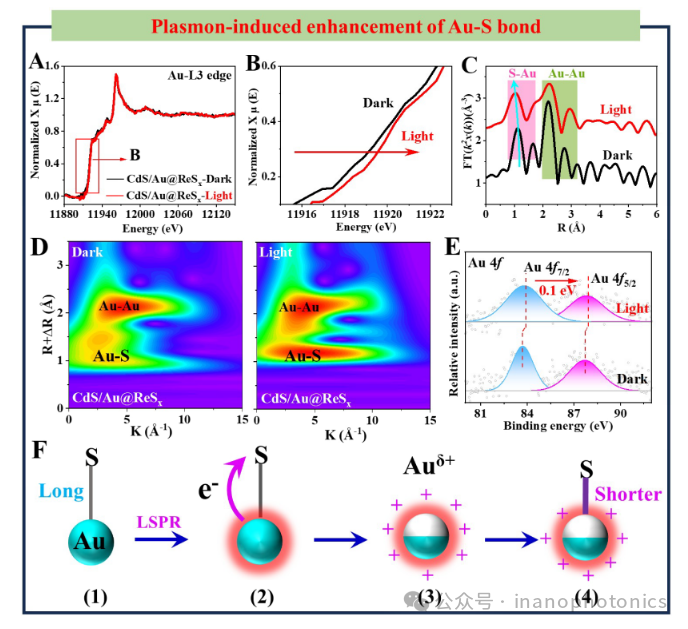
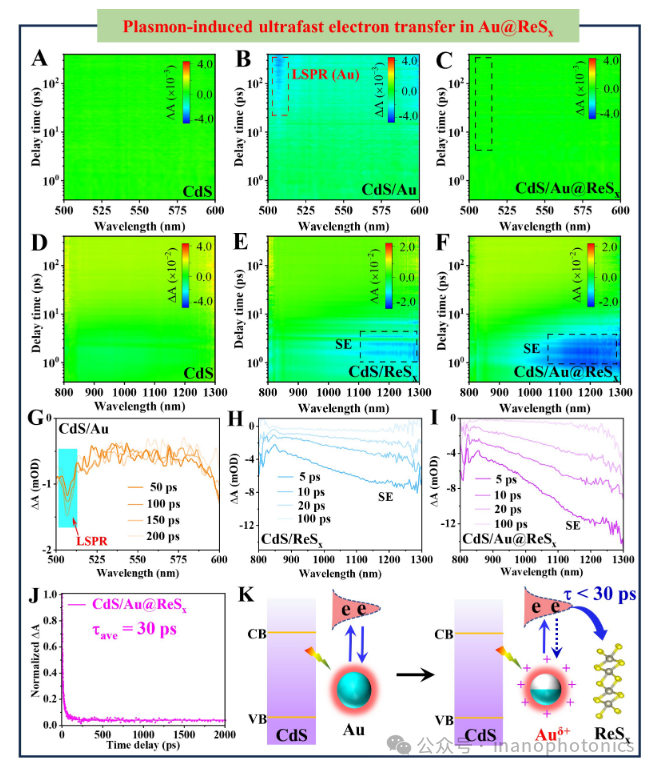
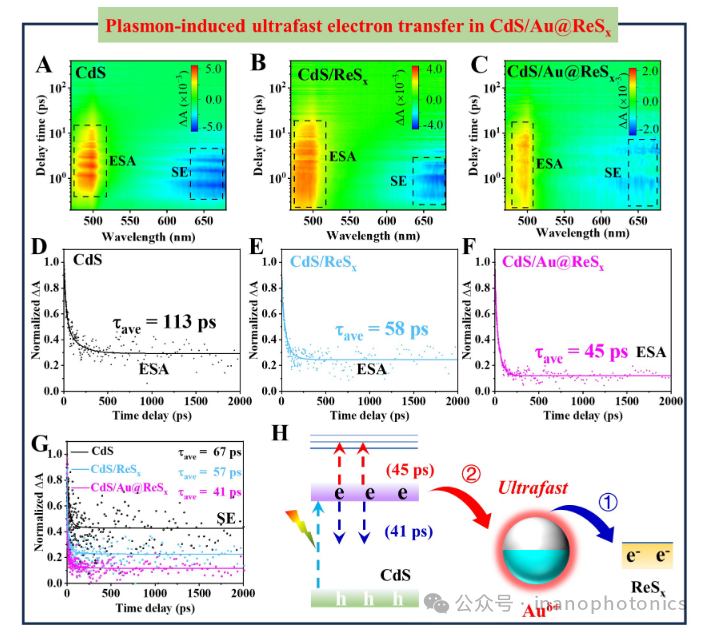
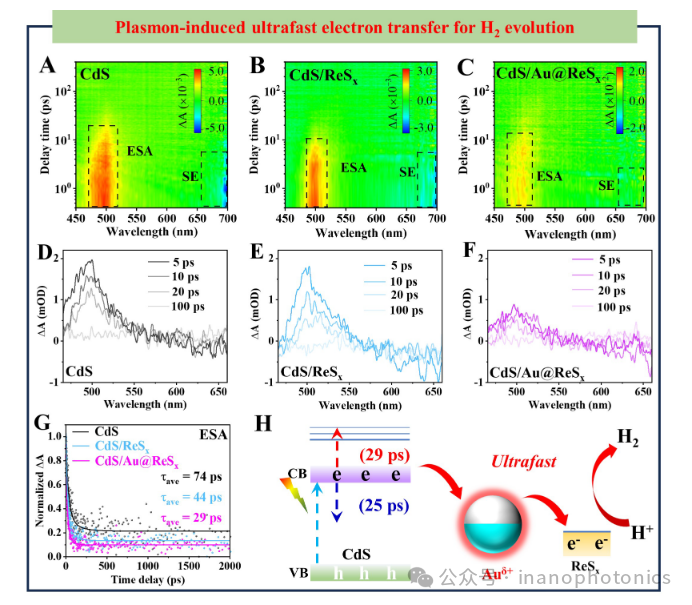
 The localized surface plasmon resonance (LSPR) effect of noble metals plays a crucial role in photocatalytic hydrogen evolution by efficiently injecting hot electrons generated by plasmons into the photocatalytic system, significantly modulating the interfacial electron transfer dynamics. However, the specific impact of noble metal LSPR effects on ultrafast interfacial charge transfer and its kinetic characteristics in photocatalytic systems has not been fully explored. To fill this knowledge gap, China University of GeosciencesXinyu Yin, Jianjun Zhang,Jiaguo Yu,Huogen Yu, and others introduced gold nanoparticles into the CdS/ReSx photocatalyst system to comprehensively investigate the LSPR-induced ultrafast interfacial charge transfer process, ultimately enhancing the photocatalytic hydrogen production activity. Experimental results show that the developed CdS/Au0.5@ReSx photocatalyst achieves a hydrogen production rate of 8.6 mmol per gram per hour (apparent quantum efficiency of 35.9%), significantly higher than CdS/Au (1.8 mmol g-1 h-1) and CdS/ReSx (4.0 mmol g-1 h-1). In situ X-ray absorption fine structure spectra and femtosecond transient absorption spectra confirm that the gold LSPR effect generates hole-deficient Auδ+ species and shortens the Au-S bond length, thereby significantly accelerating electron transport in the Au@ReSx co-catalyst. This plasmon-induced ultrafast charge transfer mechanism enables efficient migration of photogenerated electrons in the CdS/Au@ReSx system, significantly enhancing photocatalytic hydrogen evolution performance by optimizing interfacial charge dynamics. This finding provides a new perspective for understanding the charge transfer mechanism driven by LSPR effects and offers a theoretical blueprint for designing the next generation of plasmonic photocatalysts.
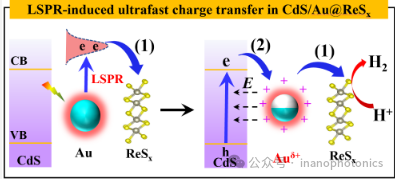 With the growing global demand for clean energy, sustainable hydrogen production technology has become a core topic in both research and industry. Among various methods to promote hydrogen evolution, photocatalytic technology is recognized as a promising and environmentally friendly hydrogen production solution due to its ability to utilize solar energy to drive water splitting. However, traditional photocatalysts face issues such as rapid recombination of photogenerated charge carriers and insufficient active sites during the photocatalytic hydrogen production process, often leading to low hydrogen production efficiency. These limitations have prompted researchers to optimize photocatalysts through various strategies, including band engineering, nanostructure design, and surface modification. Among these, co-catalyst modification has been proven to be an effective strategy to enhance photocatalytic hydrogen production efficiency by providing more active sites and effectively separating photogenerated charge carriers.Among numerous co-catalysts, noble metals are regarded as one of the most promising co-catalysts in the field of photocatalytic hydrogen production due to their excellent stability, catalytic activity, and high conductivity. In particular, the localized surface plasmon resonance (LSPR) effect—an electron resonance phenomenon generated by metal nanoparticles under light excitation—has been widely applied in the photocatalytic field and significantly enhances hydrogen production activity, with numerous studies providing evidence for this. For example, Zhang et al. confirmed that the LSPR-induced photothermal effect in Au/Ni co-catalysts generates localized high temperatures, promoting the pre-activation of H2O molecules and lowering the reaction energy barrier, achieving a high hydrogen production rate of 7610 μmol h-1 g-1 (apparent quantum efficiency of 40.2%). Herran et al. prepared AuPt photocatalysts by loading Au particles on Pt, resulting in a 3.86-fold enhancement in hydrogen production performance, attributed to the LSPR effect of Au enhancing the electric field strength and promoting the separation of photogenerated charge carriers. Hsu’s research group demonstrated that loading Au co-catalysts on Cu7S4 photocatalysts can achieve a peak quantum yield of 9.4% at a wavelength of 500 nm and a record quantum yield of 7.3% at a wavelength of 2200 nm, primarily benefiting from the contribution of hot electrons generated by the LSPR effect.Undoubtedly, the aforementioned results indicate that the LSPR effect of metal nanoparticles can significantly enhance photocatalytic hydrogen production activity through various mechanisms, including photothermal effects, localized electric field enhancement, hot electron injection, enhanced solar light absorption, and resonant energy transfer (Figure 1A). However, it is particularly noteworthy that the hot electrons generated by noble metal LSPR effects can inject into the co-catalyst system, affecting subsequent interfacial electron transfer processes—this is especially critical for photocatalytic hydrogen production. However, to date, the specific impact of noble metal LSPR effects on ultrafast interfacial charge transfer pathways and kinetics has not been thoroughly studied, and the mechanisms remain unclear. Therefore, in-depth exploration of the role of LSPR effects on ultrafast interfacial charge transfer mechanisms is of great significance for further enhancing the hydrogen production activity of metal-modified photocatalysts.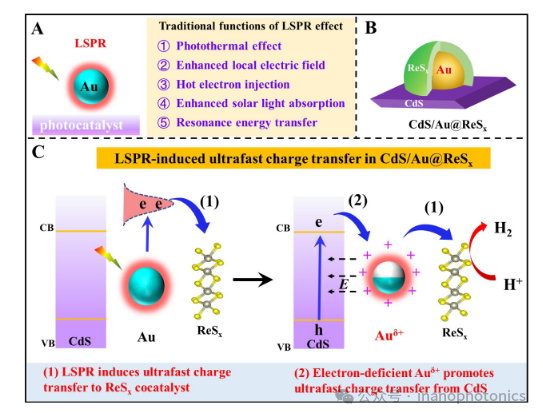
 (Images and content are from J. Am. Chem. Soc. )
Article Information:
Plasmon-Induced Ultrafast Interfacial Charge Transfer for Enhanced Photocatalytic Hydrogen Evolution
Xinyu Yin, Duoduo Gao, Jianjun Zhang,* Hermenegildo García, Jiaguo Yu,* and Huogen Yu*
Cites: J. Am. Chem. Soc. 2025, DOI:10.1021/jacs.5c11154
————————————————————
Welcome to submit articles, submission email:
Frontiers in Nanophotonics
Founded by
Guan Chao Zheng
Associate Professor, School of Physics, Zhengzhou University