As ChatGPT ignites a global AI boom, AI servers, as the core of computing power, are experiencing explosive growth, and the PCBs that support their operation have also become a focal point in the industry. Although they appear to be the “skeleton” of servers, standard server PCBs and AI server PCBs have already diverged significantly in terms of technical difficulty, material selection, and market value. The demand for AI server PCBs has brought new opportunities and challenges to the PCB industry.
1. Core Parameters: A Comprehensive Breakthrough from “Sufficient” to “Extreme”
Standard server PCBs focus on conventional data processing scenarios, with parameter design centered on stability and cost-effectiveness; whereas AI server PCBs must adapt to the massive computing power demands of GPU clusters, with parameter specifications breaking through physical limits. The specific comparisons are as follows:
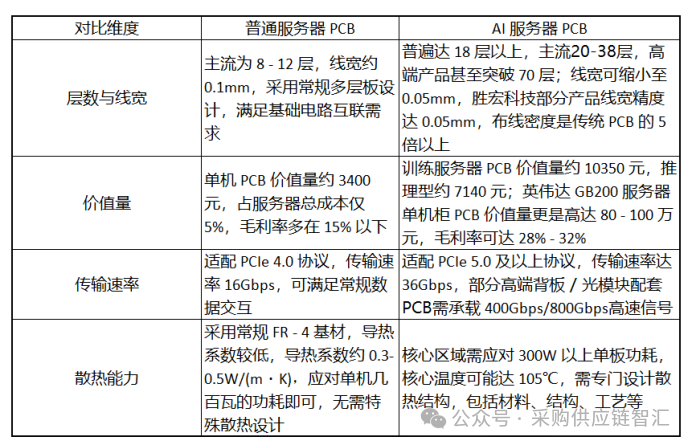
2. Technical Design: Underlying Logical Differences for Different Scenarios
1. Material Selection: An Upgrade from General to Specialized
Standard server PCBs mostly use conventional FR-4 substrates, which can meet signal transmission requirements at normal temperature and conventional speeds, with a relatively high dielectric loss (Df) typically between 4.2-4.7, requiring no special performance optimization. In contrast, AI server PCBs have stringent material requirements: to reduce high-speed signal attenuation, they commonly use PTFE (Polytetrafluoroethylene) or M9-grade high-frequency copper-clad laminates. Some high-end products even utilize self-developed low-dielectric-loss specialty resin substrates, which can control the dielectric constant (Dk) at 10GHz to 3.2±0.1, with dielectric loss (Df) ≤ 0.002, reducing signal attenuation by 35% compared to conventional substrates. With the widespread adoption of PCIe 5.0, substrates also need to be upgraded to Very Low Loss levels to further reduce signal transmission losses.
2. Routing and Stacking: From Simple Isolation to Precision Collaboration
The stacking design of standard server PCBs primarily consists of a basic structure of “signal layer – power layer – ground layer,” with relatively simple routing processes that only need to avoid basic signal interference, using traditional mechanical drilling to meet requirements. In contrast, the routing and stacking design of AI server PCBs can be described as “precision engineering”: for example, using a combined multilayer design with “differential pair symmetric routing + closely coupled reference planes,” compressing the spacing between high-speed signal layers and ground layers to 0.1mm; innovatively adopting a “power – ground – signal” sandwich structure in stacking, with each pair of signal layers equipped with an independent ground layer to avoid cross-plane signal splitting. Additionally, using laser direct imaging (LDI) technology allows for high-precision routing with a line width and spacing of 0.08mm, with blind and buried vias accounting for up to 85%, and positioning errors controlled within ±3μm.
3. Heat Dissipation Design: A Comprehensive Upgrade from Passive to Active
Standard servers operate at relatively low power consumption, and PCBs can maintain normal temperatures through their own substrates and chassis cooling (internal and external fans) without the need for additional heat dissipation structures. However, the GPU clusters in AI servers generate significant heat, rendering traditional cooling methods ineffective. AI server PCBs fundamentally address this challenge through a three-dimensional heat dissipation system of “materials – structure – process”: using high thermal conductivity substrates with embedded copper heat dissipation layers; designing high-density thermal via arrays with 40 thermal vias per square centimeter; and employing a “metal-based core board + surface silver plating” composite process, which can reduce the temperature in the core area of the PCB from 105°C to 78°C.
3. Market Applications and Development Trends: A Polarized Competitive Landscape
1. Market Demand: Stable Necessity vs Explosive Growth
Standard server PCBs correspond to downstream enterprises in office and small data center scenarios, with stable demand growth and intense market competition, primarily focusing on “volume production,” with many domestic small and medium-sized PCB manufacturers capable of production. In contrast, AI server PCBs benefit from explosive computing power demand, with the market scale rapidly expanding. In 2023, the market size for AI server PCBs approached $800 million, and in 2024, global revenue for AI server PCBs is expected to reach approximately $1.9 billion. For instance, Shenghong Technology’s production plan for AI server PCBs extends to 2026, with Q3 2025 revenue reaching 14.117 billion yuan, a year-on-year increase of 83.4%, and a net profit of 3.2 billion yuan, a year-on-year increase of 324%. Hushi Electronics also reported Q3 2025 revenue of 13.512 billion yuan, a year-on-year increase of 49.96%, and a net profit of 2.718 billion yuan, a year-on-year increase of 47.03%, both benefiting from the AI server boom.
2. Competitive Landscape: Full Competition vs Oligopoly
Standard server PCBs have a low technical threshold, with numerous market participants, and competition is concentrated on price and capacity, with generally low gross margins. In contrast, AI server PCBs, due to high multilayer design and precision process technical barriers, have long been dominated by companies such as Japan’s Ibiden, Kyocera, and Taiwan’s Unimicron. Currently, only a few domestic companies, such as Shenghong Technology and Hushi Electronics, have broken through technical bottlenecks, mass-producing AI server PCBs with more than 24 layers and obtaining certification from NVIDIA, entering the global top supply chain.
The differences between standard server PCBs and AI server PCBs essentially reflect the technical differentiation between conventional data processing and massive AI computing power demands. As AI computing power transitions from FP32 to FP8 precision and as the PCIe protocol continues to evolve, AI server PCBs will further evolve towards higher layer counts, lower losses, and stronger heat dissipation. For PCB companies, this represents both a technical challenge and a key track to break out of the internal competition.