As the world’s second-largest manufacturer of copper-clad laminates, Shengyi Technology holds a global market share of 13.7% in rigid copper-clad laminates, maintaining its position as the second largest for 11 consecutive years, only behind the Taiwanese company, Kingboard Laminates. Since January 2024, the market value of another PCB leader, Shenghong Technology, has increased 16 times, while Shengyi Technology has only increased 5 times. So, what is the future potential of the company? Is there still investment value?
Company Overview
Shengyi Technology started with copper-clad laminates, listed on the A-share market in 1998, and around 2000, broke the monopoly of the US and Japan on high-frequency materials. In 2011, it issued additional shares to expand its high-end line, and in 2016, it established Jiangsu Shengyi, focusing on high-speed materials. In 2021, it spun off its PCB subsidiary, Shengyi Electronics, to list on the Sci-Tech Innovation Board, creating an integrated closed loop of materials and boards.
Shengyi Technology’s main business is divided into two major segments: copper-clad laminates (CCL) and 48-layer finished printed circuit boards (PCBs).
Copper-clad laminates are the most fundamental material for manufacturing PCBs, used to produce single-sided and double-sided circuit boards as well as high-layer-count circuit boards. They are widely used in high-performance AI servers, automotive radar, and next-generation 5G communication base stations, such as large computers and high-end server fields. Their performance and quality directly determine the quality, reliability, and application fields of the final PCB products.
Printed circuit boards are the support and electrical connection carriers for electronic components, existing in almost all electronic devices. They fix electronic components (such as chips, resistors, capacitors) and achieve predetermined circuit functions through conductive copper foil, insulating substrates, and protective layers, which are heavily utilized in AI servers.

In the first three quarters of 2025, the company’s revenue reached 20.6 billion, a year-on-year increase of 39.8%, with profits of 2.44 billion, a year-on-year increase of 78.04%.
As a supporting facility for semiconductor development, it also has cyclicality, but the concentrated orders for AI server PCBs have shifted Shengyi Technology’s performance from a cyclical climb to a more ideal accelerated growth.
Future
So, how much potential does Shengyi Technology have in the future?
To analyze a company’s development prospects, we generally look at two aspects: the future demand for products and the competitiveness of the company’s own products.
Shengyi Technology’s track is AI servers + automotive radar, using high-frequency and high-speed copper-clad laminates to break through the ceiling of simultaneous volume and price increases.
According to relevant institutions’ forecasts, the global PCB output value is expected to reach approximately $79.1 billion by 2025, with a year-on-year growth of 7.6%. Among these, AI servers, 800G switches, and automotive radar will contribute the main incremental growth.
The growth rate for high-layer boards (18 layers and above) is 41.7%, while the growth rate for HDI boards is 12.9%. The market size for high-frequency and high-speed CCL is approximately $2.8 billion, with a compound annual growth rate of 12% from 2022 to 2027. The PCB value for a single AI server is about 1200 yuan, three times that of traditional servers, with the number of layers increasing from 12-16 to 20-28 layers, and the dielectric loss requirement decreasing from 0.01 to 0.002, which can drive the unit price of M7 and M8 level copper-clad laminates up by 2-3 times.
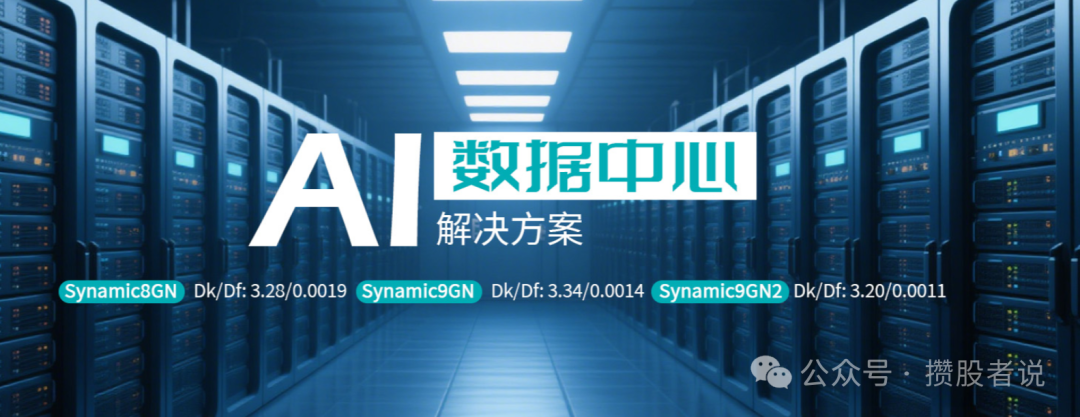
Therefore, the revenue share of Shengyi’s high-end products M7 and M8 in the first half of this year is 22%, an increase of 7% year-on-year, and they have been supplied in bulk to NVIDIA’s GB200, Amazon’s AWS, and domestic BAT computing projects.
NVIDIA has also announced its technology roadmap for the next two years, with the new generation product Rubin set to replace GB300. The PCB market space corresponding to this product will be close to 100 billion yuan, and Shengyi is one of NVIDIA’s three core CCL suppliers, being the only manufacturer on the mainland to enter NVIDIA’s Rubin supply chain, focusing on the GB and Rubin platforms.
Looking at automotive radar, the value of 77GHz millimeter-wave radar PCBs is about 80 yuan per piece, double that of 24GHz. Models above L3 will typically be equipped with 5 millimeter-wave radars, which will also drive the demand for high-frequency CCL. Shengyi’s ultra-low loss SF-GF series has been certified by Bosch, Continental, and Huawei’s automotive business unit. In the first half of the year, revenue from automotive high-frequency boards increased by 45% year-on-year. The higher the number of layers in high-end PCBs, the higher the material grade, and the cost share of CCL in PCBs will increase from 30% to 40%. As Shengyi is upstream in PCBs, it can also sell materials, enjoying a double benefit of volume and price. When the cycle turns upward, the elasticity will be even greater.

However, upon hearing the name copper-clad laminate, some may worry whether fluctuations in copper prices will affect Shengyi’s costs and subsequently its profit margins. In fact, copper foil accounts for 46% of the cost of copper-clad laminates, resin 28%, and fiberglass cloth 26%.
Therefore, fluctuations in copper prices will indeed directly impact gross margins. In the first half of the year, the average spot price of copper was about 72,000 yuan/ton, an increase of 18% year-on-year. At the same time, the price of electronic cloth also saw a recovery increase. To cope with this situation, Shengyi Technology has signed long-term supply chain agreements and hedging strategies to smooth out the impact of price fluctuations, controlling the increase in copper foil procurement prices to 12% through an annual fixed price + quarterly floating model.
At the same time, the premium for high-end products M7 and M8 is even more significant, with a unit price of about 180/m2, 2.5 times higher than ordinary FR-4, and a gross margin of up to 30%, effectively hedging against the rise in copper prices, resulting in a gross margin of 23.7% for copper-clad laminates in the first half of the year, an increase of 2% year-on-year.
During the copper price increase cycle, it achieved an increase in gross margin, and in the face of explosive demand, production capacity is also continuously growing.
The Thailand base will officially start production in 2026, adding 18 million square meters/year of copper-clad laminates and 34 million meters/year of bonding sheets, with the production capacity of high-end products directly doubling.
Risks
1. In 2025, Taiwanese companies such as Taiko and Lianmao will initiate a new round of capacity expansion, with M6-level products dropping in price by 10%, which may squeeze the profits of the company’s mid-range products.
2.Amazon’s AWS and NVIDIA together account for about 25% of revenue. If overseas cloud vendors slow down their capital expenditures, the growth rate of orders may also decline.
Institutions predict that the company’s net profit will reach 3 billion in 2025, with a price-to-earnings ratio of about 46 times, still at the high end of the company’s 10-year valuation. However, the industry outlook is good, and the performance has the potential to catch up with the valuation. Of course, if the stock price can adjust a bit lower, it would still be a good time to enter with a small position.
I am a stock accumulator, and we will chat again tomorrow.
Click to follow and like, let’s accumulate stocks together and gradually become rich!