I am Lao Yu by the sea. When NVIDIA suddenly announced the suspension of H20 chip production, when American lawmakers openly clamored that “backdoors must be reserved in exported chips,” and when the Trump administration enforced a 15% “licensing tax”—we finally see clearly: the battlefield of chips has no luck, only a life-and-death game! If we continue to allow American tech companies to advance unchecked in the Chinese market, it is tantamount to building a ladder for the enemy at the digital national gate! 1. The Backdoor Dilemma: From “Prism Gate” to the Fatal Upgrade of “Chip Gate” 1. The U.S. government openly legislates to require backdoors. The U.S. House of Representatives’ “2023 Chip Security Act” clearly requires that chips exported to China must achieve triple control—user monitoring, operation tracking, and remote shutdown. Senator Rubio even claimed: “This is gunboat diplomacy in the digital age!” 2. NVIDIA’s “innocent defense” is unconvincing. NVIDIA argues that backdoors affect stability based on “90s technology cases,” but the “Regin” system exposed by Snowden has long proven that U.S. intelligence agencies possess technology to infiltrate without destroying systems. Ironically, while NVIDIA claims “safety,” it pays 15% of its sales revenue in China to the U.S. government as an “export license fee”—this is simply a modern version of “paying protection money!” 3. The three major risk dimensions of the H20 chip 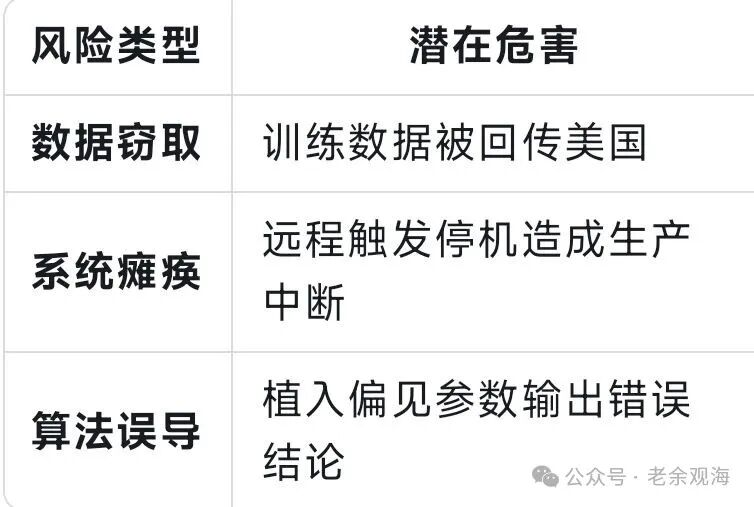 2. Regulatory Gaps: We Are Still Using “Gentlemen’s Agreements” to Combat “Robber Logic” Currently, there are three major loopholes in the regulation of American companies: 1. Weak legal constraints. Relying solely on the principle clauses of the “Cybersecurity Law” lacks long-arm jurisdiction tools like the U.S. “Cloud Act.” Companies like NVIDIA only need to verbally promise “no backdoors” without bearing substantial legal responsibility. 2. Lack of punitive mechanisms. Even if backdoors are discovered, the maximum penalty is only 5% of sales (Huawei was fined 20% by the U.S.), and there is a lack of a class action mechanism, making it difficult for users to protect their rights. 3. Ambiguous review standards. Chip security testing remains at the hardware level, lacking deep detection capabilities for malicious code at the firmware and driver levels. A certain laboratory admitted: “Existing equipment can only check known vulnerabilities and cannot detect customized backdoors.” 3. Sword Casting Plan: Four Strong Regulatory Measures 1. Security deposit system. Force companies like NVIDIA to pay 15% of their sales in China as a security deposit, stored in a designated escrow account; if no security incidents occur within five years, the full amount will be returned; otherwise, it will be used to compensate user losses. 2. Class action mechanism. Establish a “Court of Artificial Intelligence Product Liability” specifically for chip security disputes; allow collective lawsuits initiated by more than 10 users, applicable for punitive damages (up to three times the sales amount). 3. Prohibition in sensitive areas. Completely ban the use of imported AI chips in key areas such as the military, police, aerospace, and finance; remove non-domestic AI computing products from the procurement list of state-owned enterprises. 4. White-box review. Require companies to disclose source code, training datasets, and algorithm logic; establish a “Chip Security White-box Laboratory” in Xiong’an, inviting companies like Huawei and Cambricon to participate in building a detection system. 4. Independent Replacement: Building a Digital Great Wall with Domestic Chips Regulation is only defense; replacement is offense: 1. Huawei’s Ascend 910B performance has reached 80% of H20 and has been deployed at scale in the Heilongjiang Intelligent Computing Center; 2. Cambricon’s Siyuan 590 uses 7nm technology and supports trillion-parameter large model training; 3. Shanghai Tensu Zhixin launched the Zhi Armor 100, compatible with the CUDA ecosystem and without licensing risks. Data from the Ministry of Industry and Information Technology shows that by 2025, the self-sufficiency rate of domestic AI chips will increase from 35% to 60%, and NVIDIA’s market share is expected to shrink by 40%. Chip sovereignty is the sovereignty of the digital age From the Boeing MAX aircraft concealing defects to the backdoor dilemma of NVIDIA chips, countless cases prove that entrusting the security of critical infrastructure to the “moral self-discipline” of foreign companies is tantamount to seeking skin from a tiger! We must clearly recognize that: ✅ Chips are a strategic resource more important than oil ✅ Regulation is not trade protection, but the defense of digital sovereignty ✅ Independent replacement is not an option, but a necessity for survival Churchill once said: “Resorting to force may be painful, but yielding to fear is worse.” Today on the chip battlefield, we have no retreat! It is time to take action: 1. Promote special legislation for the “Chip Security Act” 2. Establish a semiconductor industry support fund of 100 billion scale 3. Incorporate chip independence into local government assessment indicators I am Lao Yu by the sea, hoping that Chinese chips will break the shackles and the digital Great Wall will stand firm! Appendix: Emergency Response Checklist 🔴 Party, government, and military systems: Urgently complete risk assessment of imported chips 🟡 State-owned enterprises: Submit domestic replacement plans as soon as possible 🟢 Private enterprises: Connect to the “Chip Security Monitoring Platform” for real-time alerts
Any other measures that can be taken are welcome to leave a message!