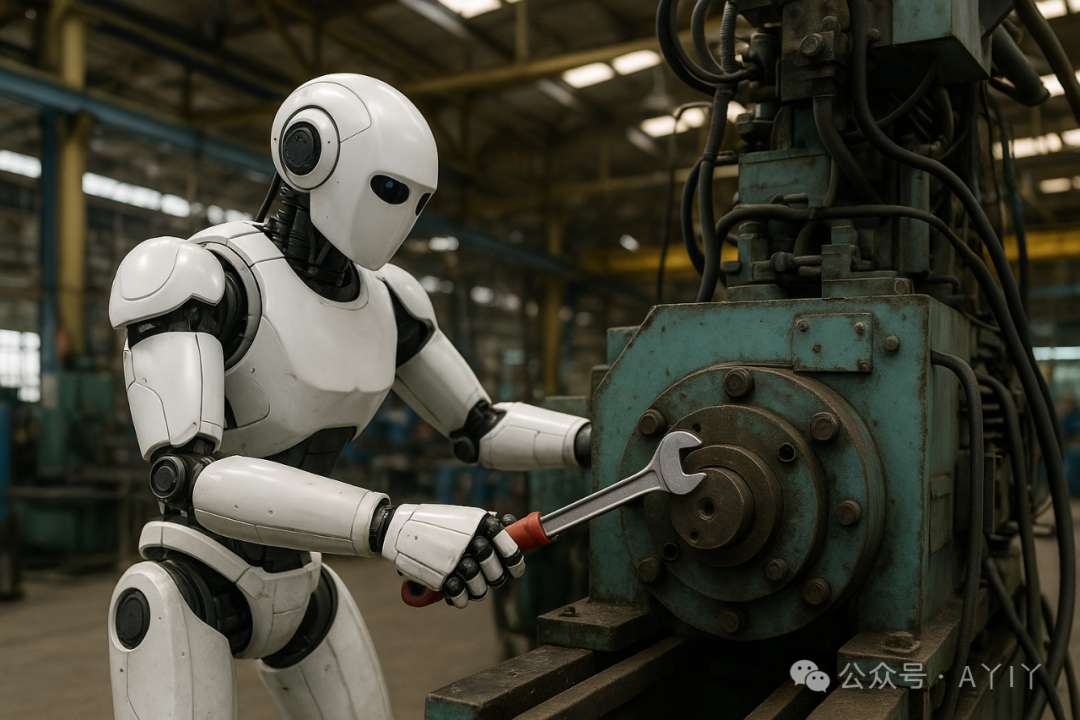
By 2025, the humanoid robot Optimus will autonomously move at a speed of 2.5 meters per second in Tesla’s factory, accurately handling components; research robots from Shanghai Jiao Tong University will skillfully complete sampling and centrifugation in genetic laboratories; in hospitals in Guangzhou, care robots will meticulously look after elderly patients’ daily needs—AI robots are transitioning from concept to reality at an unprecedented speed, profoundly reshaping our production and lifestyle.
1. Technological Breakthroughs: From “Mechanical Execution” to “Autonomous Decision-Making”
AI robots are undergoing a transition from specialized to general-purpose. The “Ten Major Development Trends of Embodied Intelligent Robots” report published in 2025 indicates that modern AI robots have achieved integration of perception, decision-making, and execution, working collaboratively through a “brain + cerebellum” architecture.
The brain (based on large models) is responsible for task analysis, decomposition, and reasoning, while the cerebellum specializes in motion control and fine operations. The robot developed by Professor Lian Wenzhao’s team at Shanghai Jiao Tong University can complete complex experimental processes involving dozens of steps, including precise sand extraction, liquid pouring, and cap screwing, with high precision requirements for real-time motion control.
Multimodal perception fusion is another key advancement. The data collection gloves developed by Pacini Perception Technology are equipped with nearly 4,000 tactile sensors, capable of real-time detection of physical feedback during grasping, combined with visual and audio data, allowing robots to both “see” and “feel”.
2. Application Implementation: Explosive Growth in Multiple Scenarios
1. Industrial Manufacturing
Tesla plans to deploy over 1,000 Optimus humanoid robots in its factories by 2025 to perform complex tasks. UBTECH’s Walker S2 robot can autonomously change batteries in 3 minutes and operate continuously 24/7, completing flexible ground movements and extreme squats. The flexible welding production line for new energy vehicles developed by Guangdong Mingluo Equipment has achieved 100% robotic operation throughout the entire process, with a production cycle of 74 seconds.
2. Medical Services
The da Vinci surgical system uses AI to assist surgeons in minimally invasive procedures, capable of real-time image analysis and precise control. Hospital service robots are used for patient monitoring and medication delivery, capable of recognizing patient emotions, understanding voice commands, and navigating autonomously. Institutions like the First Affiliated Hospital of Guangzhou Medical University have begun procuring medical robots to enrich service scenarios.
3. Home Services
TCL’s AiMe robot is positioned as an “extremely bionic humanoid home companion AI partner,” equipped with self-awareness and learning capabilities, able to actively recognize and interact with its owner. Companion robots like Pepper can recognize emotions and provide chatting or medication reminders, particularly suitable for elderly individuals living alone.
4. Applications in Special Environments
In agriculture, the Dexterous picking robot uses computer vision and machine learning to identify ripe fruits and pick them accurately. In disaster response, Boston Dynamics’ Spot robot can navigate disaster areas, detect gas leaks, and transmit real-time images. Guangdong’s underwater robots automate the cleaning of aquaculture nets, effectively improving yield and quality.
3. Market Prospects: A Trillion-Dollar Race Just Getting Started
The global robotics market is currently in a rapid growth phase. Data shows that by 2025, the global robotics market is expected to reach $50.8 billion, with service robots accounting for $40.5 billion. By 2030, the global robotics market could reach $185 billion, with a compound annual growth rate of approximately 20.28%.
China has become a global leader in robotics. In 2024, the installation of industrial robots is expected to reach 302,000 units, far exceeding other countries. By 2025, China’s robotics market is expected to reach $9.04 billion, with service robots accounting for $7.37 billion. The “Research Report on the Development of the Humanoid Robot Industry (2024)” predicts that by 2045, the number of operational humanoid robots in China will exceed 100 million units, with the overall market size potentially reaching around 10 trillion yuan.
Local governments are actively laying out plans:
-
Beijing: Plans to cultivate no less than 50 core enterprises in the upstream and downstream of the embodied intelligence industry within three years.
-
Shanghai: By 2027, the core industry scale of embodied intelligence is expected to exceed 50 billion yuan.
-
Shenzhen: An additional special investment of 4.5 billion yuan for AI and robotics industries.
-
Guangzhou: Released a demand list for “robot +” application scenarios, covering 80 typical application scenarios for 7 types of intelligent robots.
4. Challenges Ahead: Technical Bottlenecks and Ethical Risks
1. Technical Bottlenecks
Currently, there is a lack of unified operating systems and standardized software development toolchains. The diversity of robotic operating systems often increases development costs due to compatibility issues. The maturity of algorithms needs improvement, and robotic learning systems still require human intelligence intervention, failing to achieve a complete cognitive mapping from perception to action. In terms of hardware, challenges exist regarding the durability of carriers, battery energy efficiency, and deep integration with software.
2. Data Challenges
High-quality, diverse datasets that embodied intelligence relies on are severely lacking. Unlike internet text data, embodied intelligence requires complex interaction data from dynamic environments, which is costly and difficult to collect. Real data can accurately reflect physical interactions but is expensive, while simulation data, though cheaper, has discrepancies between virtual and real environments.
3. Safety and Ethical Risks
The rate of robot-related injury incidents in 2024 is ten times higher than in 2023. With the application of large language models, if system vulnerabilities are exploited by hackers, it could lead to malicious attacks. Robots equipped with complex software stacks and numerous hardware components mean that any security vulnerability in any part could open the door for attackers. The boundaries of responsibility are blurred; for instance, when intelligent machines cause losses due to misoperation, the primary responsibility of developers and operators remains undetermined.
5. Future Directions: Collaborative Innovation and Global Cooperation
Ren Xianliang, Secretary-General of the World Internet Conference, proposed three major development suggestions:
-
Promote Open Source Development: Build open-source communities, establish sharing mechanisms, and strengthen collaborative research capabilities among universities, research institutions, and enterprises.
-
Promote High-Quality Dataset Co-construction and Sharing: Construct a soft and hard collaborative virtual training ground to enhance data collection efficiency and scene coverage, co-creating large-scale high-quality datasets.
-
Deepen Global Open Cooperation: Build a global cooperation platform and communication collaboration network, gathering government, industry, academia, and research forces around core issues of embodied intelligence.
Standardization and Interoperability are crucial. There is a need to unify hardware interfaces, communication protocols, and data formats to resolve compatibility issues between different manufacturers’ robot configurations and software architectures.
Building a Safety and Ethical Framework is urgent. A safety risk assessment system needs to be established to protect user privacy and ensure that relevant applications align with human values.
The “Top Ten Potential Application Scenarios for Humanoid Robots by 2025” released by the China Electronics Society outlines a clear development blueprint: industrial general operations, automotive manufacturing, 3C manufacturing, shipbuilding, petrochemicals, power generation, safety emergencies, commercial services, home services, and agricultural production. From laboratories to mass production, from industry to home, AI robots are reshaping human production and lifestyle. With technological advancements and the continuous expansion of application scenarios, AI robots will not only address labor shortages but also usher in a new era of human-robot collaboration, ultimately becoming indispensable intelligent partners for humanity.