Click the “blue WeChat name” below the title to quickly follow
Source:Chinese Journal of Laboratory Medicine, 2025, 48(9): 1242-1247.
Authors:Li Min, Yu Xiaochen, Guan Xiuru
Abstract
Drug resistance refers to the reduced or lost sensitivity of microorganisms to key drugs commonly used in clinical treatment. Bacteria can acquire resistance through various means. Bacterial resistance is a serious issue affecting global public health. Misuse and overuse of antibiotics not only fail to treat bacterial infectious diseases but also exacerbate the evolution of bacterial resistance and the spread of resistant bacteria. As one of the cutting-edge scientific technologies, microfluidic chip technology has shown extensive application potential in various fields. In the rapid detection of drug-resistant bacteria, microfluidic chip technology offers advantages such as speed, high automation, and the ability to conduct multiplex testing. This article focuses on bacterial resistance, briefly introduces the principles of microfluidic chips, and provides a systematic overview of the application of microfluidic technology in resistance detection, offering theoretical references for the diagnosis of clinical bacterial infectious diseases.
Currently, the issue of bacterial resistance has become a major challenge to global public health. With continuous advancements in medicine and technology, detection methods for bacterial resistance are constantly evolving and improving. [1]. At present, clinical detection of bacterial resistance primarily relies on culture methods, which involve inoculating and culturing to isolate single colonies, followed by identification through morphology, characteristics, or mass spectrometry, and ultimately obtaining the sensitivity results of target bacteria to drugs through methods such as the paper disk method. However, these methods are complex, require personnel with high proficiency and sufficient knowledge, and have longer experimental cycles. In terms of antibiotic sensitivity testing, although various rapid sensitivity testing methods have emerged in recent years, including flow cytometry, bacterial nanomotion detection technology, single-cell morphology analysis, and genomic sequencing technology, these methods can only detect the sensitivity genotype and cannot assess the sensitivity phenotype, requiring further validation for consistency. Microfluidic chip technology, as an emerging technology in recent years, features automation, portability, and efficiency. In pathogen identification and sensitivity testing, microfluidic chip technology combined with biosensors can detect pathogens, with the potential advantage of achieving combined detection of “genotype + phenotype.” However, this combined detection faces multiple technical limitations, stemming from inherent differences in technical pathways, process design, and time requirements between genotype and phenotype detection. For example, genotype detection requires rapid lysis of pathogens, nucleic acid extraction, and amplification, while phenotype detection requires maintaining pathogen viability and observing growth inhibition in a miniaturized culture environment, which takes longer than genotype detection. Research has shown that designing modular chips and applying innovative detection principles can reduce the aforementioned limitations [2]. Microfluidic chip technology not only possesses the high sensitivity and specificity of molecular detection methods but can also simultaneously obtain phenotypic sensitivity results when conditions permit, providing more comprehensive information for clinical diagnosis and treatment [3].
1. Overview of Microfluidic Chip Technology for Detecting Bacterial Resistance
Microfluidic chip technology, also known as “lab-on-a-chip,” is one of the most revolutionary cutting-edge scientific technologies of the 21st century, recognized as a “disruptive technology” by the Ministry of Science and Technology of China in 2017. This technology, characterized by functional integration, short analysis time, high throughput, and low cost, aligns well with the development needs of modern laboratory medicine. It has shown tremendous application potential in various fields. In the field of high-throughput screening of drugs, this technology provides an innovative platform that can assess the efficacy and toxicity of large quantities of compounds in a short time, improving screening efficiency and reducing experimental costs [4]. In the field of disease diagnosis, microfluidic chips for biomarker detection provide new technical means for the early diagnosis of major diseases such as cancer and infectious diseases [5]. Furthermore, this technology plays a significant role in cell research, enabling the separation, culture, and analysis of cells, providing powerful tools for studying the biological characteristics of cells and their responses to drugs [6]. In the field of resistance detection, this technology can rapidly conduct antimicrobial susceptibility testing, accurately assessing the effectiveness of antimicrobial agents. This rapid detection capability provides important evidence for clinicians to formulate precise treatment plans in a timely manner, significantly improving patient prognosis.
Microfluidic chip technology involves etching or molding microchannels into materials (such as glass, silicon, or polymers), with these microchannels interconnected to achieve the desired functions [7]. Its working principle can be simply summarized as: sample injection, fluid control, chemical reaction, and data collection. Currently, microfluidic chips can integrate sample pretreatment, reaction, signal detection, and other operations onto a small area chip, forming a microchannel network that allows controlled fluid to flow through the entire system, thus being applied in various laboratory settings [8]. For example, Chen et al. [9] combined “barcode” cell sensors with chip-based methods used for rapid and automated drug exposure, establishing an economical, portable, high-throughput antibacterial drug screening device that takes only 2-3 hours.
Separating microorganisms from complex samples is the first step in identification testing. Traditional microbial separation and purification methods include streak plating, spread plating, enrichment culture, and anaerobic methods. These methods have drawbacks such as long culture times, low separation rates, poor reproducibility, and potential environmental contamination. In contrast, microfluidic chips contain multiple micron-sized channels and chambers, as well as components such as pumps, valves, and sensors, enabling complex fluid dynamics operations such as mixing, reaction, and separation, and allowing for fine processing of samples through physical and chemical methods [10]. Xu et al. [11] invented a paper-based cell culture chip that can utilize microfluidic chips to identify various urinary pathogens. Each chamber’s bottom is embedded with a colorimetric medium and antimicrobial agents, and by integrating hydrophobic membrane valves on the microchip, urine samples can be evenly distributed across the chambers. Park et al. [12] developed a plastic-based, no-assembly 3D microfluidic magnetic concentrator that selectively pre-concentrates Escherichia coli O157:H7 from 100 ml samples at a ratio of 700 times within 1 hour, using antibody-conjugated magnetic nanoparticles to separate and enrich E. coli O157:H7.
The principles of microfluidic chip technology for detecting bacterial resistance mainly include the following three aspects: (1) Microfluidic chips utilize a micron-sized channel network to construct a multi-module detection system, with a typical design including a bacterial identification area, gradient mixing channels, and a sensitivity detection area (Figure 1). By precisely controlling fluid dynamics with electromagnetic valves, a continuous gradient of antibiotic concentrations can be formed within the chip. The microfluidic chip system designed by Chang et al. [13] can form an antibiotic concentration gradient within 30 minutes and shorten the detection cycle to 6 hours. (2) Phenotypic detection: The chip monitors real-time phenotypic changes of bacteria under drug action through lens-free imaging or electrochemical sensors. For example, some chips are equipped with resazurin as a metabolic indicator. During the culture process, bacteria metabolize, and the resulting redox reactions reduce resazurin to resorufin, which then emits fluorescence [14]. Other chips track bacterial morphology (such as division stasis, formation of spherical or filamentous structures) through microscopic imaging, directly reflecting changes in bacteria under drug action. Song et al. [15] proposed a rapid system at the single-cell level based on microfluidic chips, tracking and photographing bacteria through a microscope, quickly reporting growth curves using custom code in Matlab, with a detection cycle of 30 minutes to 2 hours. (3) Genotypic detection: Some chips integrate PCR amplification or gene chip technology to rapidly detect bacterial resistance by amplifying resistance genes (such as β-lactamase genes) or detecting gene mutations. For example, Chen et al. [16] combined microfluidic chip technology with competitive allele-specific PCR technology to achieve rapid detection of resistance gene mutations in Mycobacterium tuberculosis, with an average accuracy of 95%. Moreover, the entire testing process can be completely sealed, eliminating potential contamination risks.
2. Applications of Microfluidic Chip Technology in Detecting Bacterial Resistance
1. Antimicrobial Susceptibility Testing:Microfluidic chips can integrate multiple functions, such as designing multiple microfluidic channels on a single chip to form antibiotic concentration gradients, enabling rapid screening and testing of different antibiotic concentrations, accelerating detection speed and improving result reliability. Sun et al. [17] designed a novel concentration gradient microfluidic chip for generating antibiotic concentration gradients, culturing bacteria, and producing fluorescence emission. The upper layer of the chip consists of an 8-level serpentine channel array that forms a concentration gradient generator. The lower layer includes a culture chamber, bacterial liquid injection inlet, and waste outlet. After injecting the antibiotic, it automatically diffuses to form up to 10 different concentrations, while the bacterial liquid mixes with the antibiotic gradient and flows into the culture chamber. Finally, by detecting fluorescence intensity, the antimicrobial susceptibility can be assessed. Using this microfluidic chip to test Salmonella’s resistance to ofloxacin and ampicillin, the results were completely consistent with those obtained using the gold standard method.
2. Antimicrobial Susceptibility Testing of Bacteria in Biofilms:Biofilms refer to a layer of tissue structure on the surface of objects, composed of microbial colonies. The formation of biofilms represents a protected growth mode, allowing cells to survive in harsh environments [18]. Therefore, bacteria in biofilms exhibit greater resistance to antimicrobial agents, posing challenges for clinical treatment [19]. Blanco-Cabra et al. [20] proposed an integrated interdigital sensor (biofilm chip) microfluidic platform. Bacteria in the sample first irreversibly attach to a cover slip, and after culturing in the chamber, biofilms grow. Researchers can observe biofilms through specific staining procedures under a confocal microscope or directly analyze biofilms through impedance measurements. This device has been applied in laboratory and clinical sputum sample testing, directly injecting sputum samples from cystic fibrosis patients into the chip. After culturing and staining, the growth of biofilms of Pseudomonas aeruginosa, Staphylococcus aureus, and others can be observed, as well as the growth of biofilms after adding ciprofloxacin.
3. High-Throughput Microfluidic Screening Platforms:High-throughput screening systems can simultaneously test and analyze thousands of reactions. Microfluidic chip technology, as a method for manipulating and controlling microfluids in micron-sized channels, provides an efficient and reliable means for constructing high-throughput screening systems, thereby improving the efficiency of antimicrobial susceptibility testing. Opalski et al. [21] manufactured a microfluidic device based on micropores, pre-filling the required concentrations and combinations of antibiotics into wells and transferring over 1,000 antibiotic samples to a microscope well array. This novel high-throughput droplet microfluidic platform can simultaneously screen various antibiotics and pathogens, obtaining antimicrobial susceptibility results in a short time.
4. Real-Time Monitoring of Growth and Bacterial Metabolism:Microfluidic chips can monitor real-time changes in bacteria under the action of antimicrobial agents, quickly obtaining data for analysis. For example, microfluidic chips can capture bacteria in samples and monitor their growth under different concentrations of antimicrobial agents [22]. Cermak et al. [23] invented a serial microfluidic mass sensor that allows suspended cells to flow through a microfluidic channel equipped with 10-12 resonant mass sensors. As cells pass through the channel, these sensors repeatedly weigh each cell. The system has a resolution of 0.2 pg/h for mammalian cells and 0.02 pg/h for bacteria. This system not only reveals subpopulations of cells with different growth dynamics but can also assess cellular responses to antimicrobial agents and antimicrobial peptides within minutes. Cai et al. [24] proposed a microfluidic chip made of self-sucking polydimethylsiloxane, combined with a digital β-D-glucuronidase (GUS) detection method, capable of rapidly detecting GUS expression in live E. coli. By randomly dispersing E. coli in a microchamber and detecting it through specific GUS activity methods, identification of E. coli and its resistance results can be obtained.
3. Comparison of Resistance Detection Methods
In terms of resistance detection, various methods differ in accuracy, speed, and scope of use, as shown in Table 1.
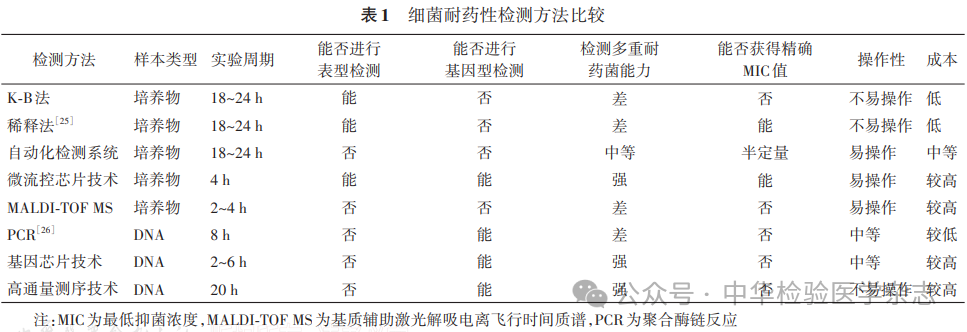
From the comparison, it is evident that microfluidic chip technology exhibits significant technical advantages in the field of bacterial resistance detection, primarily reflected in the following aspects: (1) Compared to traditional susceptibility tests (such as K-B method and dilution method), which have long detection cycles (24-72 h), limited sensitivity, and cannot reveal resistance mechanisms, microfluidic technology, through miniaturized fluid control systems and functional module integration, can complete the entire process from bacterial culture to multi-drug resistance analysis within 8 hours [27]. (2) High-throughput analysis: Microfluidic chip systems can analyze thousands of bacteria per second under the action of antimicrobial agents [28], reducing sample consumption to 1%-5% of traditional methods [29]. (3) Advantages of miniaturization and automation: Microfluidic chip technology can achieve full automation of sample processing, drug distribution, and result interpretation. For example, Jeon et al. [30] developed an automated electrochemical microfluidic chip that combines electrodes, dendritic micromixers, and normalized capacitance to automate the mixing and distribution of antibiotics in multiple test chambers and measure electrical signals. This device requires only 175 minutes and 150 minutes for bacterial counting and antimicrobial susceptibility analysis, demonstrating high automation and portability. (4) Multi-analysis capability: Combining phenotypic detection (such as dynamic monitoring of metabolic activity) with genotypic detection (such as resistance gene PCR amplification). However, issues remain regarding the reproducibility, consistency, and cost-effectiveness of microfluidic chip technology, and the extraction of bacterial cells from raw samples has not yet been achieved conveniently and with quality assurance. Robust and cost-effective characterization, data processing and analysis, and result reporting methods have yet to be established [31].
4. Combined Detection of Bacterial Resistance Using Microfluidic Chip Technology and Other Technologies
Microfluidic chip technology can be combined with genomics, proteomics, and other technologies to improve the accuracy of resistance detection. This technological integration can significantly enhance the overall analytical level, providing great assistance for clinical diagnosis of bacterial resistance.
1. Combination of Microfluidic Chip Technology and High-Throughput Sequencing Technology:High-throughput sequencing technology is a method capable of rapidly reading large amounts of DNA sequences, with advantages of speed, broad coverage, and high sensitivity. With the continuous development of high-throughput sequencing technology, shortening sequencing times, and reducing costs, its application in resistance detection is becoming increasingly common [32]. The combination of the two can form an efficient bacterial resistance detection platform. First, in sample preparation, microfluidic chip technology can effectively isolate and enrich specific bacteria from complex biological samples, eliminating interfering factors and preparing for subsequent high-throughput sequencing. Second, integrated sensors in microfluidic chips can monitor bacterial responses during drug treatment in real-time. This real-time monitoring capability provides important evidence for studying bacterial resistance [33]. In data integration and analysis, genomic data obtained from high-throughput sequencing can be combined with biological response data obtained from microfluidic chips, utilizing bioinformatics analysis tools to explore resistance mechanisms in depth. For example, changes in gene expression can be analyzed to identify key genes associated with resistance. Kim et al. [34] introduced a microfluidic sample preparation platform that integrates all key steps in second-generation sequencing sample preparation: cell concentration, lysis, fragmentation, adapter tagging, fragment purification, and size selection, reducing DNA input requirements to 1% of the original, enabling whole-genome shotgun sequencing of 10,000 cells of Mycobacterium tuberculosis and soil microbial communities, and sequencing of 100,400 clinical Pseudomonas aeruginosa libraries, with sequencing results consistent with antimicrobial resistance results obtained through phenotypic observation.
2. Combination of Microfluidic Chip Technology and Mass Spectrometry Technology:Microfluidic chip technology combined with mass spectrometry analysis shows great potential in resistance detection. This synergistic effect not only enhances the sensitivity and accuracy of analysis but also simplifies existing workflows, making them more suitable for clinical and laboratory applications. Mass spectrometry can provide molecular mass and structural information, widely used in drug analysis, metabolite detection, and biomarker identification, with high sensitivity and rapid response advantages. The integrated platform formed by the combination allows microfluidic chips to connect directly with mass spectrometers, reducing losses during sample transfer and improving consistency and reliability of analysis [35]. Zhang et al. [36] used an online microfluidic mass spectrometry system to characterize metabolic changes in bacteria under antimicrobial stimulation in real-time. Bacteria are loaded into the microfluidic device and injected into a culture medium containing antimicrobial agents, allowing observation of bacterial proliferation during the culture process. Lysis buffer is injected into the microfluidic chip to extract bacterial metabolites, and online electrospray microchip mass spectrometry analysis is performed, achieving online metabolite analysis. Mass spectrometry technology can detect intracellular metabolites in real-time, reducing metabolite variability, achieving precise measurements, and minimizing the impact of exogenous factors on metabolomics analysis. The combination of microfluidic chip technology and mass spectrometry forms a microfluidic chip-mass spectrometry system, significantly improving sample processing efficiency. Su et al. [37] proposed an integrated microfluidic chip-mass spectrometry system that can rapidly screen β-lactamase-producing bacteria and optimize the dosing concentration of β-lactamase inhibitors, providing new methods for studying β-lactamase-related research.
3. Combination of Microfluidic Chip Technology and Fluorescent Probe Technology:Fluorescent probes are chemical substances that emit fluorescence under specific wavelength illumination, capable of specifically recognizing certain biomarkers. This specificity allows fluorescent probes to effectively identify bacteria even in complex samples. Moreover, the sensitivity of fluorescent probes is higher than that of traditional detection methods, enabling detection of bacteria at extremely low concentrations, which is crucial for early detection. Through fluorescent probes, real-time monitoring of reaction processes can be achieved, providing dynamic data to researchers and helping to better understand the mechanisms of resistance. Mohan et al. [38] designed a microfluidic chip platform that obtains resistance results by detecting bacteria expressing green fluorescent protein, determining bacterial sensitivity to antimicrobial agents by measuring changes in local fluorescence intensity over time within 4 hours. Compared to traditional methods, this platform has the following advantages: (1) detection time is only 2-4 hours; (2) improved detection sensitivity; (3) minimal consumption of cell samples and antimicrobial reagents (<6 μl); (4) improved portability through the implementation of normally closed valves. Researchers utilized this platform to quantify the effects of four antimicrobial agents (ampicillin, cefalexin, chloramphenicol, tetracycline) and their combinations on E. coli.
5. Conclusion and Outlook
Microfluidic chip technology has broad application prospects in the rapid detection of drug-resistant bacteria. In terms of improving detection efficiency, microfluidic chip technology can compress detection cycles to 4-9 hours [39], while achieving high detection sensitivity. In terms of technological integration, the deep integration of microfluidic chips with artificial intelligence provides new ways for detecting drug-resistant bacteria. By applying machine learning algorithms to analyze data generated by the chip (including bacterial morphological dynamics, metabolic curves, and gene expression profiles), predictive models for drug sensitivity can be established, with a consistency of 96% compared to traditional methods [40]. Furthermore, the development of microfluidic-based bedside detection devices [41] makes it possible to shift resistance detection from central laboratories to grassroots medical institutions, offering higher immediacy and portability. Undeniably, although microfluidic technology demonstrates unique advantages in resistance detection, its clinical translation still faces multiple controversies and bottlenecks. Technically, the lack of standardization in chip design leads to significant differences in detection performance, and insufficient pretreatment of complex samples (such as sputum) remains a challenge. At the industrial level, there are issues related to high costs. Future efforts should focus on establishing comprehensive standards covering design, manufacturing, and quality control (such as reducing microchannel blockage rates), developing low-cost anti-interference materials, and balancing clinical efficacy with economic viability through multi-center validation. Only by overcoming these critical points can this technology achieve a leap from “concept validation” to “clinical necessity.” In summary, microfluidic chip technology provides new solutions for antimicrobial susceptibility testing, demonstrating significant advantages in improving detection speed, accuracy, and sensitivity [42]. The further development of this technology will help address the increasingly severe global issue of bacterial resistance, supporting public health.
References (omitted)
Scan to read the full article

Chinese Journal of Laboratory Medicine 2025 Reporting Plan