In recent years, multi-level policies and technical standards have been implemented, clarifying the construction direction, access scope, and implementation rules for IoT systems in fire safety facilities, providing a clear track and means for their advancement. However, during the specific construction of the system, there are still many practical problems and challenges, such as aging equipment and “faulty networking”, low configuration collection leading to monitoring blind spots, and a lack of water temperature sensing in low-temperature scenarios.
RAYEYE1.Overview of Requirements for IoT System Construction in Fire Safety Facilities
Figure: Relevant regulations and standards for promoting the construction of IoT systems in fire safety facilities
Administrative documents issued from the national to local levels have promoted the construction of IoT systems in fire safety facilities, responding to the practical needs of smart fire safety while clarifying requirements for networking scope, construction entities, operational responsibilities, data transmission, and regulatory mechanisms. These regulations not only specify the technical implementation paths of the system but also provide institutional guarantees for subsequent supervision and enforcement.
Technical standards have set clear requirements for the setup of urban fire remote monitoring systems and IoT systems for fire safety facilities: they must ensure efficient integration with building and city-level monitoring platforms while requiring comprehensive access of relevant fire safety facilities to the IoT platform, achieving centralized collection, transmission, and monitoring of operational status and fire safety management information. These standards not only refine system configuration and functional indicators but also provide operational technical support for the standardization of smart fire safety.
2.Current Status and Challenges of System Advancement
With the continuous development of smart fire safety, the pace of IoT construction for fire safety facilities in China has significantly accelerated. According to incomplete statistics, more than 23 provinces (autonomous regions and municipalities) have issued various regulations/suggestions to promote system construction. There are 16 local standards and 11 team standards related to this.
Overall, the progress of the construction of IoT systems for fire safety facilities is steadily deepening, but various practical challenges still exist at the implementation level. By examining the relevant clauses of various standards, it can be seen that some implementation difficulties have corresponding specifications or requirements already clarified in the current standards; other content is only reflected in local or group standards.
Challenges in Renovating Old Buildings
Many fire safety facilities in old buildings have severely aged or even failed due to long-term neglect and inadequate maintenance. Simply adding IoT devices in these buildings is unlikely to fundamentally eliminate hazards and may instead be ineffective due to insufficient foundational conditions. Therefore, a comprehensive assessment should be conducted in conjunction with the building structure and system status, and simultaneous upgrades and renovations should be implemented to effectively enhance fire safety levels.
Shanghai’s “Technical Standards for IoT Systems in Fire Safety Facilities” (DG/TJ 08-2251-2018) clearly stipulates that when constructing IoT systems for fire safety facilities, the performance, functionality, and reliability of existing fire safety facilities must not be reduced (3.1.1). This means that promoting IoT renovations in old buildings must first involve a comprehensive assessment and necessary repairs and upgrades of existing facilities to ensure their performance meets standards.
In practical applications, this clause provides important principled guidance for renovation work. However, there is still potential for further deepening and expanding in areas such as performance evaluation methods, repair implementation paths, and renovation priority sequences. As industry practices continue to accumulate, the improvement of related supporting guidelines will help construction units and management departments execute more efficiently and uniformly, and is expected to promote continuous optimization of IoT renovations in old buildings in terms of depth, quality control, and acceptance standards.
Insufficient Configuration Due to Cost Cutting
To reduce investment costs, some units only select the minimum monitoring configuration for construction projects. For example, the sprinkler system only monitors the operational status of the sprinkler pump and the pressure of the main pipeline, lacking monitoring of the pressure at the end of the sprinkler system.
Shanghai’s “Technical Standards for IoT Systems in Fire Safety Facilities” (DG/TJ 08-2251-2018) clearly states in clause 4.3.1(2) and 4.3.2 that in automatic sprinkler systems, end-of-line water testing monitoring devices should be installed at the most disadvantageous point of each alarm valve group. Shanxi’s “Technical Specifications for Urban Fire Remote Monitoring Systems” (DB14/T 2863-2023) also makes the same provision in 6.2.2.1.
From the perspective of technical standards, the installation of end-of-line water testing monitoring devices has been clearly required in many local regulations, aimed at accurately reflecting the water supply capacity of the entire sprinkler system under fire conditions by monitoring the pressure at the most disadvantageous point of the system. If only the minimum monitoring points are configured, while basic operation can be maintained, there are deficiencies in functional coverage and data integrity, weakening the timeliness of hazard warnings and emergency responses. Long-term neglect of key monitoring aspects not only reduces protection levels but may also increase costs and risks associated with later maintenance, renovations, and incident handling.
Monitoring Blind Spots Affect Warnings
Currently, many systems overlook the impact of low-temperature environments in their designs, lacking monitoring of pipeline water temperatures. When the temperature drops below 4°C, the expansion force generated by freezing water can cause pipe bursts. Without temperature monitoring, it is difficult to provide timely warnings and prevent such risks.
(Note: Water has the maximum density and minimum volume at 4°C. As the temperature continues to drop, water molecules begin to form ice crystal structures, becoming less dense and increasing in volume, entering the so-called “anomalous expansion (i.e., cold expansion and hot contraction)” range, thus generating a strong expansion force during the freezing process.)
The “Fire Protection Design Code for Buildings” (2018 Edition) (GB 50016-2014) clearly states in Article 12.2:
“An independent fire water supply system should be set up in tunnels. Fire water supply pipelines and outdoor fire hydrants in extremely cold and cold regions should take anti-freezing measures; when using a dry water supply system, automatic exhaust valves should be installed at the highest points of the pipeline, and the filling time of the pipeline should not exceed 90 seconds.”
These clauses reflect the design level’s attention to low-temperature risks, but mainly focus on structural and process protection, leaving gaps in operational monitoring. In the absence of temperature monitoring, the risk of freezing often accumulates unnoticed, appearing normal in operation until the pipeline freezes, valves jam, or equipment is damaged.
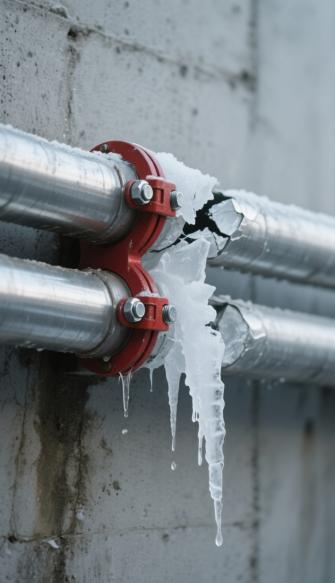
Figure: Fire pipeline burst due to low temperature
3.Conclusion
From concept promotion to system implementation, the construction of IoT systems for fire safety facilities has begun to take shape. In the face of existing technical bottlenecks and management shortcomings, only by continuously improving system architecture, equipment configuration, and data monitoring, and building a closed-loop management mechanism, can we ensure that this system continuously enhances stability, reliability, and coverage depth, providing long-term and reliable support for urban public safety.
Content Statement: This is not an original article from RAYEYE Technology, and the source will be indicated. Reproduced content is for learning and exchange purposes only, and the views expressed do not represent the position of RAYEYE Technology. Copyright belongs to the original author. If there is any infringement, please contact us for removal.
Content Source: RAYEYE Technology
Business Contact:400-920-5245
— Previous Highlights —
► Filling the Gap! The First Blue Book on Fire IoT Officially Released► The First Blue Book on Fire IoT is available for borrowing at Shanghai Library and Tongji University Library► “Shanghai Brand” RAYEYE Technology, setting the benchmark for smart fire safety services► [Yet Again] RAYEYE Technology Awarded Shanghai’s “Specialized, Refined, Unique, and Innovative”► Can the Fire Control Room be staffed by one person? A comprehensive understanding from standards and technology► “IoT + Risk Assurance” service model aids the digital transformation of fire management► Guardian Plan: Improving the risk transfer mechanism to support stable enterprise development► Case Study | AI-Anomaly Detection Algorithm, aiding rapid identification of fire hazards