
In the field of automotive safety, the Tire Pressure Monitoring System (TPMS) is a safety system used to monitor tire pressure parameters and can automatically alert when tire pressure parameters deviate from a reasonable range, playing a key role in enhancing driving safety, comfort, and energy efficiency.

Currently, TPMS in the automotive industry is mainly divided into direct TPMS and indirect TPMS. Among them, direct TPMS is the mainstream technology route in the current automotive industry.
It primarily uses highly sensitive micro wireless sensing devices to collect tire pressure and temperature parameters in real-time and accurately, displaying them on the vehicle’s dashboard or central control screen; when abnormal tire pressure data is detected, the system alerts the driver through beeping or voice notifications.
01
Digital Pressure Sensors: How to Accurately Perceive Automotive Tire Pressure
It is well known that when the tire pressure of a vehicle decreases, the contact area between the tire and the ground increases, resulting in greater friction and rolling resistance, causing the vehicle to overcome greater resistance, which in turn leads to increased fuel and energy consumption;
Conversely, when the tire pressure increases, the contact area decreases, reducing grip and increasing the braking distance, which may also lead to tire blowouts; therefore, maintaining appropriate tire pressure not only increases vehicle range but also reduces the occurrence of safety accidents.
In direct TPMS, the digital pressure sensor is the core sensing device for measuring pressure, typically combined with a battery and SoC RF transmission chip to form the TPMS transmission module, which is installed inside the wheel hub of the four wheels, or can be integrated with the tire valve in a valve-integrated internal solution (a common OEM solution).
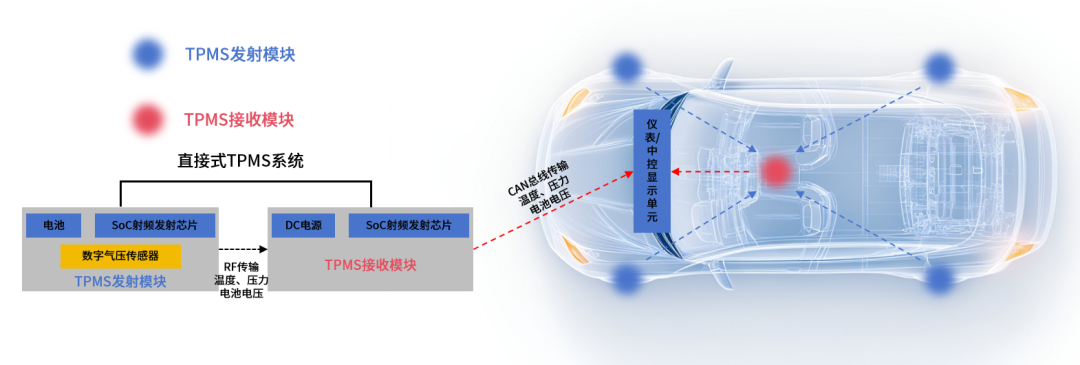
A Schematic Diagram of a Direct TPMS
The TPMS transmission module wirelessly transmits the data measured by the digital pressure sensor and its module’s battery voltage data in real-time to the TPMS receiving module;
the driver can view this data in real-time on the dashboard or central control screen to understand the current status of the tires. When the temperature, pressure, or battery voltage of any tire exceeds the alarm threshold, the system will accurately identify the tire’s position and issue a low-pressure alarm CAN signal in the form of graphics, sound, or text within a short time.
02
Digital Pressure Sensors: The “Smart Brain” of Pressure Sensing
It is worth mentioning that the digital pressure sensor, as the core sensing device of the TPMS system, must operate stably under complex automotive conditions (such as centrifugal force from high-speed tire rotation, severe temperature fluctuations, vibrating driving environments, humidity, and chemical corrosion) while also possessing key performance characteristics such as miniaturization, low power consumption, and high precision to ensure the accuracy and long-term reliability of measurement data.
For example, the HPS700A developed by Hoperf is a high-precision digital pressure sensor with a high-speed I²C interface that can simultaneously provide real-time and accurate temperature and pressure measurement data, with its pressure and temperature data output processed digitally by a high-resolution 24-bit ADC.
Additionally, the HPS700A integrates a data compensation function (using a dedicated algorithm for compensation), which can reduce the workload of the external host MCU system.
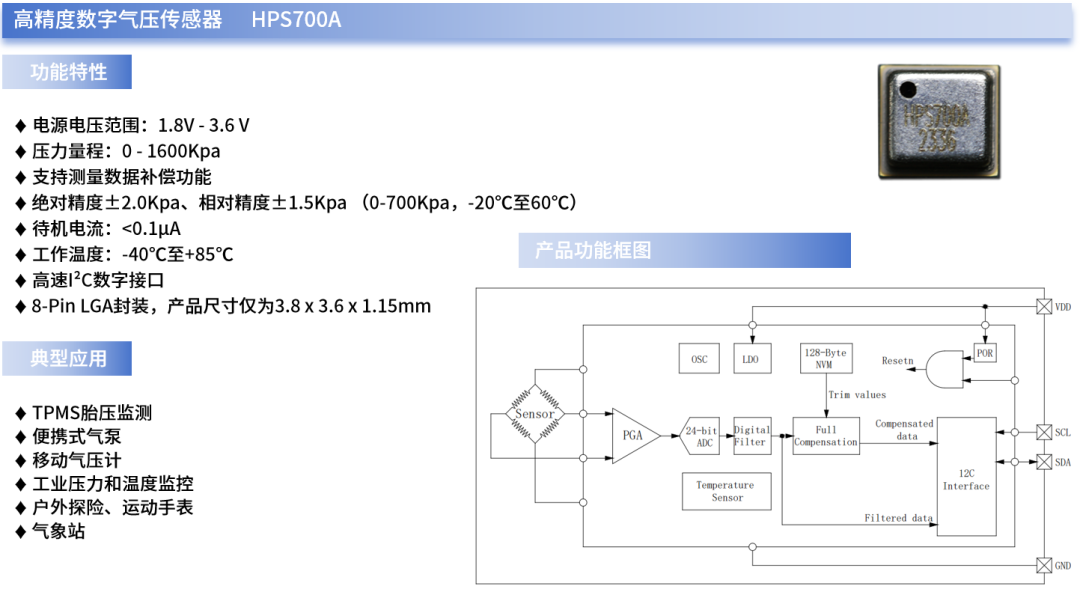
The relative accuracy of HPS700A pressure measurement can reach ±1.5kPa, supporting a wide temperature range of -40℃ to 85℃, with a measurement range of 0 to 1600kPa, and its standby current is as low as 0.1μA, which can greatly enhance the endurance of the TPMS transmission module.
Before leaving the factory, the HPS700A is individually calibrated for sensitivity and offset of temperature and pressure measurements, with calibration values stored in an on-chip 128-byte non-volatile memory (NVM), so users generally do not need additional calibration.
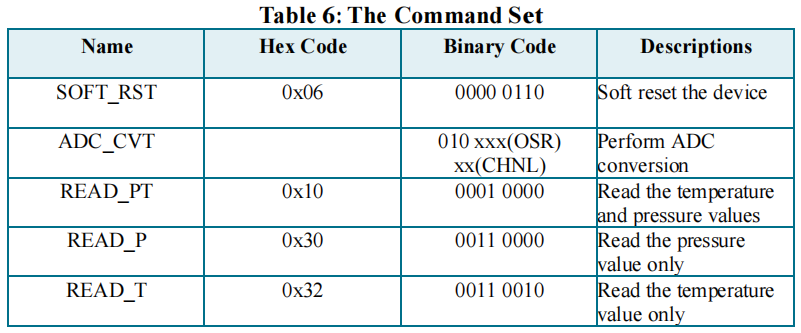
HPS700A – Instruction Set
It is also worth noting that the HPS700A supports the user host to read and write registers through the high-speed I2C digital interface to adjust the measurement accuracy and data conversion time of the device, allowing it to flexibly adapt to various measurement requirements in different application scenarios.
For example, by writing the ADC_CVT instruction (010, 3-bit OSR, 2-bit CHNL) to the register, the type of digital signal output by the sensor (temperature or both temperature and pressure) and its internal OSR oversampling rate can be set.
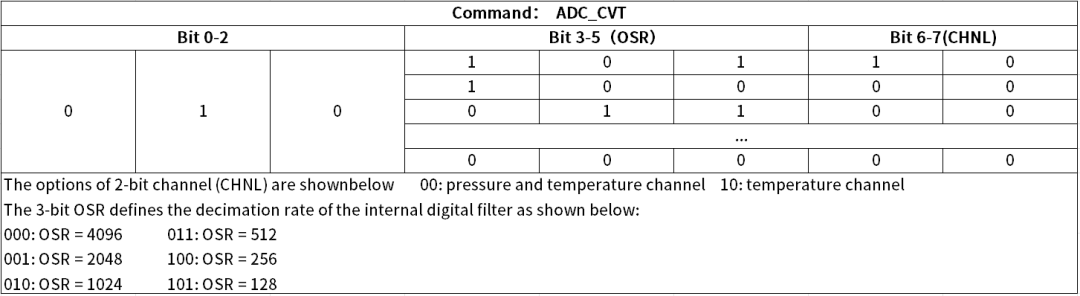
When the 3-bit OSR is set to 000, the oversampling rate of the HPS700A will be set to 4096; when the 2-bit CHNL is set to 00, the HPS700A will convert both pressure and temperature channels simultaneously (i.e., the ADC will process the raw signals of both pressure and temperature to generate corresponding digital outputs).
Note: The higher the OSR value (e.g., 4096), the more times the ADC samples and averages the raw signal, resulting in higher measurement accuracy (resolution), but conversion time and power consumption will also increase. (For more details, please refer to the HPS700A product specification).
Looking ahead, as the automotive industry accelerates its transformation towards intelligence and connectivity, digital pressure sensors, as core sensing devices in TPMS tire pressure monitoring systems, will increasingly focus on enhancing multidimensional sensing capabilities and the deep integration of intelligent algorithms, thereby promoting the evolution of automotive safety monitoring from single tire pressure parameter detection to multidimensional status assessment.
1
END
1

About Hoperf
Shenzhen Hoperf Microelectronics Co., Ltd. (hereinafter referred to as Hoperf) was established in 2004 and is a national high-tech enterprise focused on independent innovation and product development of core IoT components.
Over the past 20 years, Hoperf has expanded its development from Sub-GHz wireless communication RF chips and module products to high-precision MEMS sensors and digital isolator products, forming a product layout that integrates key links of information perception and information interaction.After years of accumulation, Hoperf has developed into a system-level service provider for IoT wireless communication, integrating RF chip design, firmware and protocol design, application development, and testing.
As one of the well-established IoT wireless RF chip brands in China, the company has accumulated a large number of high-quality customer resources and brand recognition both domestically and internationally, thanks to its solid R&D capabilities, reliable product quality, cost-effective advantages, and system-level service capabilities.
If you have any needs, please contact us immediately!
Phone: 400-1189-180
Email: [email protected]
Website: https://hoperf.cn/
For more information, please follow 【Hoperf】
↓↓↓↓
Please like

Please share

Please like