
The research team from Cornell University has developed a brand new 3D printing process over nearly a decade, which can significantly enhance the performance of compound superconductors.
This research is led by Professor Ulrich Wiesner from the Department of Materials Science and Engineering at Cornell University, primarily combining 3D printing and heat treatment to achieve a new method for manufacturing superconductors.
The core step of this process is 3D printing. The researchers first prepared a special “ink” composed of copolymers and inorganic nanoparticles, and printed it onto the substrate surface.
Subsequently, the samples underwent high-temperature treatment, transforming the ink into a porous crystalline superconductor, which forms a regular lattice at the atomic scale while maintaining the shape imparted by 3D printing at the macroscopic scale.
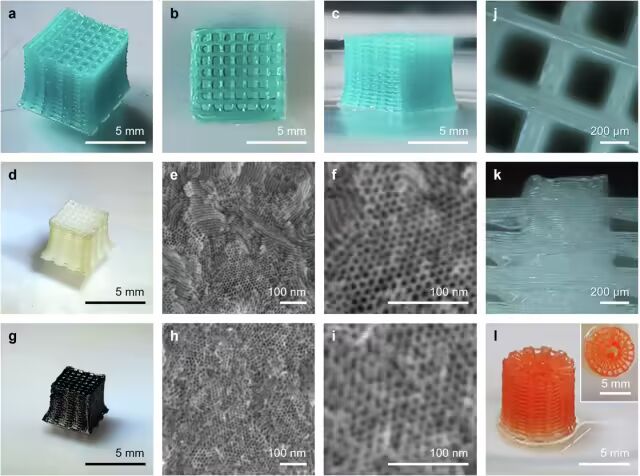
This multi-level structure refreshes the effective surface area record of compound superconductors, and a larger surface area means more active sites, which can significantly enhance the material’s performance in electronic transport and other aspects, thereby providing potential support for resource-intensive fields such as quantum computing.
Professor Wiesner stated that this achievement embodies nearly ten years of the team’s efforts.This method has currently only been successfully validated on crystalline nitrides, but theoretically, it can be extended to other metallic compounds, such as titanium nitride, which, despite differing properties, can still achieve similar high surface area characteristics.
The research is still in its early stages, and further validation and optimization are needed before industrial applications can be realized. However, this achievement provides a new perspective for the manufacturing of superconducting materials and demonstrates the enormous potential of 3D printing in the field of advanced materials, which may drive the development of cutting-edge technologies such as quantum hardware.
Source: IT Home
▼ Previous Popular Articles ▼
New Starting Point, New Journey! The Chengdu Branch of Zhongxiruang has moved to a new address
The results of the trademark agency credit evaluation in Jiangsu Province have been announced, and Zhongxiruang has received an A-level credit rating
A new chapter begins at the new address, forging brilliance! The Taiyuan Branch of Zhongxiruang has officially opened at its new location
The first prototype of a holographic 3D projection that can be interacted with by hand, “FlexiVol,” has been released
100% charging in just 18 seconds! RML Group has released the world’s highest power density VarEVolt battery
Failure to delete photography works after the authorization expires may constitute infringement!
Scientists have created a “virtual headphone” that can only be heard at a specific location
Is it legal to reference popular drama names in product links?
For the first time internationally! Chinese scientists have successfully developed a high temporal and spatial resolution Brillouin microscope
Major scientific issues, engineering technical challenges, and industrial technology problems for 2025 have been released
LG Innotek has globally launched copper pillar technology: reducing the size of mobile semiconductor substrates by up to 20% while maintaining performance
MIT has developed a new AI repair technology: “reviving” a 15th-century oil painting in three and a half hours
A new type of flexible power generation film material that can generate electricity from body heat has been developed in China
New breakthrough! A Chinese research team has completed module-level verification of a star-ground quantum direct communication system for the first time
A new sensor system has emerged! It can detect obstacles 200 meters away in extremely low visibility environments
[Warm Reminder] Some images in this article are sourced from the internet, and the copyright belongs to the original authors. If there are any issues, please contact us for modification or deletion.