
There is an old Chinese saying that “all medicine is three parts poison.” Common drug delivery methods resemble indiscriminate rainfall; once the drug enters the body, it spreads throughout with the blood circulation. While it can act on the lesions, it inevitably affects healthy tissues as well. This “inflicting a thousand injuries to oneself while harming the enemy” model is the reason many treatments produce side effects. Is there a way to deliver drugs precisely to the lesion area without affecting other places?
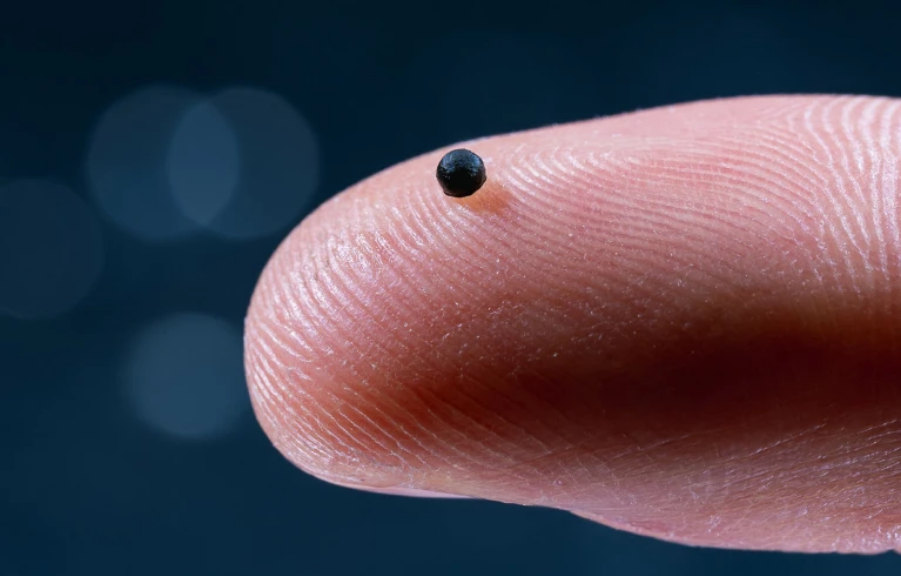
These tiny, drug-filled robots are guided by magnets as they navigate through blood vessels. Image source: Luca Donati/lad.studio Zürich
The news section article titled “Tiny robots swim through blood, deliver drugs — and then dissolve” published in Nature on November 13, 2025, introduces cutting-edge research results from a team at ETH Zurich. These robots can swim in blood, deliver drugs precisely, and then dissolve on their own.
The robots are gelatin beads the size of sand grains, filled with drugs and magnetic iron oxide nanoparticles, remotely controlled by an external magnetic field. Upon reaching the target, a high-frequency magnetic field heats the magnetic particles, melting the gelatin shell to release the drug precisely, after which the robots dissolve without leaving residues in the body.
Below is the translation of the article “Tiny robots swim through blood, deliver drugs — and then dissolve” (click here to read the original English article).
A sand grain-sized remote-controlled robot can swim through blood vessels, delivering drugs into the body and dissolving after the drug is released. This technology holds promise for enabling doctors to deliver small amounts of drugs precisely to specific locations, thereby avoiding the toxic side effects of systemic administration.
Researchers demonstrated in a paper published on November 13 in Science that magnetically guided microrobots can operate in the blood vessels of pigs and sheep.
The system has not yet been tested on humans, but it is promising as it is suitable for bodies roughly equivalent to human size, and all its components have been shown to be biocompatible. Bradley Nelson, a mechanical engineer at ETH Zurich and co-leader of the work, stated.
Nelson noted that about one-third of developed drugs that fail to reach the market do so due to excessive toxicity. The research team claims that microrobots can deliver small amounts of drugs directly to the affected area, thereby reducing potential side effects. This technology could be used to treat vascular blockages caused by strokes or brain tumors.
“These demonstrations are compelling, but they are still in the preclinical stage,” said Wei Gao, a medical engineer at Caltech in Pasadena. His team has developed an alternative robotic drug delivery system. However, he stated that if subsequent research progresses smoothly, remotely controlled drug delivery robots could be applied in the first medical fields within five to ten years.
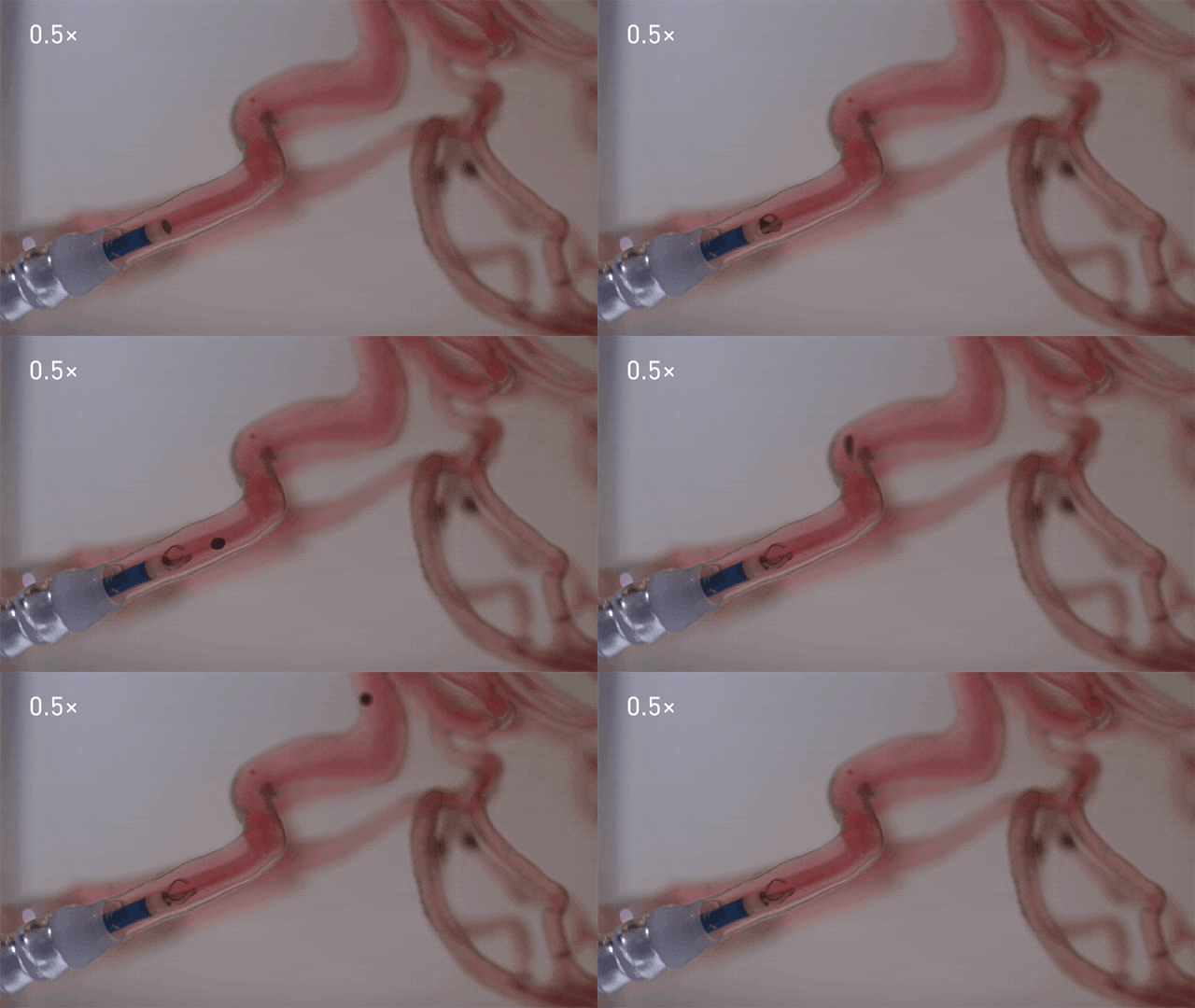
Image source: ETH Zurich
Drug Delivery by Robots
For decades, researchers have been exploring how to use microrobots for drug delivery, including using ultrasound to control them and employing rotating devices that mimic bacteria.
The system developed by the ETH Zurich team involves filling tiny gelatin beads with drugs and magnetic iron oxide nanoparticles, allowing the movement of the gelatin beads to be controlled by the magnetic field surrounding the patient.
The research team conducted experiments in the brains of pigs and sheep, demonstrating that they could implant the robots into the brain via catheters, allowing them to roll along the edges of blood vessels, flow upstream or downstream, at speeds of up to 40 centimeters per second. They used X-ray imaging to observe and manipulate these robots in real-time with millimeter-level precision. In the pig trials, the research team found that in over 95% of cases, the drugs were delivered precisely to the correct location.
To release the drugs, the research team used rapidly changing magnetic fields to heat and decompose the gelatin. Professor Gao stated that before applying this to humans, researchers need to monitor how the body clears the residual nanoparticles.
To release the drugs, the research team used rapidly changing magnetic fields to heat and decompose the gelatin. Professor Gao stated that before applying this to humans, researchers need to monitor how the body clears the residual nanoparticles.
Nelson stated that finding the right combination of materials that allows the robots to be remotely controlled while being small enough to navigate through tiny blood vessels is “significant,” and the team spent 20 years achieving this. “In hindsight, everything seems obvious. But achieving this was a huge leap.”
