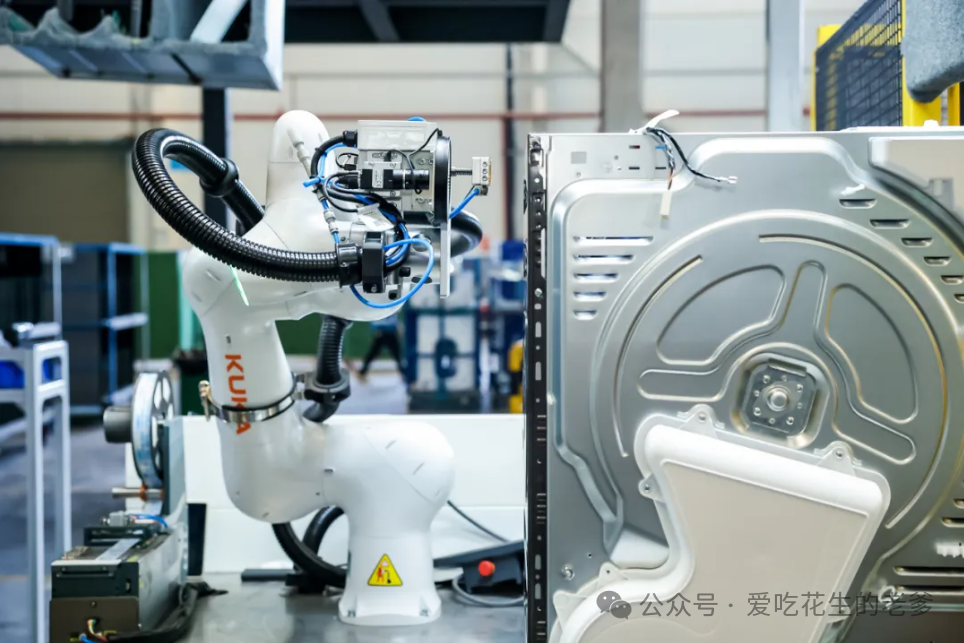
For skilled workers, tightening screws is an instinctive operation that requires no thought, but for robots, it presents a technical challenge that integrates multidimensional capabilities. In Midea’s washing machine factory in Jingzhou—this latest generation of 5G fully connected factories—the KUKA icco collaborative robot provides the answer: with multimodal technologies such as visual recognition and force feedback, it precisely completes the screw fastening tasks for different models of washing machines, vividly illustrating the AI transformation of traditional manufacturing.
In 2025, the KUKA icco collaborative robot officially entered the Jingzhou factory, with its core mission being to tackle the screw fastening challenges in mixed-flow production.
In flexible production scenarios, one moment it may be an A model product, and the next it could switch to an entirely different model, requiring all operational parameters to be adjusted in real-time.
This demands that the robot not only accurately identify hole positions, relying on touch and force feedback for precise positioning of small holes, but also control the tightening force accurately to ensure that each screw is tightened appropriately. “These capabilities need to be enhanced simultaneously, and the technical threshold is extremely high,” explained Xu Yi, the director of Midea Group’s AI Research Institute, noting that this multimodal solution is a typical representation of industrial AI applications.
Almost concurrently with icco, there is also the humanoid robot “Mei Luo No. 1”.
It is not an ordinary operator but a “deployed” “workshop director” that conducts daily safety inspections and equipment checks, adding lubricants to machines that require maintenance; it takes over the initial inspection of products, moving newly produced items to the intelligent inspection station, where data is checked for compliance, allowing the production line to continue or triggering an immediate alarm for any anomalies; in simple scenarios, it can even autonomously “think” and fine-tune machine parameters, becoming an important part of the factory’s autonomous decision-making.
“Previously, smart factories were passive, requiring humans to retrieve data and make decisions; now, with AI empowerment, factories have a ‘brain’, achieving a leap from localized intelligence to global intelligence,” described Lv Hongzhi, the head of the Jingzhou factory, highlighting the core value of AI transformation. This change is not only reflected in screw fastening and workshop inspections but also permeates the entire production process.
For example, in the quality inspection phase, past inspectors manually judged against design drawings, taking half an hour to an hour, with new employees prone to errors; now, with AI glasses taking over, the process of “taking a photo – reading – adjusting the order – comparing standards and historical error points” can be completed in seconds, achieving a 100% accuracy rate.
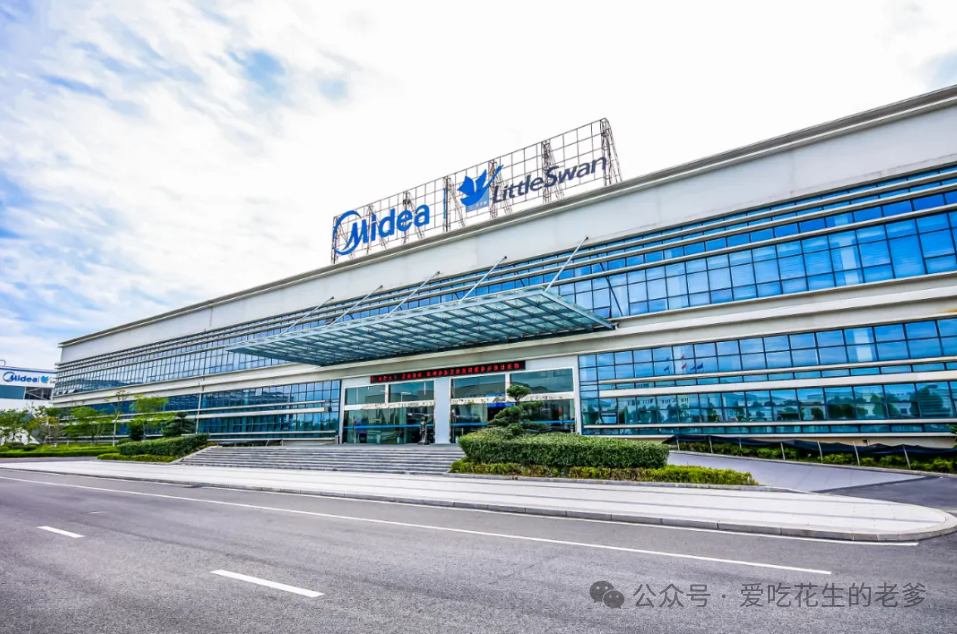
This transformation is backed by Midea’s more than a decade of digital transformation efforts.
The “632 Project” launched in 2012 is a key turning point, integrating Midea’s originally ten business units and ten systems into “one Midea, one system, one standard”, laying the foundation for subsequent intelligent upgrades.
Midea Group’s IT director Zhou Xiaoling candidly stated: “Digitalization is not an IT project but a business transformation project that must be led by business departments and consider organizational humanity; otherwise, it is difficult to promote.”
Over the past decade, Midea has invested over 20 billion yuan in digital transformation. After launching the factory AI renovation in September 2024, it has developed 14 business intelligent agents, and the addition of humanoid robots in May 2025 marks a true breakthrough moment for the factory’s “brain” activation.
The operation of the AI factory relies on massive data support.
The Jingzhou factory previously had a daily data storage capacity exceeding 10TB, equivalent to the total of 6666 high-definition movies; after introducing humanoid robots, the real-time data interaction volume surged, with daily storage skyrocketing to 30TB.
In addition to data thresholds, lean production transformation is also a prerequisite; if the logistics handling area is crowded, robots will struggle to perform. More challenging is the equipment compatibility issue, as the advanced equipment introduced during the factory’s construction, such as cloud logistics and unmanned forklifts, comes from different suppliers with varying protocols, akin to “elite soldiers who speak different languages” and cannot collaborate effectively.
To address this, Midea’s team spent considerable time breaking down barriers between intelligent agents, and KUKA robots have also explored new smart logistics solutions, allowing factory logistics vehicles to autonomously recognize their environment and report to the system in real-time, becoming the “information tentacles” of management.
The transformation effects are already evident, with core scene efficiency in the Jingzhou factory improving by 80%, compressing the production process of a washing machine to under 10 seconds.
More critically, the leap in anomaly handling capabilities has been significant; previously, production line faults required waiting for experts to investigate, but now, AI integrated with expert systems can complete diagnostics in seconds, ensuring production stability.
Even more surprisingly, AI’s autonomous evolution has simplified the factory’s original “seven-step method” for handling offline issues into a single step, directly generating the optimal solution.
“Today’s machines are not just executors but also evolvers,” Lv Hongzhi remarked, noting that the planning agent can now complete in seconds what used to take planning specialists hours; although human review is still necessary, the trend of AI replacing some specialized work has become evident.
This factory transformation is not an isolated case but a practical model of Midea’s AI strategy.
The high-end factory in Wuxi, which began production in November, is the 2.0 version iterated from the 1.0 intelligent agent factory in Jingzhou.
Midea’s choice is not coincidental; in its multi-scenario layout, the manufacturing end is its unique advantage, as while there are general large models in the market, there is a lack of large models for production and manufacturing; the data structure of factory scenarios is highly structured, and once the technology matures, it can spill over into building technology and other fields, creating significant leverage.
AI empowerment has also injected new momentum into Midea’s B-end business. In 2024, Midea’s B-end business revenue surpassed 100 billion yuan for the first time, with a year-on-year growth of 18% in the first three quarters of 2025, and three segments have reached a revenue level of 30 billion yuan. The digital platform Meiyun Zhishu has already received orders for intelligent agents, marking a key step in AI commercialization. According to the plan, Midea’s future AI research will progress along two lines: continuously iterating factory technology while also focusing on the home end, promoting dual innovation in scenarios and technology.
“Internet giants excel in developing general large models, while Midea’s advantage lies in its rich manufacturing and product scenarios, which is the best training ground for AI self-evolution,” Xu Yi admitted, noting that the current evolution of factory AI is still in its infancy, and future challenges include overcoming three major hurdles: single-point specialization, technological generalization, and data accumulation speed. However, he is very confident: “Midea has massive data, and if fully utilized, it can definitely compete with internet companies in the AI era.”
From the KUKA icco’s precise screw fastening to the intelligent inspection of Mei Luo No. 1, Midea has answered the question of “how many steps are needed to tighten a screw”—the answer is: one step, an AI-led full-process intelligent execution.
This transformation that began in the workshop not only reconstructs production efficiency but also highlights the determination of traditional manufacturing enterprises to undergo a “self-revolution”. As dozens of factories and over 50 years of manufacturing experience achieve interconnectivity through AI, Midea is sketching a new picture of future industry: where N people are needed, only one robot is present, and this is just the beginning of AI empowering the manufacturing industry.