Programmable Logic Controllers (PLC) are the core devices in modern industrial automation, often referred to as the “brain of industrial automation.” Whether you are a seasoned electrical engineer or a newcomer to the field, mastering the professional terminology of PLCs is fundamental to understanding and applying this technology. This article aims to provide you with a comprehensive and systematic guide to PLC terminology, helping you clear the obstacles on your learning path.
1. Hardware-Related Terms

-
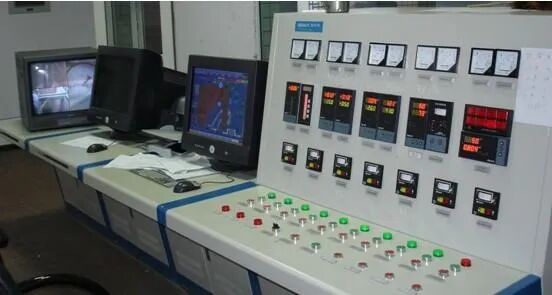
PLC (Programmable Logic Controller) – 可编程逻辑控制器
-
Definition: A digital computing electronic system specifically designed for industrial environments. It uses programmable memory to store instructions for executing logical operations, sequential control, timing, counting, and arithmetic operations, and controls various types of machinery or production processes through digital or analog input/output.
CPU (Central Processing Unit) – 中央处理单元
-
Definition: The core component of the PLC, analogous to the human brain. It is responsible for executing user programs, processing data, coordinating the operation of various parts of the system, including controlling input/output, performing logical and mathematical operations, and communicating with external devices.
I/O (Input/Output) – 输入/输出
-
Input: Refers to the interface through which the PLC receives signals from external field devices (such as sensors, buttons, switches). These signals indicate the status of the devices (e.g., whether a switch is closed, whether the temperature exceeds limits).
-
Output: Refers to the interface through which the PLC sends control signals to external field devices (such as relays, solenoids, motor starters). Through these signals, the PLC can control the start/stop or state change of the devices.
-
DI/DO (Digital Input/Output) – 数字量输入/输出: Channels that handle on/off (1/0) signals, such as buttons and indicator lights.
-
AI/AO (Analog Input/Output) – 模拟量输入/输出: Channels that handle continuously varying signals, such as temperature, pressure, flow sensors (input), or adjusting valve openings, motor speeds (output).
Module – 模块
-
Definition: Functional units in a PLC system that can be independently installed and replaced. Common types include power modules, CPU modules, digital I/O modules, analog I/O modules, communication modules, and special function modules. Modular design allows for very flexible configuration of the PLC.
Rack/Chassis – 机架/底板
-
Definition: The hardware structure used to install and secure various PLC modules. It provides mechanical support and electrical connections (such as power and data bus) for all modules.
Power Supply – 电源
-
Definition: A device that provides a stable operating voltage (usually DC 24V or DC 5V) for the PLC system (CPU, I/O modules, etc.). It converts AC mains power (e.g., AC 220V) into the DC power required by the PLC.
Fieldbus – 现场总线
-
Definition: A system used in industrial fields to achieve bidirectional, serial, multi-node digital communication between controllers, sensors, and actuators. Common types include PROFIBUS, PROFINET, Modbus, DeviceNet, CC-Link, etc. It greatly reduces field wiring.
2. Software and Programming-Related Terms

-
Ladder Diagram (LD/LAD) – 梯形图
-
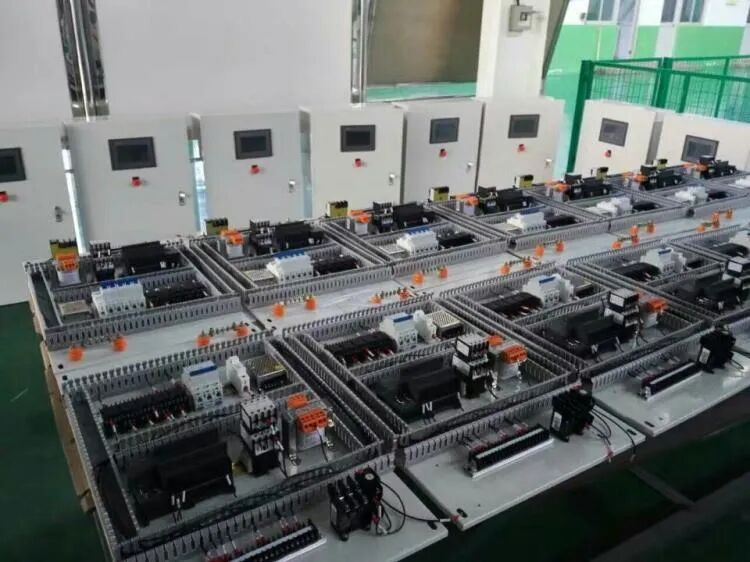
Definition: The most commonly used and intuitive PLC programming language, its graphical symbols resemble relay control circuit diagrams. It uses symbols such as contacts and coils to represent logical control relationships, making it easy for electrical personnel to understand and master.
Function Block Diagram (FBD) – 功能块图
-
Definition: A graphical programming language that constructs programs by encapsulating program functions into “blocks” and connecting them with lines. Each block has inputs and outputs, making it very suitable for process control and handling complex algorithms.
Structured Text (ST) – 结构化文本
-
Definition: A high-level text programming language similar to Pascal or C. It uses complex statements, conditional judgments (IF…THEN…ELSE), loops (FOR, WHILE), etc., making it very suitable for data processing, algorithm implementation, and mathematical calculations.
Instruction List (IL) – 指令表
-
Definition: A low-level, assembly-like text programming language. It consists of a series of instructions, each occupying a line, suitable for experienced programmers to write compact and efficient code, but it is now used less frequently.
Sequential Function Chart (SFC) – 顺序功能流程图
-
Definition: A graphical language used for compiling sequential control programs. It describes the execution order of the program through steps (Step), transitions (Transition), and directed connections, particularly suitable for control with obvious stepping processes (e.g., robotic arms, production lines).
Tag (Variable) – 标签/变量
-
Definition: A meaningful name assigned to a memory address in software programming (e.g., “Motor_Start”, “Tank_Level”). Using tags instead of absolute addresses (e.g., I0.0, Q0.1) makes the program more readable and maintainable. This is standard in modern PLC programming.
Data Type – 数据类型
-
BOOL (Bit): Boolean type, 1 bit, values 0 or 1.
-
BYTE: Byte, 8 bits.
-
WORD: Word, 16 bits, commonly used to represent 16 DI states or an integer.
-
INT: 16-bit signed integer.
-
DINT: 32-bit signed integer.
-
REAL: 32-bit floating point, used to represent decimals.
-
TIMER: Timer type.
-
COUNTER: Counter type.
-
Definition: Defines the type and size of data represented by the variable. Common types include:
Scan Cycle (Scan Time) – 扫描周期(扫描时间)
-
Definition: A complete process in which the PLC repeatedly executes its work. A typical scan cycle includes: reading input status -> executing user program -> processing communication requests -> performing self-diagnosis -> updating output status. The time of the scan cycle is an important indicator of PLC performance.
-
3. Function and Instruction-Related Terms

-
Timer – 定时器
-
Counter – 计数器
-
Function (FC) / Function Block (FB) – 函数/功能块
-
Data Block (DB) – 数据块
-
PID (Proportional-Integral-Derivative) Control – PID控制
TON (On-Delay Timer): A timer that starts timing after the coil is energized, and the contact acts when the time is up.
TOF (Off-Delay Timer): A timer that starts timing after the coil is de-energized, and the contact resets when the time is up.
TP (Pulse Timer): A pulse timer that generates a fixed-width pulse after the coil is energized.
Definition: Function instructions used to implement delay or timing. Common types include:
CTU (Up Counter): An up counter that accumulates rising edge pulses and activates the contact when the set value is reached.
CTD (Down Counter): A down counter that decrements pulses starting from the set value.
CTUD (Up/Down Counter): An up/down counter.
Definition: Function instructions used to accumulate the number of input pulses. Common types include:
FC: A code block without a static storage area (similar to a function in C). It generates temporary data during execution, which is not retained after exiting. Suitable for general operations without memory functions.
FB: A code block with a dedicated background data block (DB). Its internal state (static variables) is retained each time it is called, suitable for control with memory functions, such as motor control, valve control, etc.
Definition: A memory area used to store user data. It can be a global data block (accessible by all programs) or a background data block (exclusive to a specific function block FB).
Definition: A widely used feedback loop control algorithm in industrial control. It combines proportional (P), integral (I), and derivative (D) calculations to ensure that the controlled physical quantity (such as temperature, pressure) accurately and stably reaches the set value.
4. Communication and Network-Related Terms

-
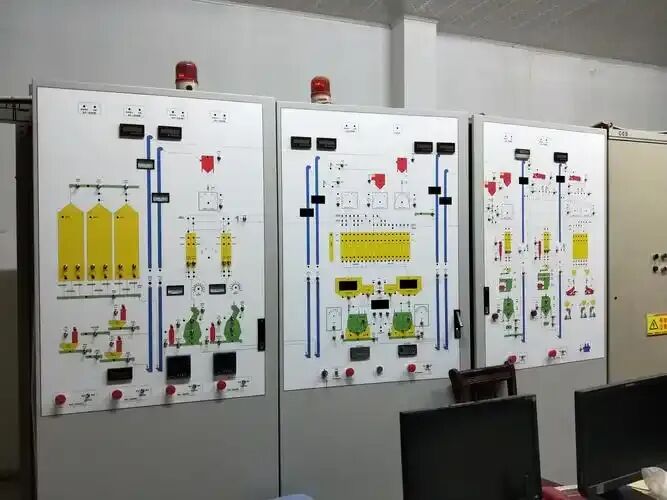
HMI (Human Machine Interface) – 人机界面
-
SCADA (Supervisory Control And Data Acquisition) – 数据采集与监视控制系统
-
OPC (OLE for Process Control) – 用于过程控制的OLE
-
Protocol – 协议
Definition: The interface for interaction and monitoring between operators and machines/devices, usually referring to touch screens, text displays, etc. HMI connects to the PLC via communication protocols (such as MPI, PROFINET) to display device status, set parameters, and issue operational commands.
Definition: A higher-level monitoring system, typically used to monitor entire factories or large-scale processes. It consists of multiple HMIs, PLCs, remote terminal units (RTUs), and communication networks, responsible for data collection, monitoring, alarming, and recording historical data.
Definition: A set of software interface standards based on the Windows platform, especially OPC UA (Unified Architecture), which enables secure and reliable data exchange between devices and applications from different manufacturers (such as PLCs, DCS, SCADA, MES), solving the “information island” problem.
Definition: The rules, standards, or agreements established by both parties for communication. Common protocols in PLC communication include Modbus RTU/TCP, PROFIBUS, PROFINET, Ethernet/IP, etc.
5. Advanced and System Terms

-
Firmware – 固件
-
Redundancy – 冗余
-
Watchdog Timer – 看门狗定时器
-
Interrupt – 中断
Definition: The basic software written into the PLC hardware that controls the most fundamental operations of the PLC. It is usually updated by the manufacturer to fix vulnerabilities or add new features.
Definition: Backup schemes adopted to improve system reliability. Common types include power redundancy, CPU redundancy, and network redundancy. When the main device fails, the backup device can immediately take over the work without interruption, ensuring continuous processes.
Definition: A built-in hardware or software timer used to detect whether the program is running normally. If the program crashes or enters a deadlock and fails to reset the watchdog regularly, the watchdog will time out and force the CPU to reset, restoring system operation.
Definition: A signal that forces the CPU to pause the currently executing program and execute a specific program (interrupt service routine) of higher priority, returning to the original program after completion. It is used to handle urgent events, such as high-speed counting or emergency shutdown.
Mastering these PLC professional terms is like obtaining the key to unlock the door to industrial automation. They are not only the foundation for reading technical manuals, writing programs, and communicating with peers but also the cornerstone for deeply understanding the working principles and system architecture of PLCs. It is recommended that you continuously review and apply these terms in practical projects to integrate and gradually grow into an excellent automation engineer.