QUIC is the TCP terminator developed by Google, and Microsoft has launched its own version of QUIC: MsQuic. Microsoft revealed that it is a user of QUIC. QUIC is the successor to TCP and is essential for HTTP/3, but it has not garnered much interest outside of Google and Cloudflare.The full name of QUIC is Quick UDP Internet Connections, a protocol released by Google in 2013, designed to replace the cumbersome, OS-dependent TCP, thereby helping the internet scale and speed up. Both Google and Cloudflare are keen on faster and more efficient internet interconnection technologies, pushing QUIC into the IETF standardization process, and the protocol has become part of HTTP/3.Although QUIC has been integrated into the Chrome browser, observation agencies like W3Techs have found that only 3% to 4% of websites use the protocol.This is why Microsoft’s decision to open-source its implementation of QUIC as a user and advocate has attracted significant attention!As usual, Microsoft has developed its own version of QUIC, naming it MsQuic. The post released by the company shows how it uses MsQuic, as follows:
-
Windows will include MsQuic in the kernel to support various inbox features. The Windows HTTP/3 stack is built on MsQuic.
-
Microsoft 365 is testing a preview version of IIS using HTTP/3 to reduce tail loss delay in the last mile. This is currently being actively used in internal environments.
-
.NET Core has built-in HTTP/3 support in Kestrel and HttpClient based on MsQuic. The experimental preview version of .NET Core 5.0 provides HTTP/3 support.
-
SMB in Windows is also prototyping to use MsQuic. QUIC brings several benefits to SMB, such as better internet reachability, secure connections based on industry-standard TLS, and server authentication with certificate validation. Best of all, this brings a completely different workload on MsQuic, enhancing the versatility of the transport protocol.
The post also reveals why Microsoft is tinkering with QUIC:
“MsQuic brings performance and security improvements to many important network scenarios. Our online services benefit greatly from performance enhancements (such as reduced tail latency and faster connection setups). Our connections will be able to seamlessly switch networks as they can withstand the impacts of IP address/port changes. This translates to a better user experience on our edge devices.”
QUIC is still in the IETF standard tracking process. Microsoft states that MsQuic is at the same stage of “ready for prototyping and testing” and promises to disclose more details about its implementation of this protocol soon.The IETF also believes that QUIC will be the foundation of the upcoming HTTP/3 standard, just as SPDY was the foundation of HTTP/2 and TCP was the foundation of HTTP/1.Link to the open-source MsQuic: https://github.com/microsoft/msquic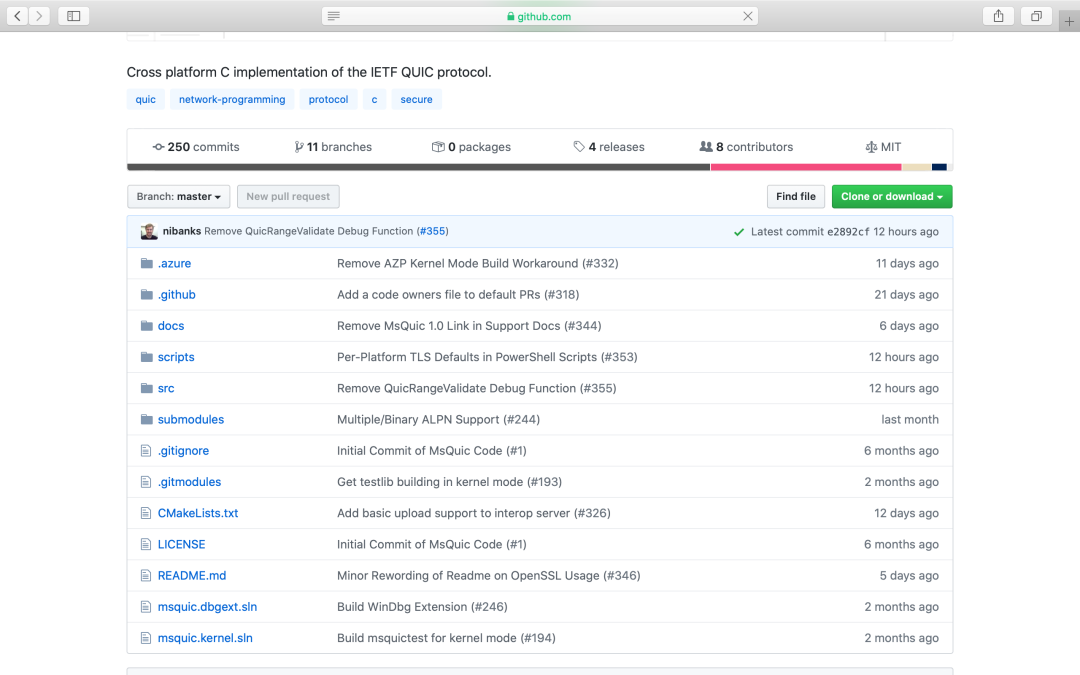 Related Articles:Is TCP/IP Finished? After New IP, Another Non-IP EmergesIETF: New IP is HarmfulHuawei’s New IP Paper: Exploring New Connections and Capabilities for Future Data NetworksHuawei and Others Propose to Restructure the Internet to Adopt a New Core Network Technology Standard Called “New IP”HTTP 3.0 Replaces TCP Protocol with Google’s UDP-Based QUIC