This is an academic paper on selective carbon dioxide adsorption, primarily discussing the achievement of selective adsorption of carbon dioxide through computational design in superhydrophobic molecular pyrene frameworks. Below is a brief overview of these core contents:
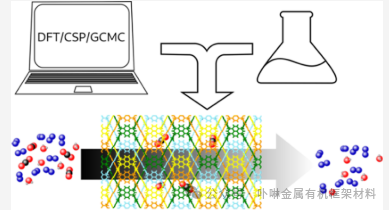
Using porous materials to separate carbon dioxide from industrial flue gas is often hindered by humidity. Most porous adsorbents have a better adsorption effect for water than for carbon dioxide. Therefore, water competes with carbon dioxide for adsorption sites, reducing the working adsorption capacity for carbon dioxide and increasing the regeneration cost of the adsorbent. Here, we describe two pyrene-based hydrogen-bonded organic frameworks (HOFs) that can separate carbon dioxide under humid conditions. The building blocks of these frameworks were selected after high-throughput density functional theory screening, followed by crystal structure prediction (CSP) targeting two-dimensional hydrophobic porous frameworks. Gas adsorption experiments show that these HOFs exhibit selective adsorption for carbon dioxide, with very low water adsorption. Under simulated flue gas conditions, dynamic column breakthrough measurements in a mixed gas environment indicate that the working capacity for carbon dioxide is completely unaffected by moisture at relative humidities of up to 75%. CSP shows that one of the HOFs selective for carbon dioxide—diMeTBAP-α—is the thermodynamically most stable structure on the crystal energy landscape. This stability prediction is reflected in experiments, where an isomorphic, scalable analog of diMeTBAP-α, MeTBAP-α, retains its porosity and crystallinity even after boiling in acidic water, which is crucial for capturing carbon from acidic, humid flue gas.
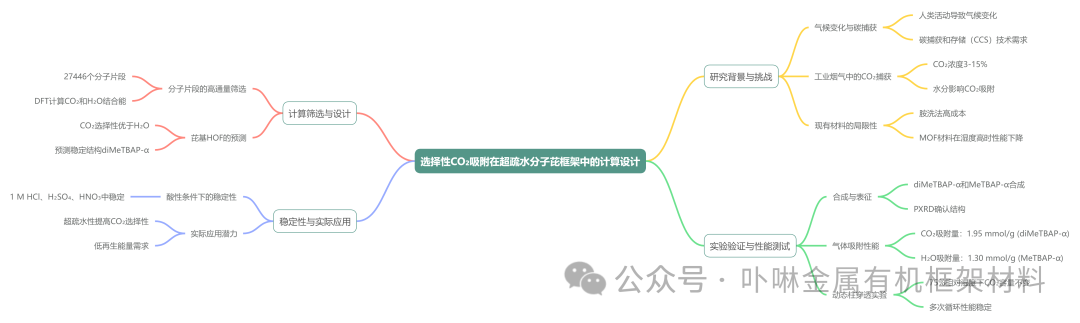
1. Research Background and Challenges:
– Background: Anthropogenic climate change is one of the major challenges facing society today, and reducing carbon dioxide emissions is a key strategy to address this challenge.
– Challenge: Existing carbon dioxide capture technologies, such as amine scrubbing, face issues such as high regeneration costs and equipment corrosion. Moisture in industrial flue gas competes for adsorption sites, reducing the adsorption capacity for carbon dioxide.
2. Computational Methods and Screening:
– Density Functional Theory (DFT): Used to calculate the binding energies of carbon dioxide and water on molecular fragments, screening for fragments with potential carbon dioxide selectivity.
– Crystal Structure Prediction (CSP): Predicts the crystal structures of candidate materials, assessing their porosity and stability.
– Grand Canonical Monte Carlo (GCMC): Simulates the adsorption capacity of carbon dioxide, constructing energy-structure-function (ESF) diagrams.
3. Pyrene-based Hydrogen-Bonded Organic Frameworks (HOFs):
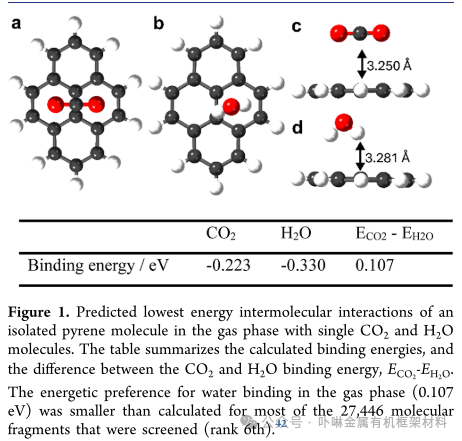
– Molecular Design: Through high-throughput DFT screening, pyrene derivatives were identified as building blocks to design two-dimensional hydrophobic porous frameworks.
– Structure Prediction: CSP predictions show that diMeTBAP-α has the most stable crystal structure and good carbon dioxide adsorption performance.
4. Experimental Validation:
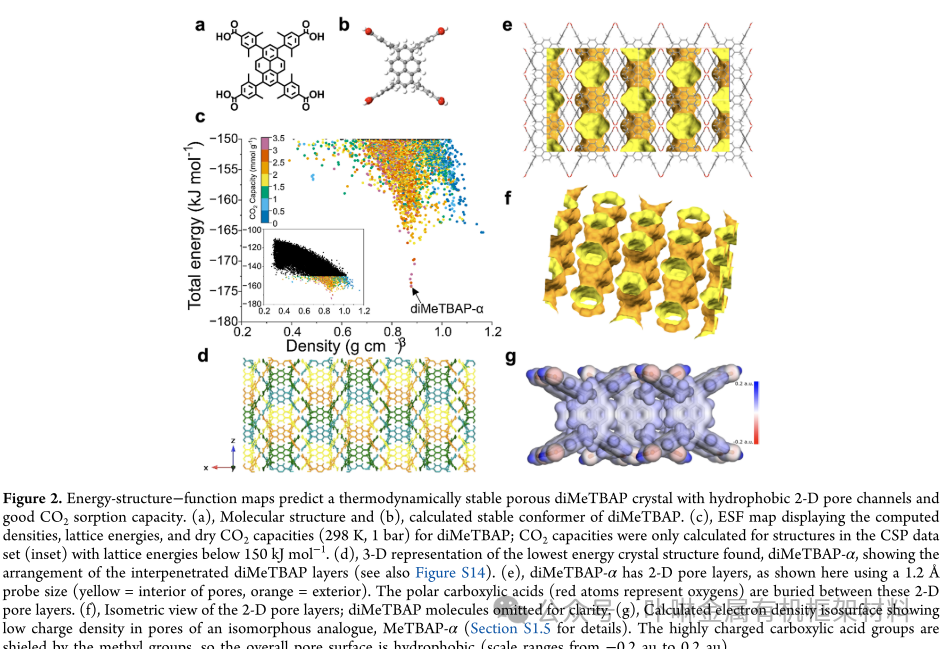
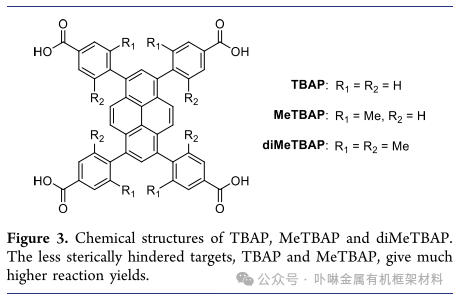
– Synthesis and Characterization: Successfully synthesized diMeTBAP-α and its scalable analog MeTBAP-α, confirming their crystal structures through PXRD and single-crystal XRD.
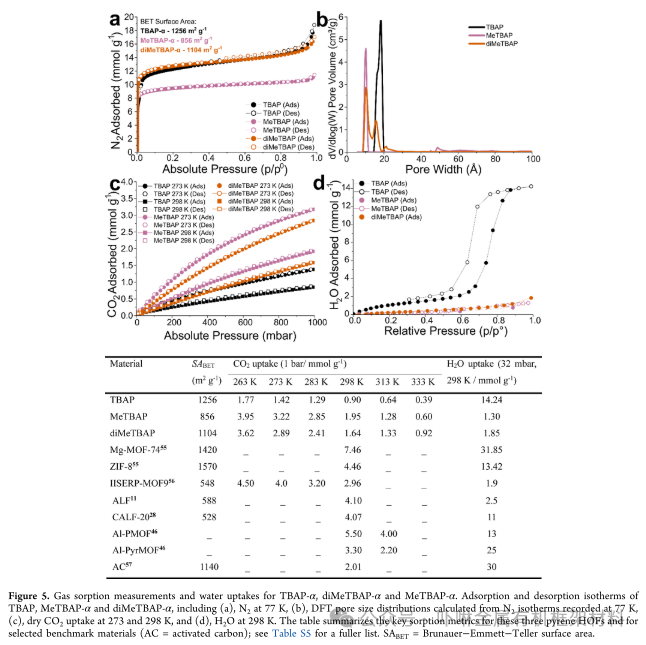
– Gas Adsorption Performance: In single-component adsorption experiments, diMeTBAP-α and MeTBAP-α exhibited carbon dioxide adsorption capacities of 1.95 and 1.64 mmol/g at 1 bar and 298 K, respectively, with very low water adsorption capacities of 1.30 and 1.85 mmol/g.
5. Dynamic Adsorption Experiments:
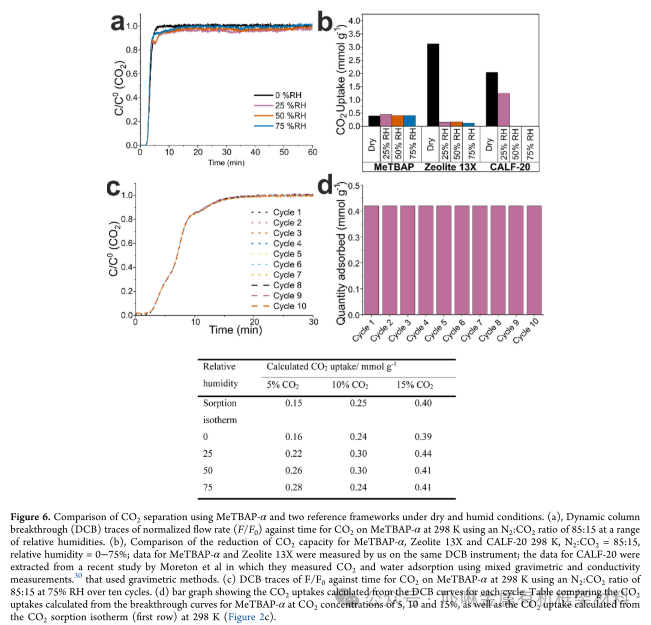
– Mixed Gas Environment Testing: Under simulated flue gas conditions, the carbon dioxide adsorption capacity of MeTBAP-α remained unaffected at relative humidities of up to 75%.
– Cycle Stability: MeTBAP-α exhibited high regeneration stability and reproducibility in multiple cycle experiments.
6. Stability under Acidic Conditions:
– Acid Resistance Testing: MeTBAP-α retained its crystal structure and porosity after boiling overnight in 1 M hydrochloric acid, sulfuric acid, and nitric acid, demonstrating excellent chemical stability.
7. Conclusion and Outlook:
– Conclusion: Computational design successfully guided the development of superhydrophobic pyrene-based HOFs, which exhibit excellent carbon dioxide selectivity and adsorption performance in humid and acidic environments.
– Outlook: These materials have potential application value in carbon capture and storage (CCS) technologies, and future exploration of more efficient regeneration strategies, such as steam stripping, is warranted.
This article provides new computational design and experimental validation methods for developing efficient and selective carbon dioxide adsorption materials, addressing the interference of moisture in industrial flue gas on carbon dioxide adsorption through innovative material design.
Original link:https://pubs.acs.org/doi/10.1021/jacs.5c06861