 Contact me for automotive-grade chip business consultation👆🏻
As the process of automotive intelligence accelerates, NPU is becoming the core engine for multimodal interaction in smart cockpits. With its powerful parallel computing capabilities, it can real-time fuse and process multidimensional interaction data such as voice, gestures, and vision, significantly enhancing interaction accuracy and response speed, while also driving the evolution of human-vehicle interaction towards a more natural and intelligent direction. This technological breakthrough is redefining the interaction standards of future smart cockpits.
Introduction to NPUCONTENT
NPU, or Neural Processing Unit, is a processor specifically designed for artificial intelligence computing tasks. It is deeply optimized in architecture, instruction set, and operational mechanisms for neural network computations, enabling efficient execution of large-scale parallel computations.
Compared to traditional CPUs (Central Processing Units) and GPUs (Graphics Processing Units), NPUs have a higher energy efficiency ratio and lower latency when processing deep learning models.
While CPUs are versatile, they are less efficient in handling core AI tasks such as matrix multiplication and convolution operations; GPUs can process large amounts of data in parallel, but their design is primarily for graphics rendering, limiting their optimization for AI computations.
In contrast, NPUs utilize customized computing units, data paths, and storage structures to allocate most transistor resources directly for computation, providing several times or even tens of times the AI computing power at the same power consumption.
The core advantage of NPU lies in its hardware acceleration capability for deep learning algorithms. It typically contains a large number of Multiply-Accumulate (MAC) units that can perform thousands of operations simultaneously, making it particularly suitable for tensor operations in Convolutional Neural Networks (CNN), Recurrent Neural Networks (RNN), Transformers, and other models.
Additionally, NPUs are often equipped with dedicated instruction sets and data compression technologies, which can maintain high-precision calculations while reducing memory bandwidth pressure. In practical applications, NPUs can not only accelerate the inference process of models but also support a certain degree of training tasks, especially in incremental learning and model fine-tuning on edge devices.
With the rapid development of artificial intelligence technology, NPUs have been widely applied in smartphones, autonomous vehicles, smart home devices, security monitoring, industrial robots, medical imaging analysis, and other fields.
In smartphones, NPUs can process tasks such as image recognition, voice assistants, and AR effects in real-time, enabling smart functions in low-power states; in autonomous driving, NPUs can quickly process massive data from multiple sensors to achieve real-time environmental perception and decision-making; in the medical field, NPUs can accelerate the analysis of medical images, helping doctors diagnose diseases more accurately.
These application scenarios share a common characteristic: they require high-performance AI computing within limited power and space.
NPU Core ArchitectureCONTENT
The development trends of NPU are mainly reflected in three aspects:
First is the continuous improvement of computing power, achieved through advanced chip manufacturing processes and more efficient architectural designs to enhance performance per watt;
Second is the enhancement of versatility; the new generation of NPUs not only supports various neural network models but can also work in conjunction with CPUs and GPUs to form heterogeneous computing platforms;
Finally, the popularity of edge computing is driving the development of low-power, miniaturized NPUs, as more smart devices require local processing of AI tasks with the growth of the Internet of Things and embedded systems.
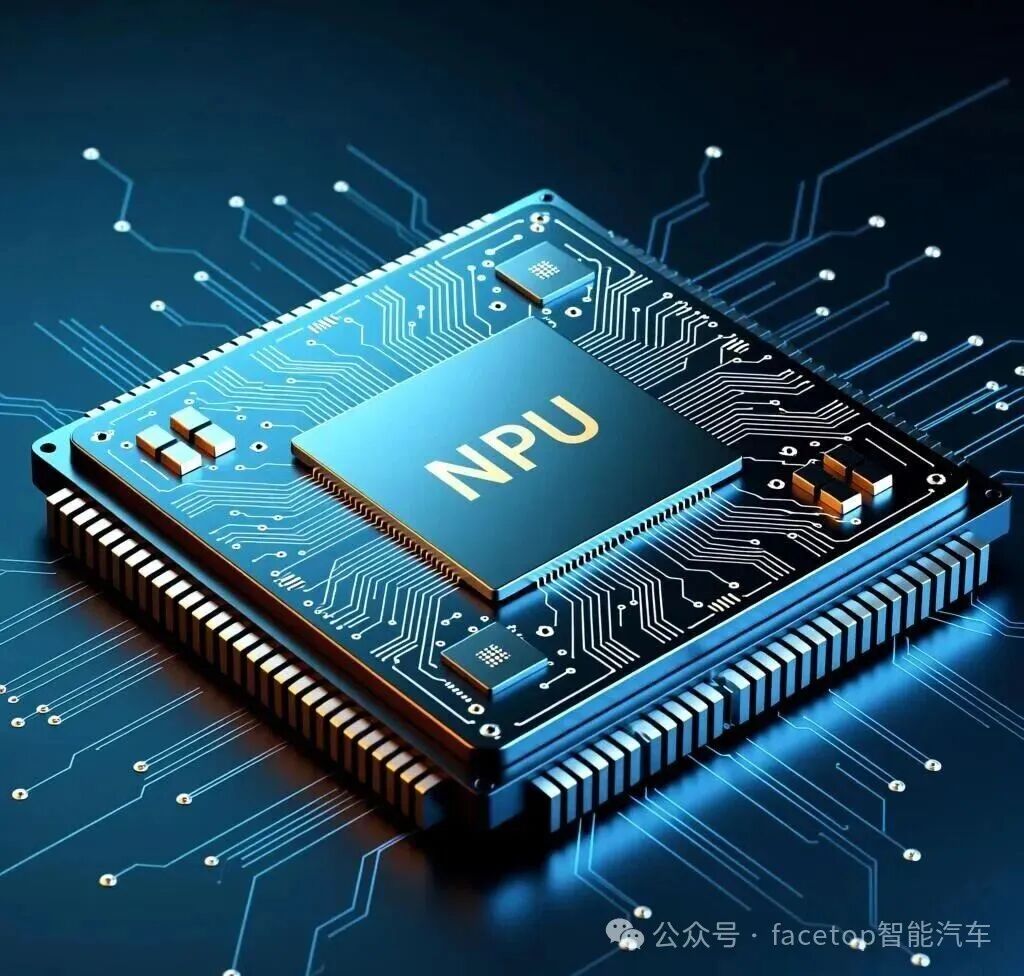
The core architecture of NPU is designed around the characteristics of neural network operations, with the core goal of efficiently handling large-scale parallel computations, mainly consisting of three core components: computing units, storage subsystems, and control scheduling modules.
The computing unit is the core of NPU’s computing power output, typically containing a large number of Multiply-Accumulate (MAC) units, with some high-end architectures integrating Floating Point Units (FPU) to accommodate high-precision models.
These units are arranged in an array, allowing for thousands of multiply-accumulate operations to be executed simultaneously, perfectly matching the core operations of neural networks such as convolution and fully connected layers, significantly enhancing tensor operation efficiency. Some architectures also design dedicated attention computation units for Transformer models, further optimizing the processing speed of popular AI tasks.
The storage subsystem adopts a “multi-level cache” architecture to address the high data throughput challenges in AI computations. Close to the computing units are high-speed registers and on-chip caches (SRAM) for storing immediate computation data, reducing data transfer delays; the outer layer consists of larger off-chip memory interfaces that support high-speed access to DDR and other memory types.
At the same time, the architecture employs data compression and on-demand loading techniques to reduce memory bandwidth pressure, avoiding storage bottlenecks that could limit computing power.
The control scheduling module serves as the “command center,” coordinating the collaborative work of computing units and storage subsystems through customized instruction sets and intelligent scheduling algorithms.
It can dynamically allocate computing resources based on task types; for example, prioritizing convolution computing units when processing image recognition tasks, and activating attention computation modules for natural language tasks. Some advanced architectures also support dynamic precision adjustment, allowing for flexible balancing between precision and power consumption based on task requirements, ensuring both computational efficiency and energy efficiency.
The Role of NPU in Multimodal InteractionCONTENT
NPU plays a key role in multimodal interaction (voice, gestures, in-cabin vision)
The Key Role of NPU in Voice Interaction
In the voice interaction scenario of multimodal interaction, NPU is the core support for achieving real-time and accurate voice understanding, playing an irreplaceable role throughout the entire process from voice signal processing to semantic parsing.
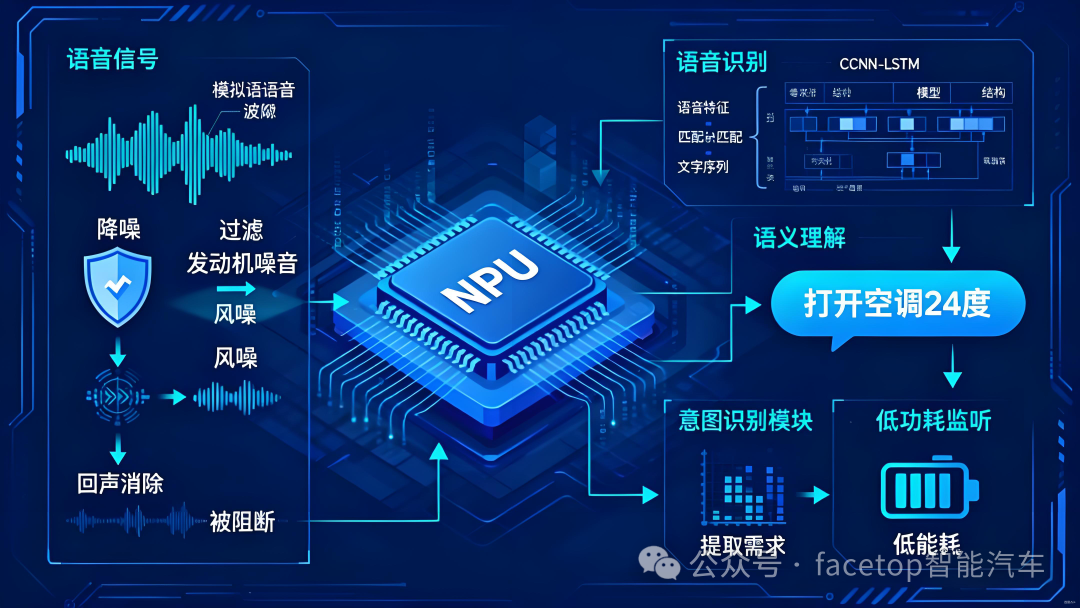
Voice interaction requires first converting analog voice signals into digital signals, followed by preprocessing steps such as noise reduction and echo cancellation. NPU, with its efficient parallel computing capabilities, can quickly run noise reduction algorithms to filter out interference signals such as engine noise and wind noise in the vehicle, ensuring the purity of the voice signal.
In the subsequent voice recognition phase, NPU can accelerate the inference process of deep learning models (such as CNN-LSTM hybrid models), quickly matching voice features to text sequences, achieving millisecond-level recognition response and avoiding user wait delays.
In the semantic understanding stage, for customized commands in the vehicle environment (such as “set air conditioning to 24 degrees” or “navigate to the nearest gas station”), NPU can efficiently run intent recognition models to accurately extract user needs, while supporting contextual associations for multi-turn dialogues by caching conversation history data, dynamically adjusting semantic parsing logic to make interactions more coherent.
Moreover, the low power consumption characteristics of NPU are suitable for the energy constraints of in-vehicle devices, allowing for effective energy control even when in a long-term voice wake-up listening state, ensuring the continuous availability of voice interaction.
The Key Role of NPU in Gesture Interaction
Gesture interaction, as a non-contact interaction method, requires extremely high real-time and accuracy, and NPU becomes the core driving force for its stable operation by accelerating visual processing and gesture recognition algorithms.
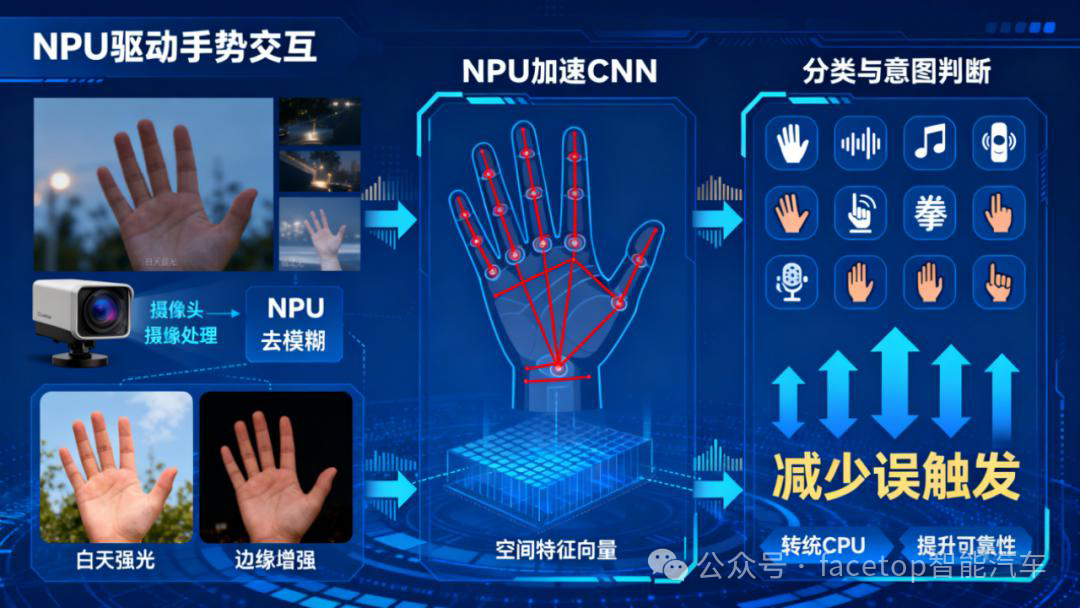
First, in the preprocessing stage after gesture image acquisition, NPU can quickly complete operations such as image deblurring and edge enhancement, especially in scenarios with varying lighting conditions in the vehicle (such as strong light during the day and weak light at night), dynamically optimizing image contrast to provide clear gesture features for subsequent recognition.
In the gesture feature extraction phase, NPU’s acceleration of Convolutional Neural Networks (CNN) and skeleton extraction models is particularly critical, allowing for rapid extraction of gesture key points (such as finger joints and palm contours) from images, constructing spatial feature vectors of gestures, achieving several times the processing speed compared to traditional CPUs, and avoiding delays between gesture actions and device responses.
In the gesture classification and intent judgment phase, NPU supports the training and inference of models for custom gestures (such as waving to adjust volume or making a fist to pause playback), continuously learning user gesture habits to optimize recognition accuracy, while distinguishing between unintentional actions and valid gestures to reduce false triggers, ensuring the convenience and reliability of in-vehicle gesture interaction.
The Key Role of NPU in In-Cabin Visual Interaction
In-cabin visual interaction involves scenarios such as driver state monitoring and passenger demand recognition, and NPU becomes the core technical support for ensuring interaction safety and personalization by efficiently processing visual data.
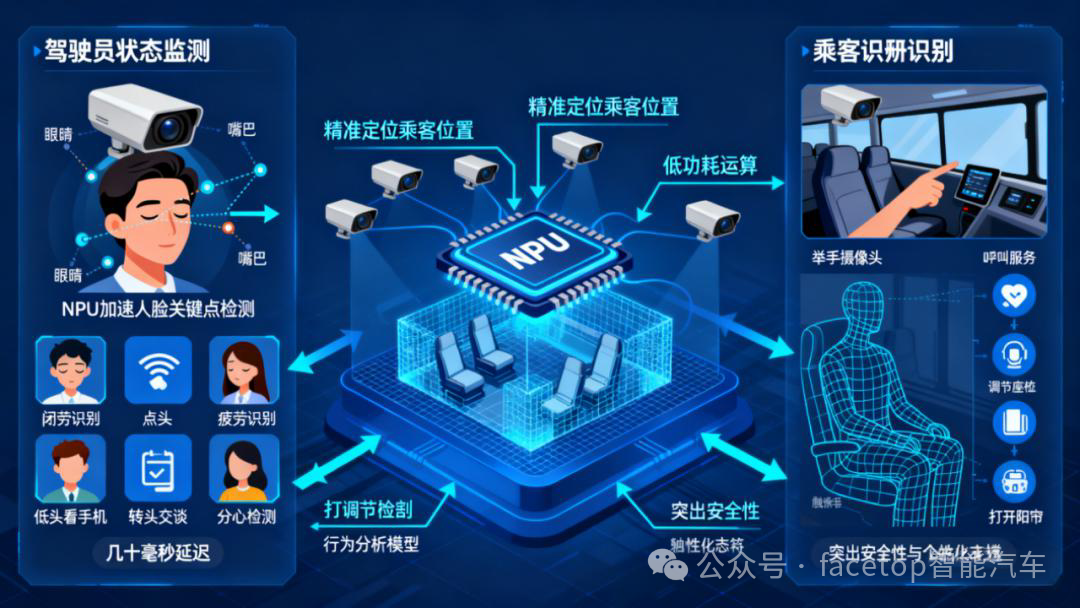
In driver state monitoring, NPU can analyze facial images captured by cameras in real-time, accelerating the operation of algorithms for facial key point detection and eye tracking, quickly identifying risks such as driver fatigue (e.g., closed eyes, nodding) or distraction (e.g., looking down at a phone, turning to talk) while also assisting in understanding driver commands through lip reading, enhancing interaction accuracy in noisy environments, and keeping the entire processing delay within tens of milliseconds to allow ample time for safety warnings.
In the passenger demand recognition scenario, NPU can capture passenger actions (such as raising a hand to call for service or pointing to a function button) through in-cabin cameras, accurately determining passenger intent by combining image segmentation and behavior analysis models, thereby triggering corresponding services (such as adjusting seat angles or opening sunshades).
Additionally, NPU supports the synchronous processing of data from multiple cameras, integrating visual information from different angles to construct a three-dimensional scene in the cabin, achieving precise positioning of passenger locations and postures, providing data support for personalized interactions (such as adjusting air conditioning vent directions based on passenger positions), while ensuring that long-term in-cabin visual monitoring does not excessively consume vehicle energy through low-power computing design.
 ConclusionCONTENT
In the current era of rapid technological development, multimodal interaction in smart cockpits has become a key area of automotive intelligence transformation, and NPU plays an irreplaceable core role in this, leading it into a new stage of development.
In the future, NPU will drive the fusion of multimodal sensor data such as voice, gestures, and vision to new heights.
It can rapidly perform spatiotemporal alignment and feature extraction on different modal data; for example, in complex driving scenarios, it can simultaneously analyze the driver’s voice commands, hand gestures, and facial expressions to accurately determine the driver’s intent.
For instance, when a driver says, “I’m a bit hot” while raising their hand to make a gesture to adjust, NPU can quickly understand that the intention is to adjust the air conditioning temperature rather than misinterpreting it as another command, significantly enhancing interaction accuracy and reducing the probability of misoperation.
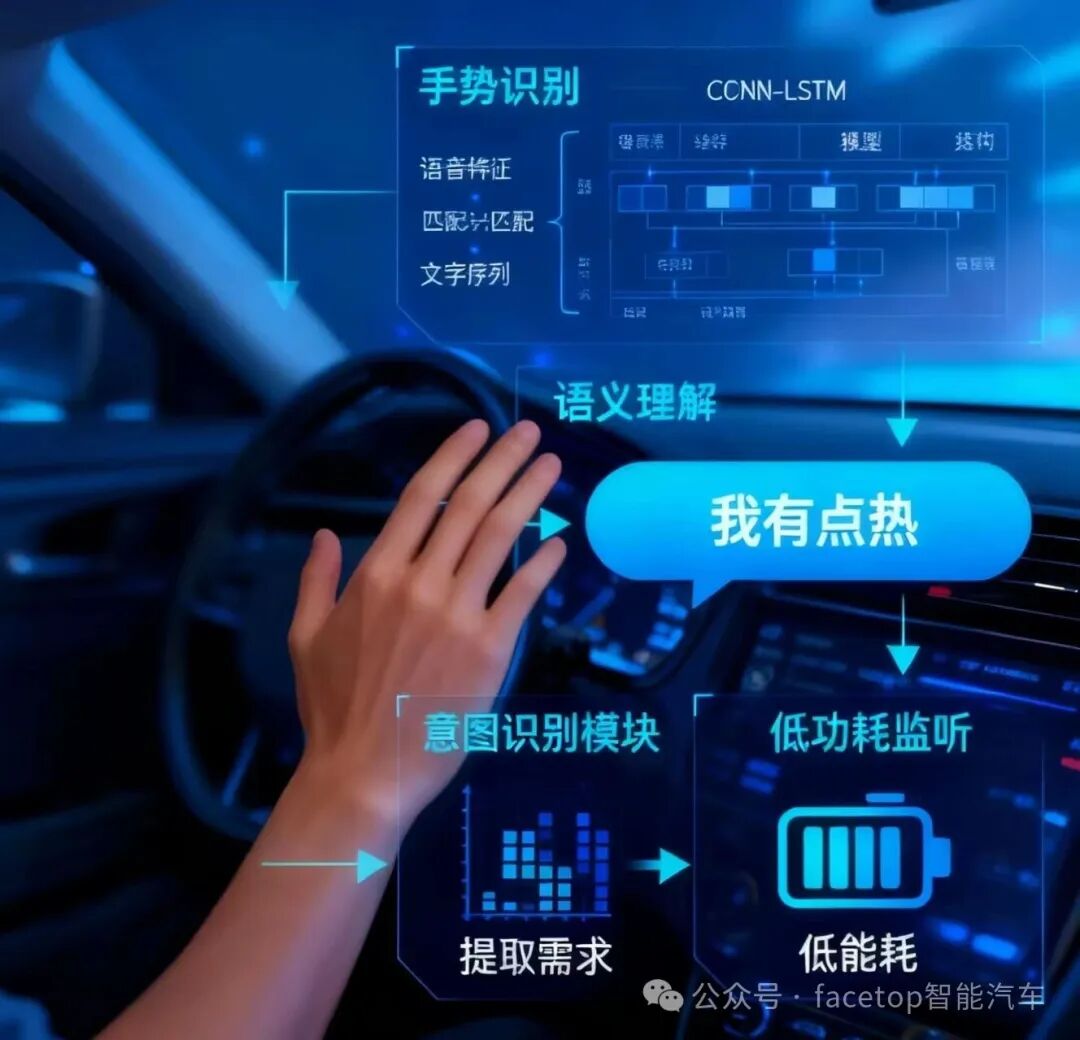
With its powerful computing capabilities, NPU can compress multimodal interaction latency to the millisecond level.
In voice interaction, the time from the driver’s voice to system recognition and response is extremely short, nearly real-time; during gesture interaction, when the driver makes gestures to switch music or adjust volume, the NPU drives the system to respond immediately, making the interaction smooth and natural, akin to instant communication between people, completely eliminating the lag of operational waiting, providing drivers with a seamless interaction experience.
NPU supports continuous learning and optimization of multimodal large models locally in the vehicle. It can automatically adjust model parameters based on each driver’s unique voice habits, gesture preferences, and visual interaction characteristics. For example, if a driver tends to use specific dialect vocabulary for commands, NPU can enable the model to learn quickly and recognize accurately without requiring the user to repeat training, achieving personalized autonomous evolution of the interaction model that becomes increasingly aligned with personal usage habits.
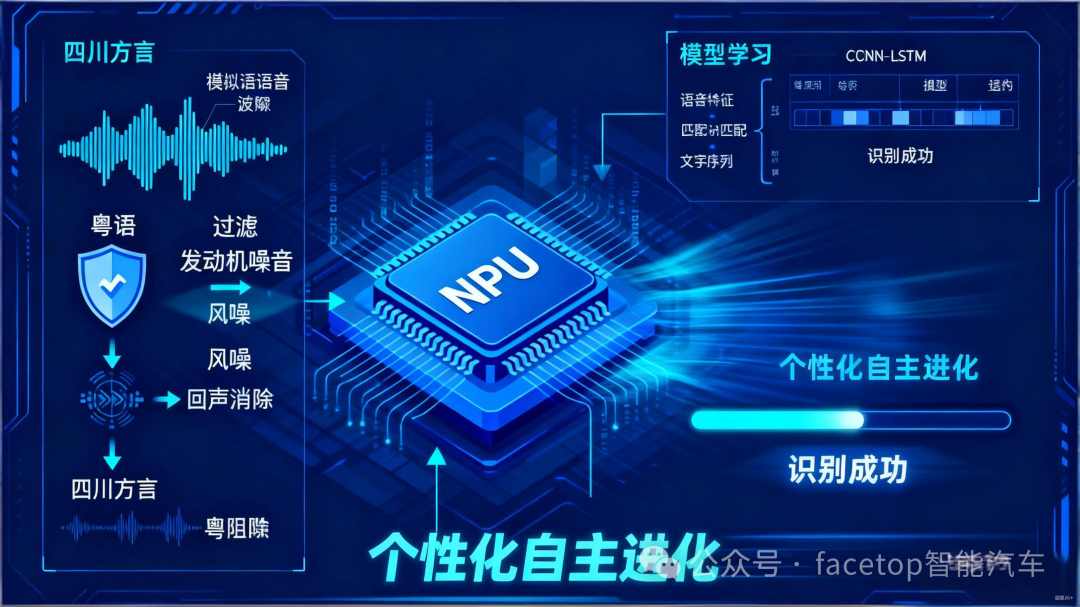
Automakers, chip manufacturers, and technology companies are closely collaborating around NPU and multimodal interaction.
Automakers optimize cockpit design based on NPU characteristics, chip manufacturers continuously upgrade NPU performance to meet complex interaction demands, and technology companies leverage algorithm advantages to develop innovative interaction applications, collectively driving the rapid iteration of multimodal interaction technology in smart cockpits and accelerating product deployment, such as Qualcomm and other chip manufacturers collaborating with automakers to launch smart cockpit solutions equipped with high-performance NPUs.
As NPU technology matures and multimodal interaction experiences are optimized, the market penetration of smart cockpits will significantly increase.
Consumer demand for intelligent and convenient cockpit interactions is continuously growing, prompting more vehicle models to be equipped with advanced multimodal interaction systems, driving the market scale to expand continuously. It is expected that in the coming years, the smart cockpit market will experience explosive growth, becoming a new profit growth point and competitive focus in the automotive industry.
In the future, a multi-level, full-process data encryption and protection system needs to be established to guard against cyberattacks, ensuring user privacy and driving safety. In terms of functional safety, mechanisms such as fault diagnosis and redundancy design need to be improved to ensure stable and reliable operation of the platform in complex environments, laying a solid foundation for the widespread application of integrated cockpit central computing platforms.
—end—
 Contact me for automotive-grade chip business consultation👆🏻
Recommended Reading:
Development and Typical Product Technologies of Domestic GPU Companies
Deep Comparison of Cockpit Chip CPU Architectures and Scenario Functions: x86 Architecture AMD vs. ARM Architecture Qualcomm Snapdragon 8295
What is TPU? Comparison of TPU, CPU, GPU, and NPU
From “One Car, Hundreds of Chips” to “Central Computing”: The Evolution of Automotive Chip Architecture
Analysis of Rockchip’s Chip Product Strength: Reconstructing Smart Cockpit Experience with Full-Domain Computing Power
Analysis of the Latest Financial Reports of Global Leading Automotive Chip Companies