Last week, I mentioned the lifelike capabilities of Xiaopeng’s humanoid robot. What would the future look like if robots were integrated with brain-computer interfaces? First, let’s talk about brain-computer interfaces. My first encounter with this concept was during a “mind competition” at a science museum. After a small attempt, I found it quite fascinating. Many people’s understanding of brain-computer interfaces comes from science fiction movies, such as the cables connected to the back of the head in “The Matrix” or the protagonist in “Avatar” who transfers their consciousness into a remote biological entity and controls the avatar through thought, allowing them to experience freedom in another world and “swim” in a virtual realm. But is the distance between science fiction and reality really that far?


Currently, Elon Musk’s Neuralink and various brain-computer interface “Chinese solutions” are rapidly transitioning from the laboratory to reality, almost like a real-life version of science fiction. With just a “shot” in the blood vessel, electrodes equivalent to 1% of a hair’s width can be delivered into the brain, bringing hope to patients with paralysis, Parkinson’s disease, and ALS. Without the need for implanted devices, one can play chess or control drones merely through thought… Humanity has made significant strides in brain-computer interface research.
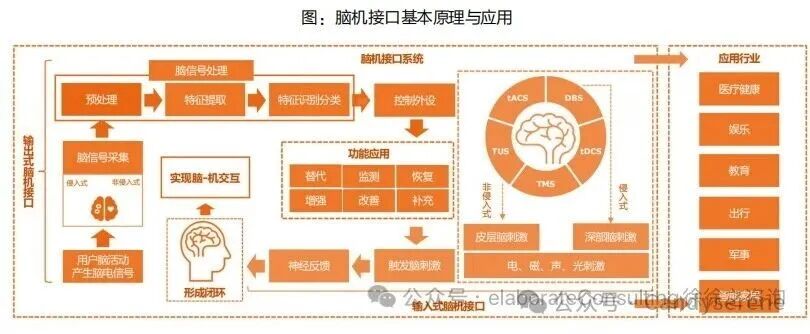
Boldly imagining the future, I guess it could be something like the following: First, all human health issues such as blindness, deafness, and limb decay could be restored to normal. Second, as depicted in current sci-fi films, human consciousness could transcend the limitations of the physical body through neural connection technology, exploring and traveling across interspecies planets and virtual worlds. Meanwhile, human consciousness could be loaded into “robots” to achieve consciousness immortality. So, students might say that in the future, they could directly implant textbooks into their brains (if you don’t want to study, just say it~ doge). Who wouldn’t want that? 



 Technically, it is possible now, but let’s not forget that our physical bodies currently cannot bear excessive mental development, as referenced in the sci-fi film “Lucy”.

So, returning to the main topic, what will the future look like if robots integrate brain-computer interfaces? By now, everyone probably has their own answers 
 . Feel free to leave comments or discuss the next topic about the core models related to intelligent agents and AI.