In the wave of Industry 4.0, embodied intelligent industrial robots are transitioning from concept to reality.
They are no longer mechanical repetitive “tools” but rather “collaborative partners” capable of perceiving the environment, making autonomous decisions, and executing tasks precisely.This achievement relies heavily on the computational support provided by high-performance industrial core boards.As the computational hub and neural link of humanoid robot systems, it bears the responsibilities of data processing, algorithm execution, and device control, and is crucial for determining whether robots can perform stably under complex working conditions.
—

The case user is a global leader in intelligent robot R&D and manufacturing, providing collaborative robot upgrade solutions for industries such as automotive parts, 3C electronics, metal processing, and healthcare.
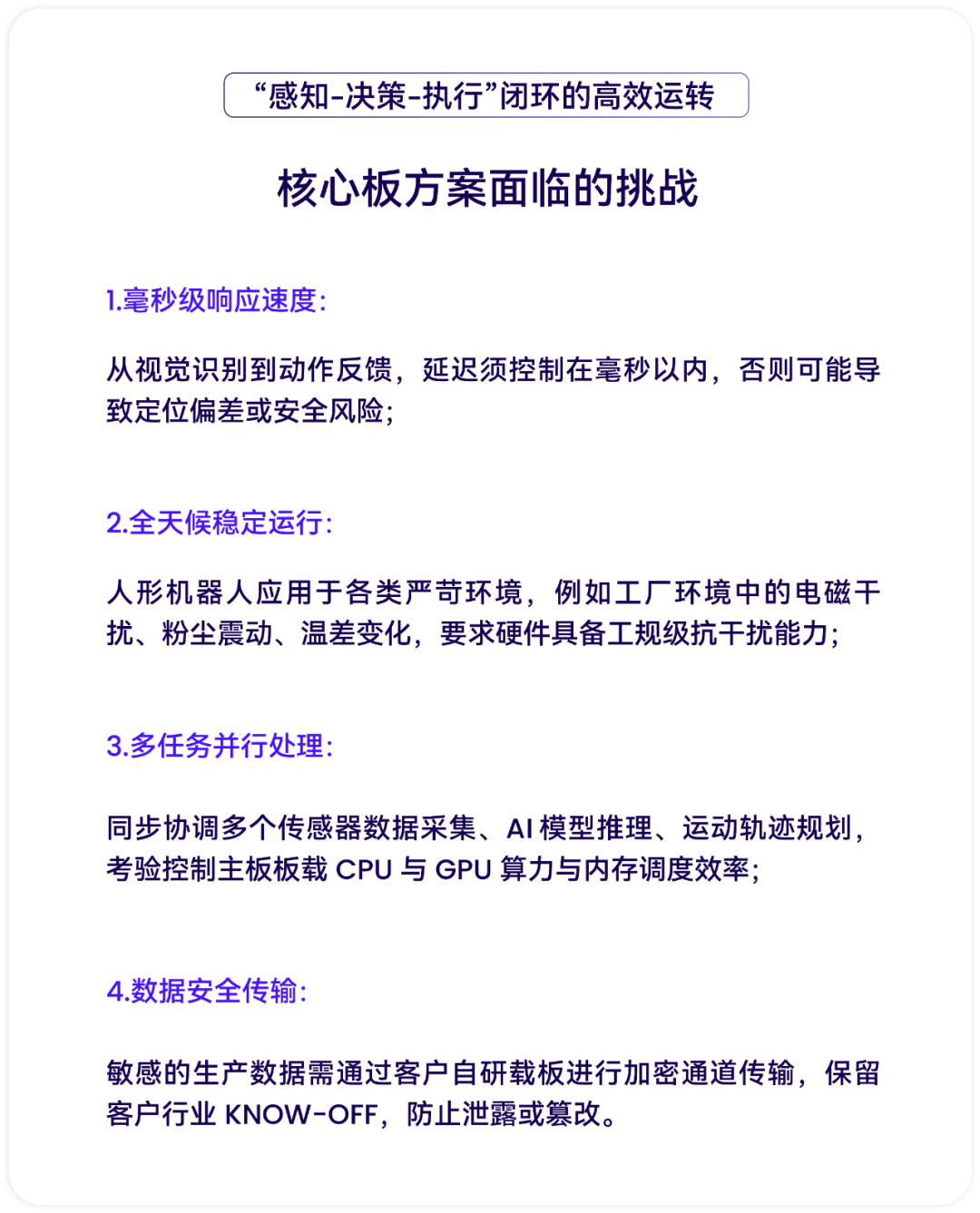
The essence of embodied intelligent humanoid robots lies in the efficient operation of the “perception-decision-execution” closed loop,In this humanoid robot control core project, the company designed a core board + self-developed baseboard architecture for the main control core,During this process, each link imposed strict requirements on the core board itself:
In the process of seeking solutions, they learned about the industrial core board CIB-ITLU-EC01 from Source Control, which, thanks toSource Control’s mature core board + carrier board development and design capabilities, both parties gradually confirmed the cooperation for this project.

Based on the above background, Source Control sorted out the performance requirements and usage scenarios of the company’s humanoid robots.
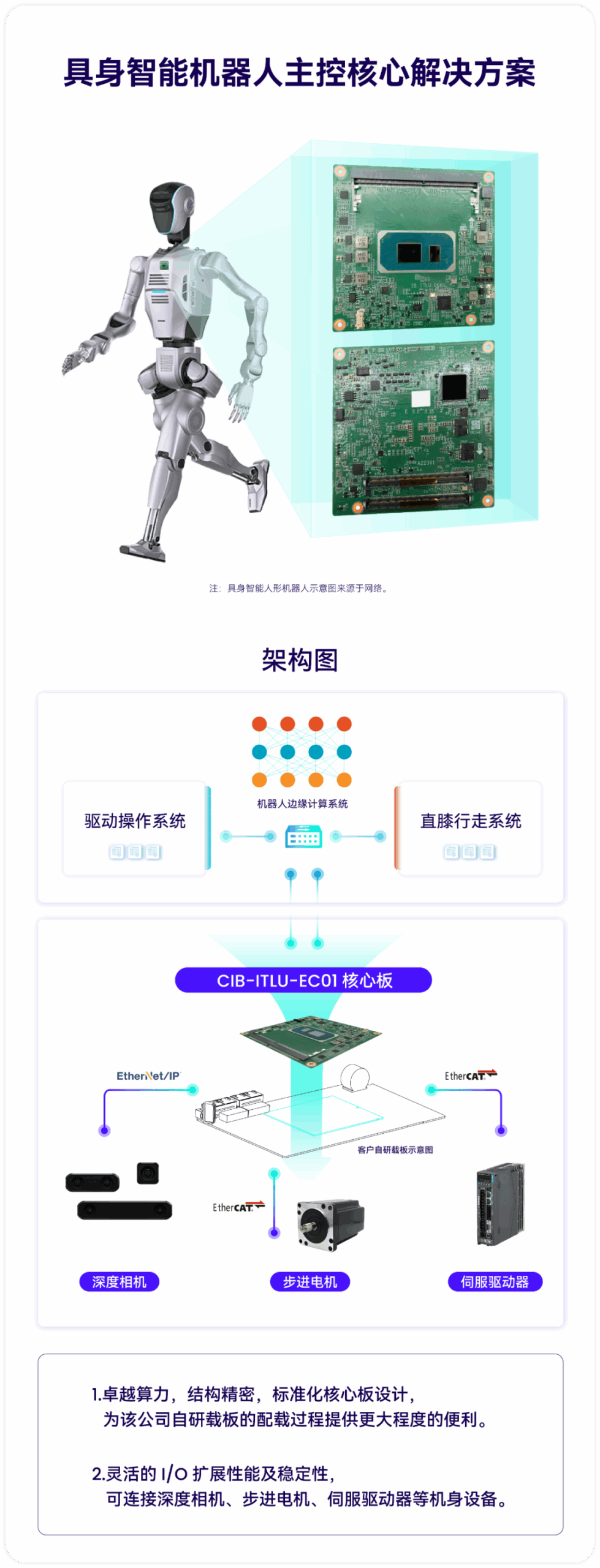
Traditional consumer-grade motherboards cannot meet the above requirements, whileSource Control’sindustrial core board CIB-ITLU-EC01 uses industrial-grade components,standardized core board design specifications, and its compact size of 95x95mm provides greater convenience for the company’s self-developed baseboard integration process,with flexible I/O expansion capabilities to connect depth cameras, stepper motors, servo drivers, and other body devices,operating continuously 7x24h,and the core board has good dustproof and anti-interference performance1,equipped with Intel® CoreTM 11th i5 series processorwith a 10nm microarchitecture design, and supports VNMI deep learning acceleration2and is equipped withIris® Xe Graphics, providing 80 execution units, capable of multi-threaded processing of graphic data, with a maximum dynamic frequency of 1.30GHz3, supporting a wide temperature range of -40℃~85℃, with RAM and storage configured according to humanoid robot industry standards.
The design of the core board + customer self-developed carrier board aims to provide a more compatible hardware platform for industrial use cases, allowing the customer’s industry KNOW-HOW to be isolated from the core board, supporting modular upgrades and replacements. These conditions provide reliable hardware support with low latency and high responsiveness for the perception, decision-making, and execution of humanoid robots,adapted to the extreme pursuit of reliability in embodied intelligent humanoid robots.
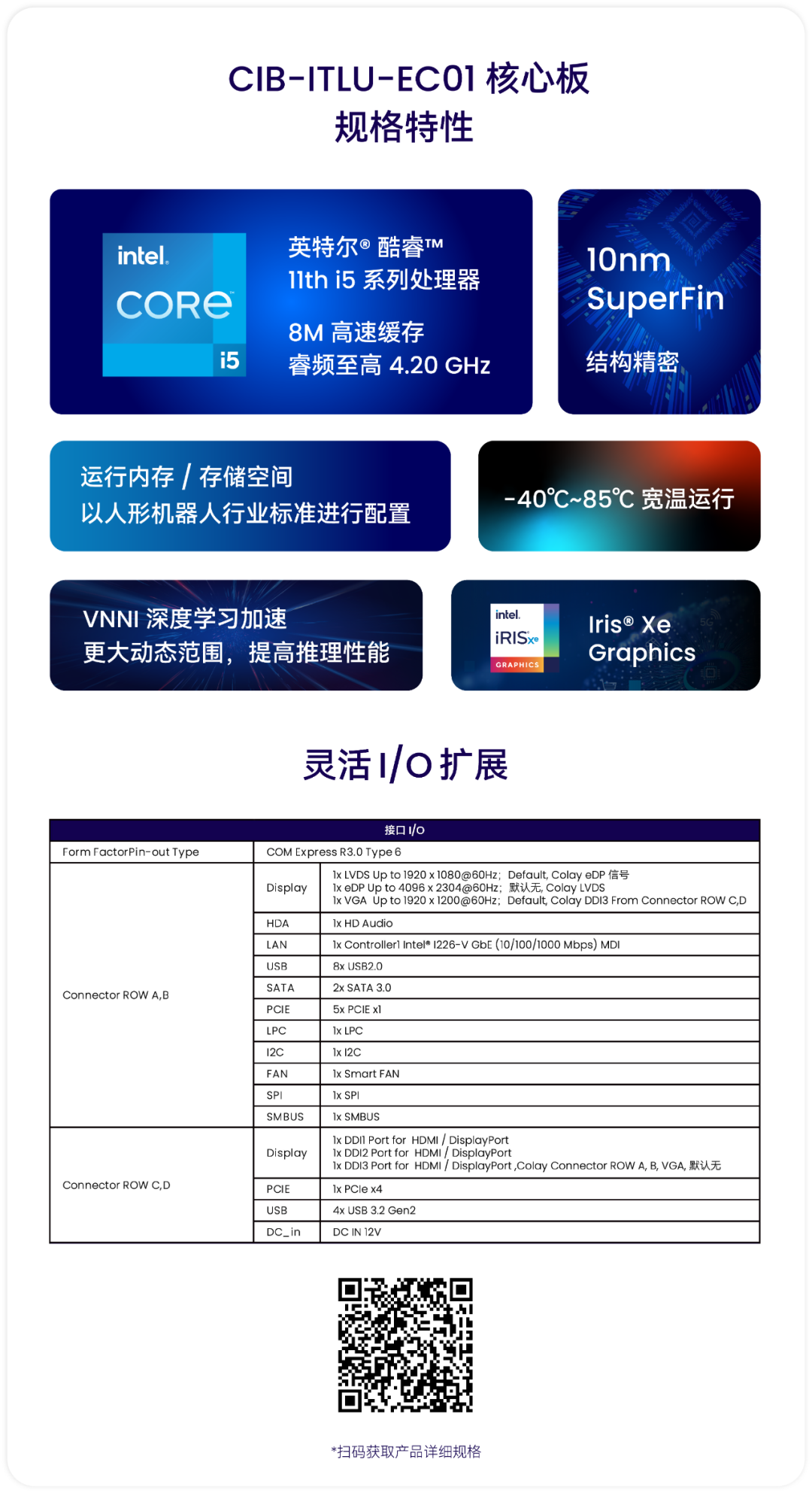
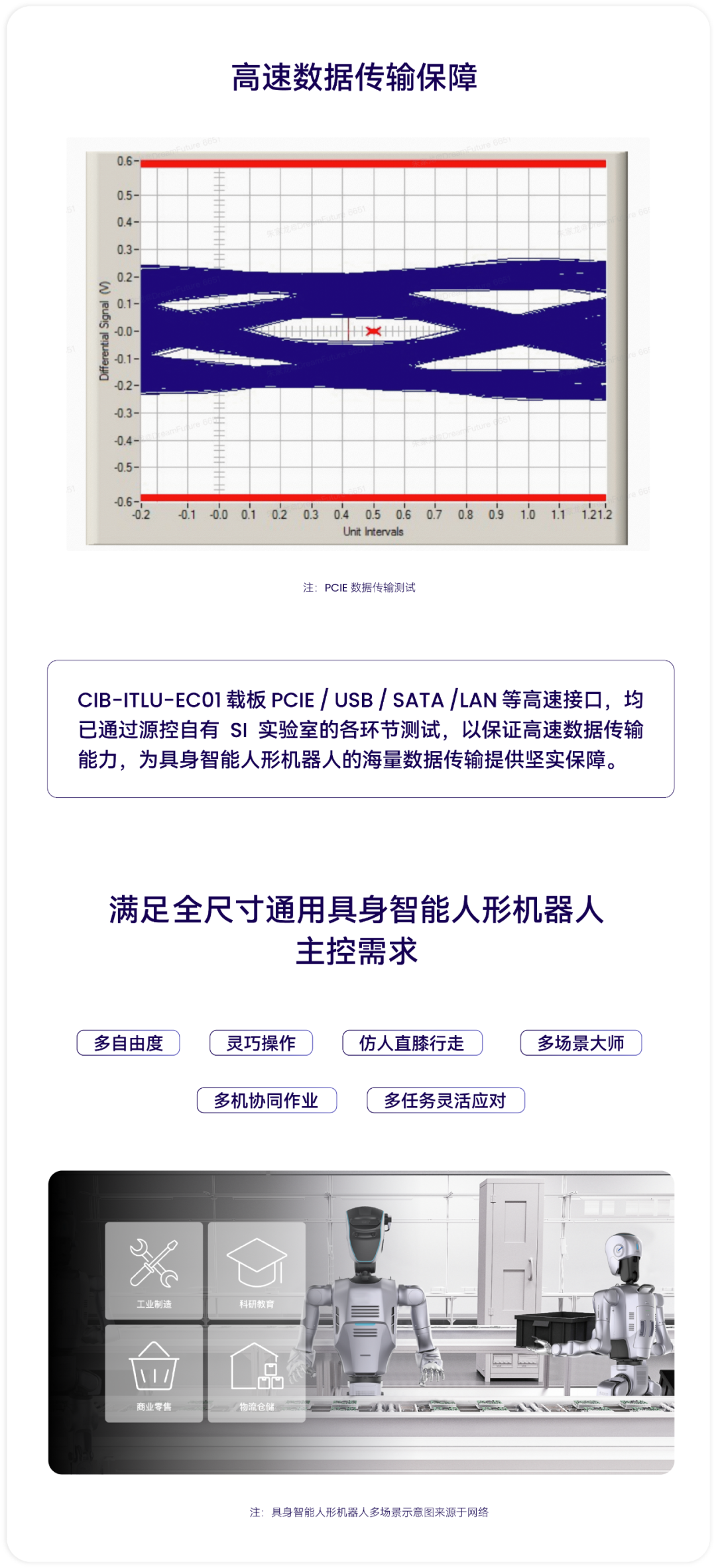 Targeting scenarios such as assembly material handling in automated factories, process operations in commercial retail, and logistics warehousing for handling and stacking,industrial-grade humanoid robots capable of precise operations can perform cross-scenario, multi-machine collaboration, and complex operation generalization tasks. Whether it is fingertip control of lightweight robotic arms or joint linkage of six-axis robots, the core board can support smooth human-machine collaboration with “invisible power” within the core controller.As embodied intelligence leads supporting equipment to gradually land in various human-machine collaboration scenarios, humanoid robots are no longer isolated devices but intelligent nodes connecting the Internet of Things and smart factories.Source Control’sindustrial core board CIB-ITLU-EC01 provideshigh-reliability computing power, compact design, and scenario extensibility that endows robots with the capabilities of “sensitive perception, agile thinking, and precise action”. From automotive parts assembly to semiconductor wafer handling, from hazardous chemical operations to medical rehabilitation assistance, Source Control will continue to empower complete machine manufacturers for solution integration, facilitating the digital transformation of various industries.
✓
Su Zhou Robot Industry Association
The Su Zhou Robot Industry Association was established on November 22, 2019, and is a non-profit social organization registered with the Suzhou Civil Affairs Bureau, guided by the business departments such as the Suzhou Economic and Information Commission,composed voluntarily of units engaged in robot industry R&D, manufacturing, sales, testing, certification, intellectual property and standardization, education, consulting, and training in Suzhou.The association adheres to the concept of “serving enterprises and empowering industries”, actively promotes and implements national industry policies and laws and regulations, widely carries out industry exchange activities, organizes technical research, compiles industry development reports, promotes resource linking and collaborative innovation along the industry chain, and plays an important supporting role in the development of Suzhou’s robot industry and the regional industry’s external influence.
Recently, the WeChat public platform has adjusted its push mechanism
The reading list of subscription accounts is no longer sorted by publication time
Please set the WeChat public account
“Su Zhou Robot Industry Association” as a star
so that you can see our articles in a timely manner
Set a star, don’t get lost!