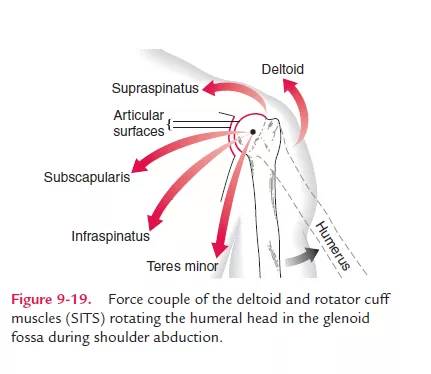
The rotator cuff, including the Supraspinous Muscle (冈上肌), Infraspinatus Muscle (冈下肌), Teres Minor Muscle (小圆肌), and Subscapularis Muscle (肩胛下肌), is collectively known as the SITS muscles.
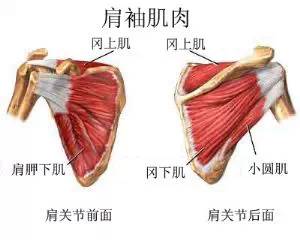
These four muscles originate from different areas but all attach to the humeral tuberosities, except for the Subscapularis Muscle which attaches to the lesser tuberosity. The other three muscles insert on the greater tuberosity. The distal attachment points of these four muscles form a straight line, with the intertubercular groove in the middle, through which the biceps tendon passes. They converge at the location of the glenohumeral joint capsule, forming a tendon sleeve that surrounds the shoulder joint.
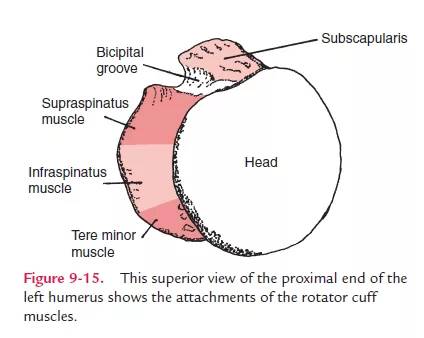
How to Palpate the Greater and Lesser Tuberosities of the Humerus?
The subject sits with their arm against the body, elbow bent at 90 degrees, and palm facing up. The examiner uses several fingers to touch the coracoid process of the scapula while the other hand performs an external rotation. On the lateral side of the coracoid process, the lesser tuberosity can be felt. If the subject’s arm is internally rotated, the lateral intertubercular groove and greater tuberosity can be felt sliding under the fingers.
The Subscapularis Muscle is the only rotator cuff muscle that originates from the front of the scapula.
Origin: Subscapular fossa
Insertion: Lesser tuberosity of the humerus
Function: Internal rotation of the shoulder joint
Innervation: Subscapular nerve (C5, C6)
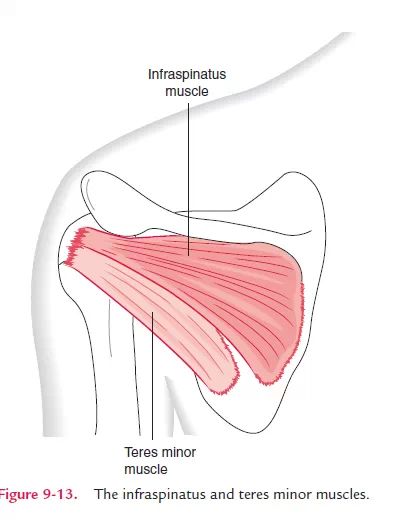
The Infraspinatus Muscle
Origin: Infraspinous fossa of the scapula
Insertion: Greater tuberosity of the humerus
Function: External rotation, horizontal abduction of the shoulder joint
Innervation: Suprascapular nerve (C5, C6)
The Teres Minor Muscle is similar to the Infraspinatus Muscle in anatomy and function.
Origin: Lateral border of the scapula
Insertion: Greater tuberosity of the humerus
Function: External rotation, horizontal abduction of the shoulder joint
Innervation: Axillary nerve (C5, C6)
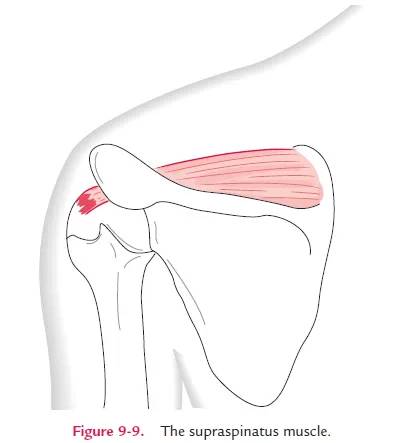
The Supraspinatus Muscle
Origin: Supraspinous fossa of the scapula
Insertion: Greater tuberosity of the humerus
Function: Abduction of the shoulder joint
Innervation: Suprascapular nerve (C5, C6)
In addition to the physiological functions mentioned above, the rotator cuff muscles also play a crucial role in maintaining the stability of the humeral head within the glenoid cavity. At the same time, the glenoid labrum deepens the cavity, enhancing the congruence of the joint surfaces.
Participants

All clinical doctors engaged in: acupuncture, orthopedics, surgery, internal medicine, pain management, acupuncture and massage, rehabilitation therapy, and other levels of hospitals and medical units can participate in the learning.
Course Introduction
Comprehensive Acupuncture Course
Starting from March 8 to 15, aimed at doctors who have not studied acupuncture before, the course covers acupuncture theory, anatomy, imaging, acupuncture operations, and manipulation techniques. The original tuition fee is 4980 yuan/person, with a study duration of (6 days of theoretical teaching and 2 days of clinical practice).
Advanced Acupuncture Course
Starting from March 14 to 18, aimed at those with a certain foundation in acupuncture who want to further improve their acupuncture treatment skills and learn to treat various difficult diseases. Duration: 3 days 2 nights + 2 days of clinical practice, original tuition fee: 3800 yuan/person.
Full Acupuncture Course
Starting from March 8, aimed at students who have ample time to fully master acupuncture theory and clinical operations, with training duration: 12-14 days of systematic theoretical study + two months of clinical operational skills internship (registration available year-round), tuition fee: 15800 yuan/person.
Elite Acupuncture Course
Starting from March 8 to 18, covering the complete comprehensive course + advanced course (a discount of 1980 yuan compared to separate registrations), original tuition fee: 6800 yuan/person.
Offline Training Schedule
Classes start on March 8, 2023. All students must contact staff 1-2 days in advance to submit a registration fee of 500 yuan/person (included in the tuition fee) to arrange for textbooks. No unregistered attendance is allowed; the course lasts for 8 days. Please bring personal ID, medical qualification certificate (original or copy), 4 passport photos, and invoices issued within three months when reporting.
Training Features
Live Streaming Online
Online Comprehensive Course is conducted through live streaming of the offline comprehensive course. The online comprehensive course (6 days each session) teaches the four basic theories of acupuncture medicine, six main components, and eleven methods of acupuncture, focusing on various chronic soft tissue injuries such as tendinitis, frozen shoulder, tennis elbow, heel spur, cervical spondylosis, lumbar disc herniation, osteoarthritis of the knee, and over 50 common and frequently occurring diseases, along with acupuncture diagnosis techniques, local anatomy, specific acupuncture operations, postoperative techniques, and drug combination treatments.
Online Course Training Schedule
Enroll Anytime, which can offset the cost of offline courses (comprehensive class, elite class, full course). After completing the online course, you can participate in the same offline class for free for life. This is aimed at medical personnel who have not been exposed to acupuncture and are short on time for short-term learning. A completion certificate for acupuncture training will be awarded upon completion.
Training Location
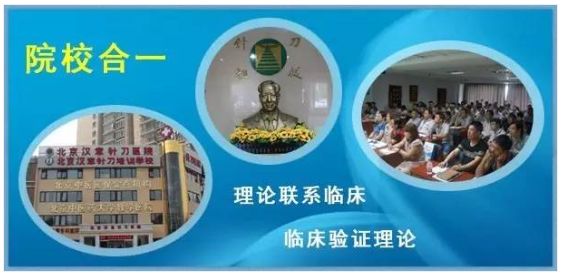
Address: Building 26, No. 16, Xi Sanqu, Tiantongyuan, Changping District, Beijing, 4th Floor, Beijing Hanzhang Acupuncture Training School
Transportation Directions
1. From Beijing Railway Station: Take Subway Line 2 to Yonghegong, transfer to Line 5 to “Tiantongyuan” Station Exit A, walk north for 20 meters, turn left at the intersection, and walk 50 meters to arrive.
2. From Beijing South Station: Take Subway Line 14 to Puhuangyu Station, transfer to Line 5 and follow the same instructions as above;
4. From Beijing West Station: Take Subway Line 7 to Ciqikou, transfer to Line 5 and follow the same instructions as above;
3. From Capital International Airport: Take the airport subway to Dongzhimen Station, transfer to Line 2 to Yonghegong Station, then transfer to Line 5 and follow the same instructions as above;
Registration Method
Contact Persons:
Liu Shuang, Wei Xiaomei, Wang Jing:
18701110686 (same number on WeChat)
13810971564 (same number on WeChat)
18701110876 (same number on WeChat)
13810249385 (same number on WeChat)
Website: www.zhendaopeixun.cn (Beijing Hanzhang Acupuncture Training School Official Website)