
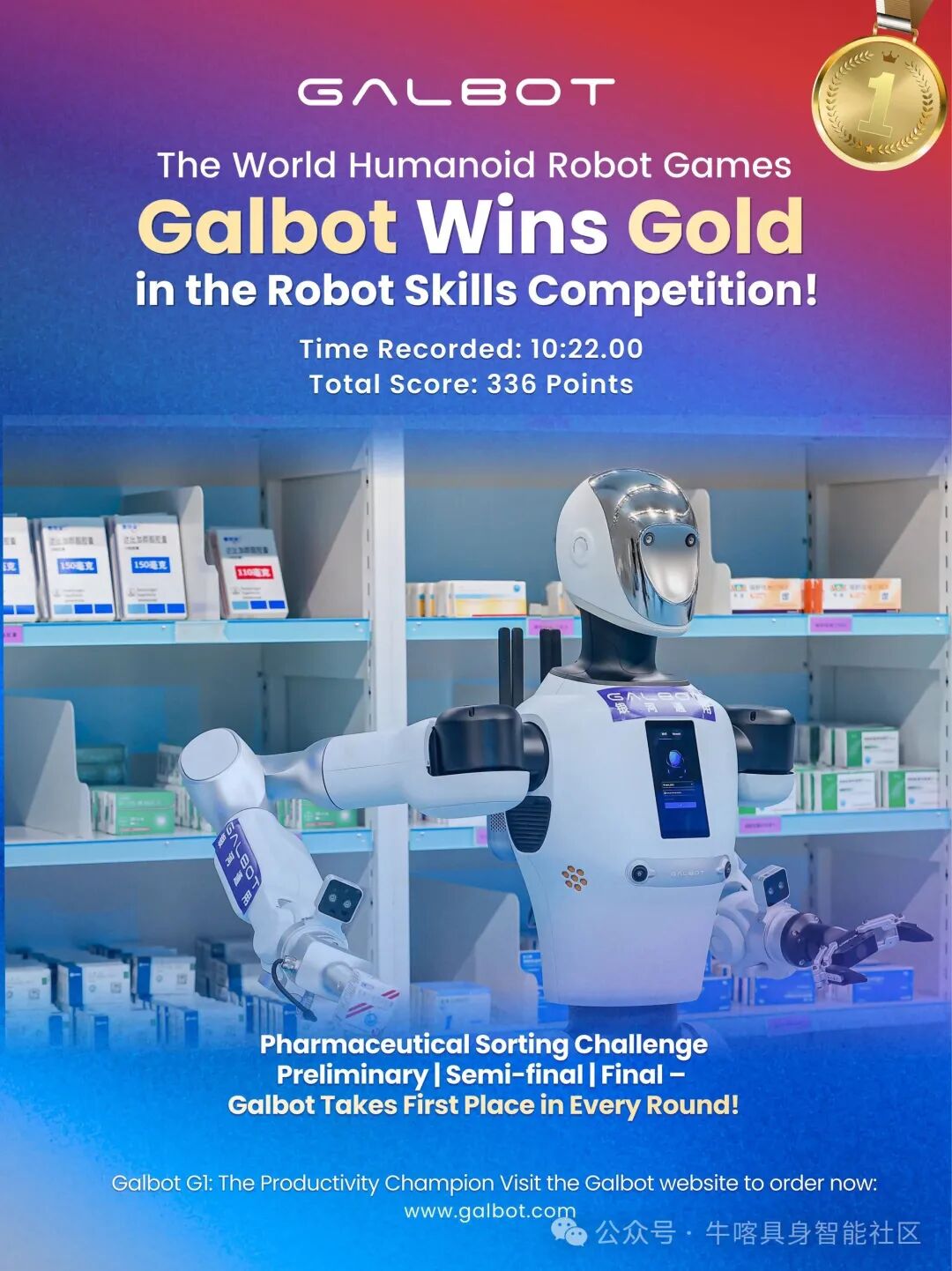
 Abstract:Galbot won the gold medal at the World Humanoid Robot Competition, achieving victory in the Pharmaceutical Sorting Challenge with fully autonomous technology. Leveraging the Sim2Real method to reduce costs, it has been implemented in smart pharmacies in Beijing, leading the application of robots in real-world scenarios.
1. Technical Background: The Challenge of Autonomy in Humanoid Robots and Real-World Implementation
As the “crown jewel” of the robotics field, the core value of humanoid robots lies in their ability to achievefully autonomous operation in the real world—performing perception, decision-making, and execution tasks independently without human remote control. However, most humanoid robots currently rely on a hybrid model of “remote operation + pre-set programs,” which limits their adaptability in dynamic environments (such as changes in object positions or sudden disturbances), making it difficult to truly implement them in high-precision and autonomous-demanding scenarios like healthcare and retail.
The inaugural World Humanoid Robot Games in 2025 introduced “real-world productivity” as a core competitive metric, with the “Pharmaceutical Sorting Challenge” being particularly critical: requiring robots to autonomously identify, locate, and grasp specified medications from multi-layered shelves and accurately deliver them to target containers, directly simulating the actual workflow of a pharmacy. Galbot’s humanoid robot stood out with itsfully autonomous operation, not only winning the gold medal but also marking a significant step forward in the autonomous application of humanoid robots in real-world scenarios.
2. Core Technology: Full-Chain Innovation from Competition Victory to Real-World Implementation
(1) Competition Performance: “Hardcore Validation” of Fully Autonomous Capability
In a robotics skills competition with 22 teams, Galbot’s core advantage lies in its “zero reliance on remote operation”:
-
Task Process: Faced with hundreds of medications on six layers of shelves, Galbot needed to complete three major steps—reading medication labels (including text and barcodes) through its vision system, autonomously planning the grasping path (avoiding shelf edges and other items), and accurately grasping (weights ranging from 5g tablets to 500g bottles) and delivering them to designated containers.
-
Key Data: The entire process took 10 minutes and 22 seconds, completing the precise classification of 9 types of medications, with a total score of 336 points, leading the second place by 160 points, and achieving zero errors—this performance far exceeded that of competitors relying on remote operation (most teams took over 20 minutes due to human operational delays or judgment errors, with an accuracy rate of less than 80%).
(2) Core Technology: Sim2Real Method Solving the “Data Dependency” and “Generalization” Challenges
Galbot’s fully autonomous capability stems from its innovative **”Sim2Real” methodology**, a breakthrough technical path to address the “high training costs and poor scene adaptability” of humanoid robots:
1. Large-Scale Simulation Pre-Training:
In a virtual environment, a “digital twin pharmacy” was constructed, generating massive synthetic data—over 100,000 types of medication appearances (labels, shapes, packaging materials), over 1,000 shelf layouts (height, spacing, item placement density), and over 500 disturbance scenarios (such as lighting changes, slight shelf shaking, and medication position shifts). Through deep learning models pre-trained in the simulation environment, Galbot can quickly master the foundational capabilities of “visual recognition – motion planning – grasping control” without relying on expensive real-world data collection.
2. Fine-Tuning with Minimal Real Data:
When transitioning from the simulation environment to the real scene, only a small amount (about 500 sets) of real pharmacy data (such as the reflective characteristics of actual medications and the physical interaction feedback between the robotic arm and real objects) is needed to fine-tune the model, achieving precise alignment between the “virtual and real”. This “simulation pre-training + real fine-tuning” model reduces the demand for real-world data by 90%, significantly compressing the R&D cycle and costs.
(3) Hardware and Perception System: Precision Design for Real-World Adaptation
To support fully autonomous operation, Galbot has made targeted optimizations at the hardware and perception levels:
-
Visual Perception: Equipped with a combination of multi-modal sensors—high-resolution industrial cameras (for recognizing medication label text/barcodes), 3D structured light cameras (to obtain the three-dimensional coordinates and depth information of objects), and infrared sensors (to adapt to low-light environments), achieving a medication recognition accuracy of 99.5% (even with worn or partially obscured labels).
-
Robotic Arm Design: Utilizing a 7-degree-of-freedom lightweight robotic arm, equipped with a force-controlled gripper (including a 6-axis force sensor), which can automatically adjust the gripping force based on the weight of the medication (e.g., using 0.5N force for tablets and 5N force for bottles), preventing crushing damage or slippage.
-
Motion Control: Based on the Model Predictive Control (MPC) algorithm, it adjusts the robotic arm’s motion trajectory in real-time to cope with constraints such as narrow shelf spacing (minimum spacing of 15cm), ensuring collision-free grasping.
3. Comparative Advantages: Redefining the “Practical Value” of Humanoid Robots
(1) Core Advantages: Dual Breakthroughs in Full Autonomy and Real-World Adaptability
1. Stability with Zero Human Intervention
Compared to robots relying on remote operation (which are affected by human reaction speed and operational experience, leading to significant stability fluctuations), Galbot maintains consistent precision in repetitive tasks through fully autonomous decision-making (with an accuracy rate consistently above 99% over 100 consecutive classification operations), making it particularly suitable for scenarios requiring high-frequency repetitive labor, such as pharmacies and warehouses.
2. Cost and Efficiency Advantages of the Sim2Real Method
Traditional humanoid robot training requires collecting tens of thousands of data sets in real environments (with the cost of a single data set exceeding 100 yuan), while Galbot’s simulation pre-training can reduce data costs to 1/100; at the same time, the simulation environment can quickly generate extreme scenarios (such as medication spills or shelf shaking), enhancing the robot’s disturbance resistance, which is difficult to cover with real data collection.
3. Plug-and-Play Real-World Implementation Capability
Currently, Galbot has been deployed in over 10 smart pharmacies in Beijing, capable of completing tasks such as prescription sorting and over-the-counter medication shelving, with a single robot handling over 500 orders daily, equivalent to the workload of 1.5 pharmacists. Its deployment requires no modification of the existing pharmacy environment (only standard shelves need to be adapted), and the installation and debugging cycle is only 24 hours, far less than traditional industrial robots (which require several weeks for modification and programming).
4. Generalization Potential
Based on the Sim2Real method, the model architecture has transferability—by changing the visual recognition module and grasping strategy, it can quickly adapt to tasks such as retail shelf organization and laboratory sample classification without needing to redevelop core algorithms, laying the foundation for “general robots”.
(2) Existing Challenges (Disadvantages): Progress Barriers from “Specialization” to “Versatility”
1. Scene Limitations
Currently, Galbot’s core capabilities are focused on classification tasks in “flat shelves + regular objects”; in unstructured environments (such as irregularly packaged medications or curved shelves) or dynamic scenes (such as sudden human contact with the shelf), its decision-making response speed can drop by over 30%, necessitating further optimization of real-time environmental perception.
2. Robotic Arm Load and Flexibility Boundaries
Due to lightweight design limitations, the maximum load of the robotic arm is 1kg, making it unable to handle overweight items (such as large packages of medications over 5kg); at the same time, the gripper’s structural design is more suited for hard packaging, with a success rate of only 85% for soft packaging (such as aluminum foil bag medications), necessitating the development of more universal end-effectors.
3. Insufficient Adaptability to Extreme Environments
In high-temperature (>35°C) and high-humidity (>80%) environments, sensor accuracy can be affected (with visual recognition accuracy dropping to 90%), while pharmacies and warehouses may experience environmental fluctuations, requiring enhanced environmental tolerance of the hardware.
4. High Initial Investment Costs
The hardware cost of a single Galbot is approximately 500,000 yuan; although it can recover costs in the long term by replacing human labor (based on a pharmacist’s annual salary of 100,000 yuan, with a payback period of 3-5 years), it remains a barrier for small and medium-sized pharmacies, necessitating cost reduction through large-scale production.
4. Application Prospects: An “Automation Revolution” from Healthcare to Multiple Industries
Galbot’s technological breakthroughs provide a model for automation upgrades across various fields:
1. Smart Healthcare Scenarios
In hospital pharmacies, it can replace pharmacists to complete sorting tasks after prescription review, reducing human error (currently, the error rate for manual sorting is about 0.5%, while Galbot can reduce it to below 0.1%); in laboratories, it can assist in completing repetitive tasks such as reagent classification and sample packaging, freeing up researchers’ time.
2. Retail and Warehouse Automation
It can adapt to tasks such as organizing snack areas in supermarkets and shelves in convenience stores, identifying and removing expired products through visual recognition, or automatically restocking based on sales data, improving inventory turnover efficiency.
3. Industrial Quality Inspection Assistance
In electronic factory assembly lines, it can replace humans to complete classification and defect detection of small parts (such as identifying bent chip pins), integrating machine vision to achieve “sorting + quality inspection” in one.
4. Potential for Home Services
In the future, through lightweight design and cost control, it is expected to enter home scenarios, completing tasks such as classifying food in refrigerators and organizing bookshelves, but it needs to address issues of safety collisions (avoiding contact with humans) and privacy protection (visual data processing).
5. Industry Impact: A Milestone in the “Practicalization” of Humanoid Robots
Galbot’s victory at the World Humanoid Robot Competition not only proves its technical strength but also redefines the development direction of humanoid robots—from “showy performances” (such as dancing and parkour) to “solving real problems.” The core insights include:
-
Autonomy is a prerequisite for implementation: Only by achieving full autonomy can humanoid robots break free from dependence on specialized operators and truly integrate into daily life and industrial scenarios;
-
Sim2Real is key to cost reduction: The efficient integration of simulation and reality addresses the industry’s pain points of “difficult training and high costs” for humanoid robots, clearing obstacles for large-scale applications;
-
Scene specialization precedes versatility: Focusing on specific scenes (such as pharmacies) before gradually expanding to general fields is a reasonable path to balance technical difficulty and practical value.
6. Future Plans: From “Single Scene” to “Universal Autonomy”
The Galbot team plans to break through existing limitations through three aspects:
1. Upgrading the sensor array (adding millimeter-wave radar) to enhance real-time perception capabilities in complex environments;
2. Developing modular end-effectors to adapt to the grasping of all types of objects from soft to overweight;
3. Expanding the Sim2Real scene library to cover over 100 industry scenarios, with plans to extend deployment to over 100 smart pharmacies and pilot retail and laboratory scenarios by the end of 2025.
END

 Click “Read the original text” for more information