Recently, GigaDevice officially launched its new entry-level MCU—the GD32C231 series. As a leading player in the domestic MCU field, GigaDevice is targeting the 32-bit “low-end” market with a succinct summary:“Affordable yet fully equipped, performance maximized”..
What Makes It “High-Performance”?
First, let’s look at the core parameters: the GD32C231 is equipped with theArm Cortex-M23 core, with a maximum frequency of48MHz, which offers about a 10% performance improvement over the classic Cortex-M0+.
The memory configuration is also quite practical:32KB~64KB Flash + 12KB SRAM, and all areas come withECC error correction functionality. This effectively prevents data errors, making it particularly suitable for industrial control scenarios where reliability is crucial.
Low Power Consumption + Anti-Interference
For battery-powered devices, energy efficiency is a necessity. The GD32C231 has a current as low as5μA in deep sleep mode, with a wake-up time of only2.6μs, which extends battery life while allowing for quick responses to external signals.
Even more impressive is its anti-interference capability:ESD protection reaches 8KV (contact discharge) and 15KV (air discharge), far exceeding the industry average. This means it can operate stably in complex electromagnetic environments, such as industrial sites or automotive electronics, without fear of static electricity or disturbances.
Rich Peripheral Configuration
The peripheral configuration of the GD32C231 can be described as “rich”:
● Communication Interfaces: 2 SPI channels (supporting QSPI mode, up to 24Mbps), 2 I2C channels (1Mbps), 3 UART channels (6Mbps), along with DMA and I2S modules, making high-speed data transmission a breeze.
● Analog Functions: 12-bit ADC (13 channels) + 2 comparators, meeting the needs for precise measurements, such as temperature monitoring in small appliances or battery voltage collection.
● Timers: 4 general-purpose 16-bit timers + 1 advanced timer, easily achieving complex PWM control.
More importantly, it supports1.8V~5.5V wide voltage supply and operates in a wide temperature range of -40℃~105℃, making it suitable for everything from household appliances to industrial equipment.
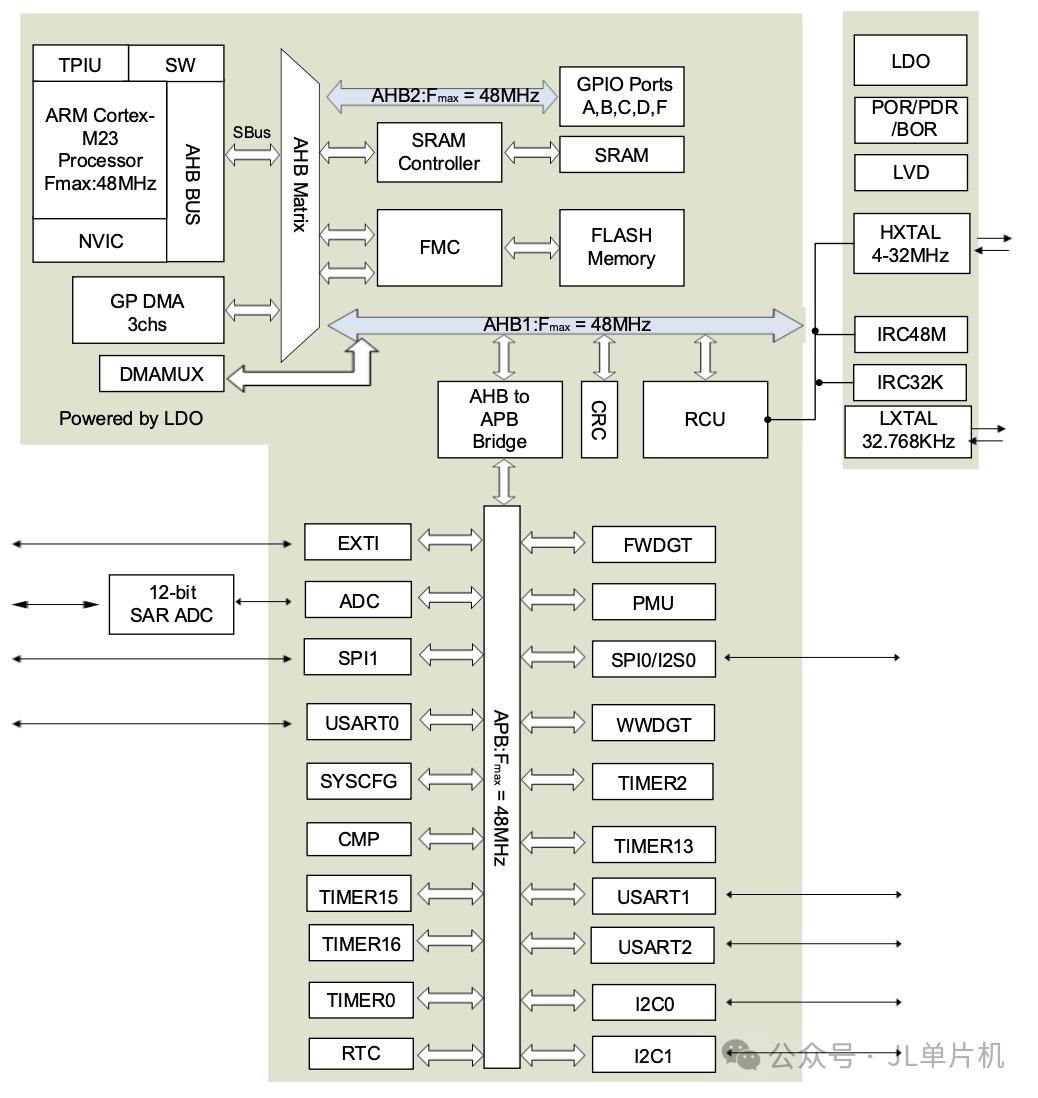
System architecture diagram of the GD32C2x1 series devices
Mature Development Ecosystem
On the development side, GigaDevice has also prepared a complete toolchain:
● IDE Support: Keil, IAR, and their own GD32 Embedded Builder (graphical configuration + code auto-generation).
● Debugging Tools: GD-Link supports dual-mode debugging (SWD/JTAG), plug-and-play.
● Resource Packages: SDK, FreeRTOS support, and example code are all available, allowing beginners to get started quickly.
Application Scenarios
The official target market is very clear:small appliances (rice cookers, air fryers), BMS battery management, small display devices, automotive aftermarket systems, industrial auxiliary control, etc. These fields share a common point:they are sensitive to cost-performance ratio but cannot sacrifice reliability..
For example, in small appliances, the high integration of the GD32C231 can reduce the number of peripheral components, directly helping customers save on BOM costs; in industrial control, its wide voltage, low power consumption, and high reliability give it an advantage over traditional 8-bit MCUs.