Antarctic Bear Guide: The technology in this paper may have significant market value.On September 20, 2025, Antarctic Bear learned that a research team from the Technical University of Denmark (DTU) has made a major breakthrough in sustainable energy technology, successfully developing a new type of all-ceramic fuel cell based on 3D printing technology, which is likely to change the application limitations of fuel cells in high-end mobile scenarios such as aerospace.
△ Related research results have been published in the journal “Nature Energy”, titled “Manufacturing Integrated Spiral Solid Oxide Batteries through Additive Manufacturing Technology” (link).
3D Printing of New Spiral Fuel CellsTraditional fuel cells rely on a large number of metal seals and connection components, resulting in their weight accounting for over 75%, severely limiting their application in weight-sensitive fields such as aviation and aerospace. In contrast, pure electric solutions also face the fundamental challenge of insufficient energy density— for example, replacing 70 tons of jet fuel in an aircraft with lithium-ion batteries would increase the total weight to 3,500 tons, making it completely unfeasible.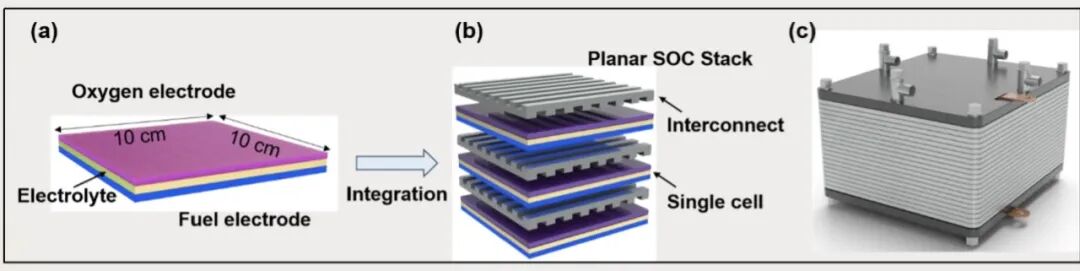
△ The image shows the structure and components of a traditional SOC battery pack, including individual cells, metal interconnects, and sealants.
To address this bottleneck, the DTU Energy and DTU Construct joint team achieved original innovation from the perspective of structural design. They drew inspiration from the spiral geometric forms found in butterfly wings and industrial heat exchangers, utilizing a triply periodic minimal surface (TPMS) structure, and through mathematical optimization and 3D printing processes, created the world’s first “monolithic spiral solid oxide battery” (referred to as “monolithic”). This structure greatly increases the electrochemical active area while ensuring mechanical strength, achieving a leap in power output per unit mass—exceeding 1 watt per gram, setting a new record for this type of electrochemical device.Senior researcher Venkata Karthik Nadimpalli stated: “Currently, energy conversion technologies based on electricity, such as batteries and fuel cells, are not very meaningful for aerospace applications. But our new fuel cell design changes that. This is the first time sustainable green technology has demonstrated the watt-to-gram ratio (or specific power) required for aerospace.”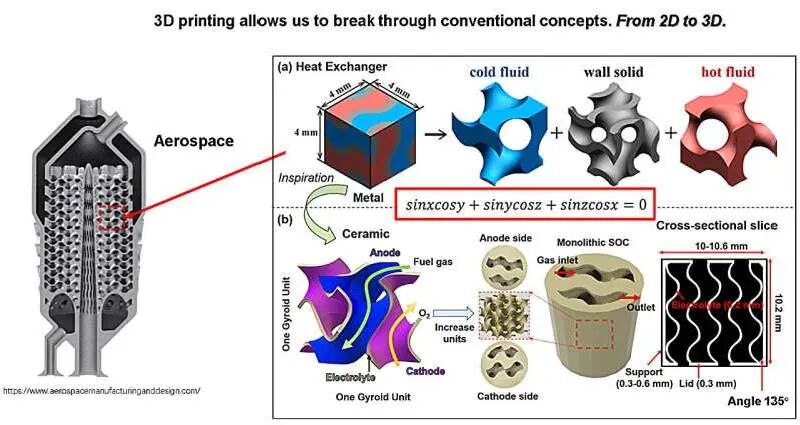
△ A heat exchanger using a spiral structure, particularly suitable for aerospace applications.
Simplified Manufacturing ProcessFuel cells have powered hydrogen-powered vehicles, ships, data centers, and hospitals, and can also store renewable energy through electrolysis. The new DTU design adds several advantages: efficient airflow, better heat distribution, higher stability, and a hydrogen production speed nearly ten times faster than traditional systems.Professor Vincenzo Esposito stated: “We have also tested the system under extreme conditions, including temperature fluctuations of 100°C, and repeatedly switched between fuel cell and electrolysis modes. The fuel cell performed excellently, showing no signs of structural failure or delamination.”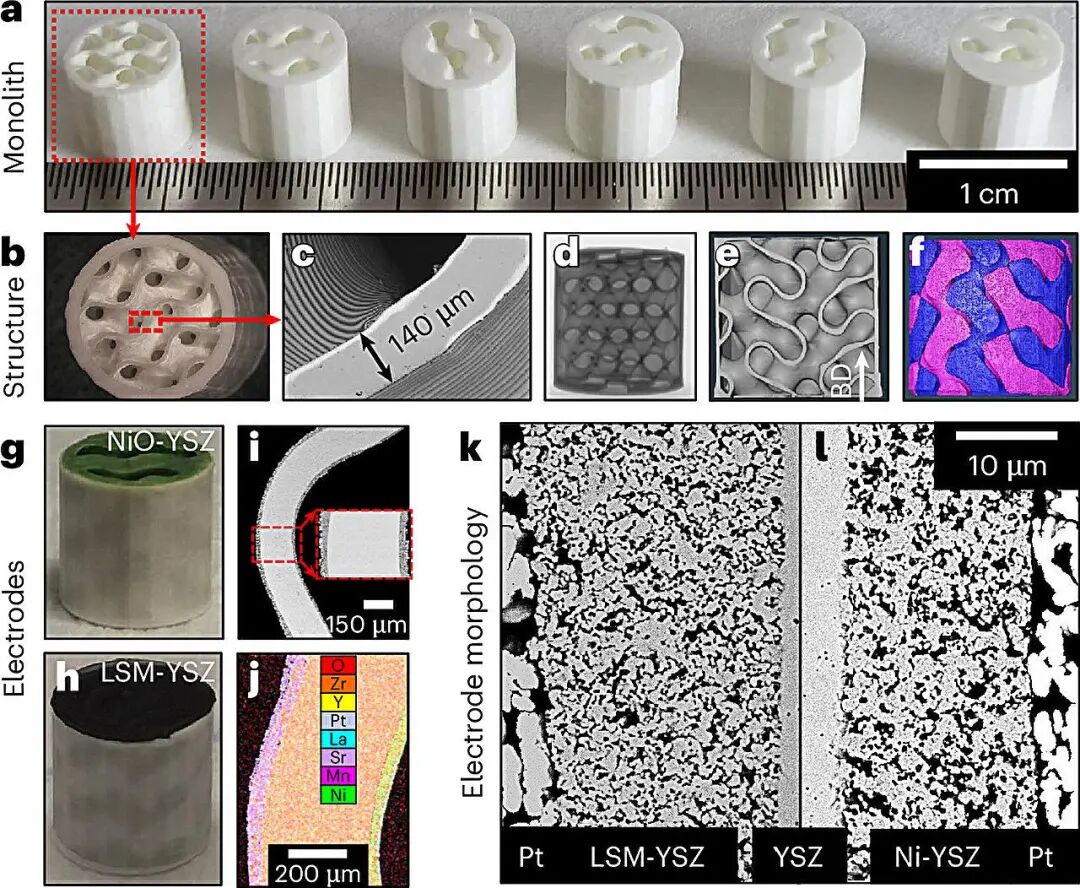
△ Structural characterization of the 3D SOC.
This technology is expected to be directly applied to projects such as NASA’s “MOXIE”, which currently weighs over 6 tons for producing oxygen in the Martian atmosphere. If the DTU solution is adopted, it could be reduced to 800 kilograms, significantly enhancing mission feasibility.The research team emphasized that traditional SOC stacks require dozens of processes and use various easily degradable materials, while this all-ceramic monolithic design only requires five manufacturing steps, eliminating the need for metal components and addressing the fragility issues associated with traditional sealing structures. Researchers further pointed out that thinner electrolytes, low-cost current collectors, and compact structural designs will leave ample room for performance enhancement.“Over 2000 Chinese 3D printing manufacturers directory included” △ Please scan the code to fill in company information.“Directory of Chinese 3D printing manufacturers” can contact Antarctic Bear official customer service WeChat nanjixiong3ddayin.