▲ Click the blue text aboveto follow our public account, and reply with“Feilian Cloud” to obtain【Data Download Method】

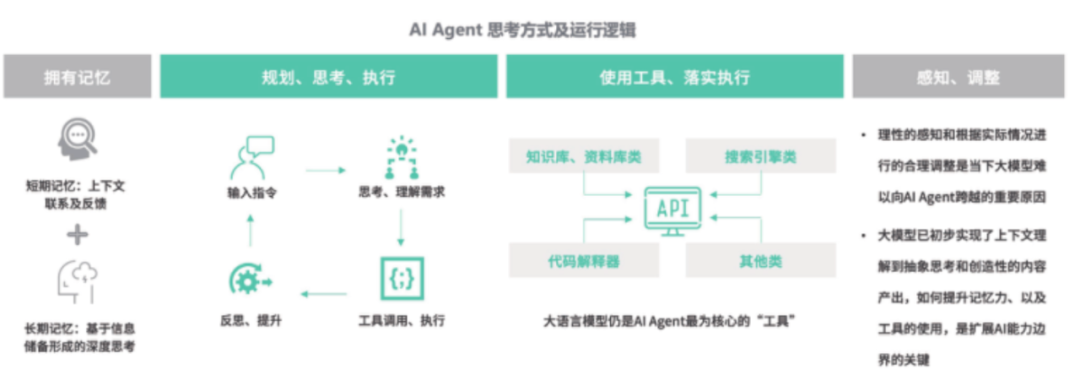
An AI Agent refers to an intelligent entity capable of proactive thinking and action, working in a human-like manner. It utilizes large models to “understand” user needs, actively “plan” to achieve goals, employs various “tools” to complete tasks, and ultimately “acts” to execute these tasks.AI Agents differ from traditional artificial intelligence in that they possess the ability to independently think and utilize tools to gradually achieve given objectives.Essentially, an AI Agent is a proxy system that controls various tools to solve problems.
An AI Agent is a system driven by a large language model, capable of autonomous understanding, perception, planning, memory, and tool usage, enabling it to automate the execution of complex tasks.
Characteristics of AI Agent Applications
Autonomy: AI virtual agents can perform tasks independently without human intervention or input.
Perception: Agents perceive and interpret their environment through various sensors (such as cameras or microphones).
Reactivity: AI agents can assess their environment and respond accordingly to achieve their goals.
Reasoning and Decision-Making: AI agents are intelligent tools that can analyze data and make decisions to achieve objectives. They use reasoning techniques and algorithms to process information and take appropriate actions.
Learning: They can learn and improve their performance through machine learning, deep learning, and reinforcement learning techniques.
Communication: AI agents can communicate with other agents or humans using various methods, such as understanding and responding to natural language, recognizing speech, and exchanging messages through text.
Goal-Oriented: They are designed to achieve specific goals, which can be predefined or learned through interaction with the environment.
Technical Features of AI Agents:
Relation to Large Models
The difference between AI Agents and large models lies in the interaction between the large model and humans, which is based on prompts. The clarity of user prompts affects the response quality of the large model. In contrast, an AI Agent only requires a given goal to independently think and take action towards that goal.
Fundamentally, the core driving force of an AI Agent is the large model, supplemented by three key components: planning, memory, and tool usage.
The large model is the prerequisite and foundation for the implementation of AI Agents. We can metaphorically compare AI Agents to biological entities and their brains; AI Agents have hands and feet to work and execute tasks, while the large model serves as their brain.
Working Principles
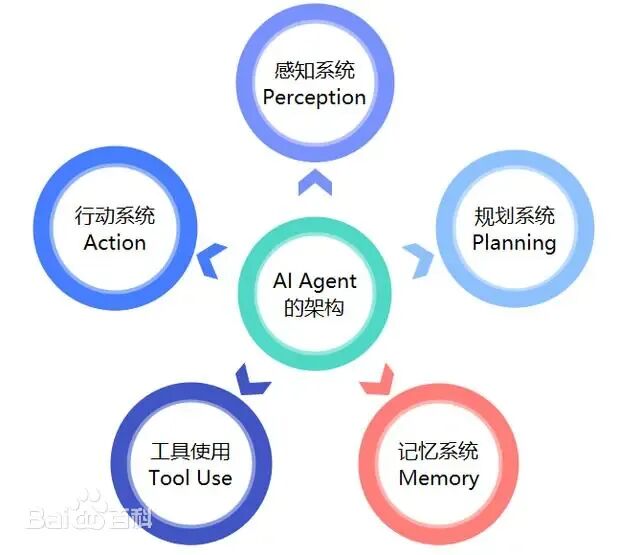
The architecture of an AI Agent is the foundation of its intelligent behavior, typically including key components such as perception, planning, memory, tool usage, and action, which work together to achieve efficient intelligent behavior.
Future Characteristics
More intelligent, autonomous, and adaptable. They will be able to learn and improve their behavior, make optimal decisions based on different contexts and users, and handle uncertainty and complexity.
More human-like, friendly, and trustworthy. They will be able to understand and express emotions, build and maintain relationships with users, and adhere to ethical and social norms.
More diverse, specialized, and collaborative. They will be able to provide specialized services or assistance for different fields and tasks, and effectively collaborate and coordinate with other AI Agents or humans.
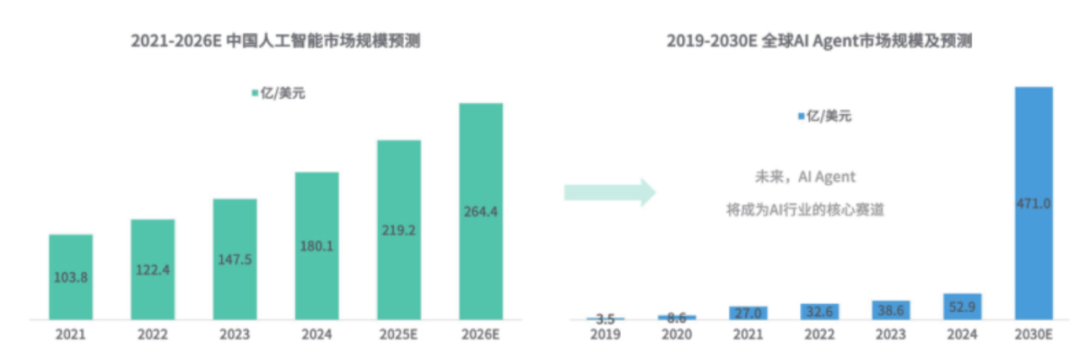
The scale of AI Agents is less than ten billion, with considerable growth potential in the future.
The Chinese AI market is steadily increasing and is expected to become a major player in the future AI Agent arena.
According to industry public data forecasts, the global AI Agent market size is expected to reach $5.29 billion in 2024, and this figure is projected to reach $47.1 billion by 2030. Despite the need for technological breakthroughs in the AI Agent field, considering the continuous increase in China’s AI market share, it is expected to become a major player in the future AI Agent arena.
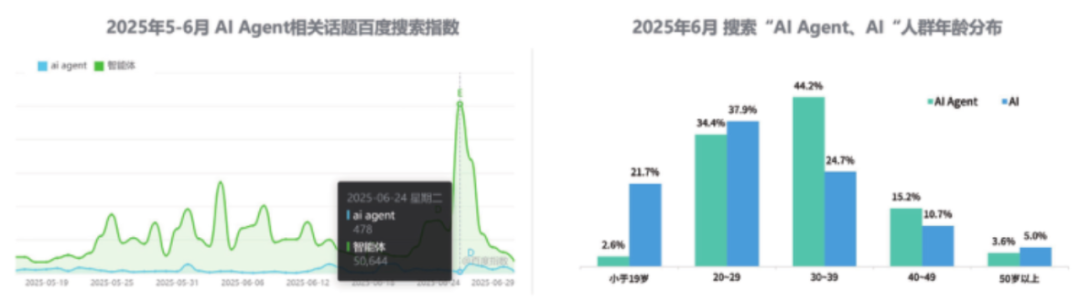
Domestic interest in AI Agents is relatively low, with males aged 30-39 being the primary search demographic.
The market is still in the conceptual definition stage, with AI Agent search popularity significantly lower than mainstream concepts like “AP”.
Currently, AI Agents remain a relatively niche concept. Although leading tech companies are accelerating their layout and launching related platforms, the search volume for this keyword remains in the thousands, which is significantly lower compared to the millions for popular keywords like AI. Notably, in AI Agent-related searches, users tend to search for specific product names like Manus, Tars, and MCP. From the user profile perspective, the 30-39 age group contributes over 40% of the AI Agent-related content search volume. Overall, the interest in this field is steadily rising, with major manufacturers quietly advancing product development and continuously improving agent technology levels.
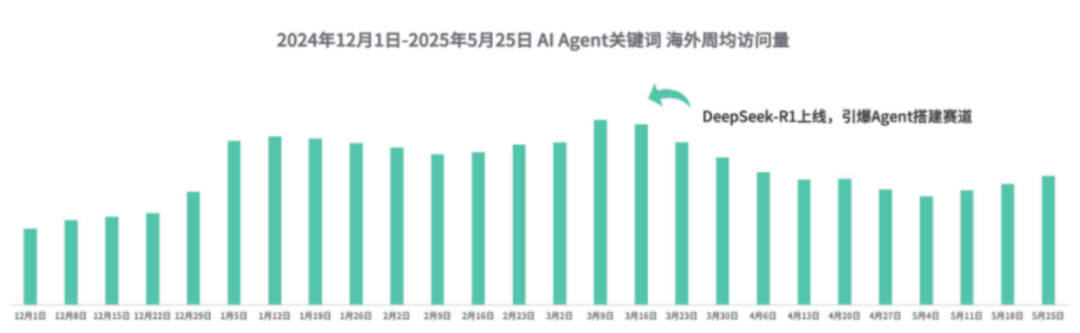
Overseas interest in AI Agents is higher, with Deep Seek driving click growth.
Weekly visits exceed 90,000, with nearly 50,000 natural clicks.
Overseas markets show significantly higher interest in AI Agents compared to domestic markets, but there is still a notable gap compared to the search volume for popular concepts like generative AI and large models. Current data shows that the launch of Deep Seek has significantly lowered the barrier to building agents, leading to a rapid increase in the number of educational content, technical tutorials, and building videos related to AI Agents overseas, with the click-through rate for related keywords showing a continuous upward trend. By May 2025, the average daily visits in this field are expected to stabilize around 60,000. The industry anticipates that with the release of next-generation large models like Deep Seek-R2, AI Agent-related content will experience explosive growth, driving a new surge in keyword click volume.
Deep Seek (large model): faster, better, stronger performance.
Although it has not achieved agent-level intelligence, it has become the core foundation of AI products.
Deep Seek-AI large model: set to launch by the end of 2024, aiming to catch up with leading overseas large models through algorithm and technology iterations.
Function Introduction: Deep Seek is an open-source general natural language processing model, proficient in tasks such as text generation, computational reasoning, document processing, and intelligent dialogue.
Web Information: As of February 2025, Cursor ranks 61st globally and 6th in the program development industry. During this period, Deep Seek has surpassed OpenAI (ranked 90th) in global rankings.
Future Outlook for the AI Agent Industry
AI Agents, as an important carrier of artificial intelligence technology, are reshaping the boundaries of human-computer interaction, automated decision-making, and personalized services. From a technological trend perspective, the enhancement of multimodal integration, autonomous learning, and real-time interaction capabilities will drive deeper penetration of AI Agents in vertical fields such as healthcare, finance, and education.
Market Potential and Challenges
Despite the continuous expansion of market size (with the global AI Agent market expected to exceed $100 billion by 2030), the industry still faces challenges such as data privacy, ethical risks, and computing costs. Leading companies are consolidating their advantages through technological iterations and ecosystem collaborations, while startups need to focus on innovation in niche scenarios.
Conclusion
The evolution of AI Agents is not only a technological breakthrough but also an extension of human productivity and creativity. In the future, with improved policy regulations and the democratization of technology, AI Agents are expected to become the core infrastructure for digital transformation, bringing paradigm shifts to global industries and social life.
Thank you for watching!

Disclaimer:The articles published in this public account are either original or edited and organized based on online searches. The copyright of the articles belongs to the original authors and is for readers’ learning and reference only. Commercial use is prohibited. Due to numerous reprints, it is impossible to find the true source. If the source is incorrectly marked or if there are any infringements regarding the software/materials contained in the images, text, or links used in the article, please contact us for deletion. Thank you!