
Written by | Zhou Tian Finance
Original Production by Zhou Tian Finance
Buying insurance is difficult, and selling it is equally challenging. The reasons are a lack of understanding and fear of pitfalls; in summary, it’s about the fear of loss and the need for certainty and a sense of gain. However, traditional insurance models cannot provide this sense of certainty, with a plethora of products and complex terms, often spanning dozens of pages filled with convoluted sentences.
A deeper concern is that insurance advisors have their own interests in quickly closing deals, raising doubts about whether their advice is genuine and whether they can truly represent my interests. As a result, I have procrastinated on purchasing many insurance products.
However, it is not a solution to run naked in the face of risk; I still have underlying worries. At the same time, I see that large models are penetrating industries today, and the concept of agents is gaining popularity. Naturally, I hope there can be an AI insurance agent that can lead me to a certain answer, help me compare core terms, and present me with multiple-choice questions instead of fill-in-the-blank ones.
Therefore, whenever I hear about a new insurance agent being released, I am always the first to try it out.
On September 12, at the 2025 Inclusion Bund Conference, Ant Insurance launched its next-generation super-intelligent insurance advisor, “Ant Insurance Agent.” Given Ant’s aggressive embrace of AI in recent years, I planned to challenge the insurance AI agent with some obscure questions to see if it could solve my insurance dilemma.
 01 A Brand New Model of Insurance Intelligence
The first question was quite tricky.
In the past, a family member bought critical illness insurance for me without asking about my health status, while I had just undergone a physical examination and found some abnormal indicators. I had heard of cases where omissions in health disclosures could lead to insurance companies denying claims.
I asked several people but did not get a definitive answer; this type of question is definitely a necessity.
This time, I asked on behalf of my family whether macular degeneration affects insurability. The answer from Ant Insurance Agent was surprisingly definitive, citing the source as: Anxin Insurance.

Another area where I lacked knowledge was auto insurance. I must admit that as a ten-year car owner, I have always struggled to differentiate between third-party liability insurance and vehicle damage insurance.
So, I asked Ant Insurance Agent, and for the first time in ten years of driving, I understood the difference between third-party liability and vehicle damage insurance. A key aspect was that Ant Insurance Agent used structured charts to highlight the critical differences.
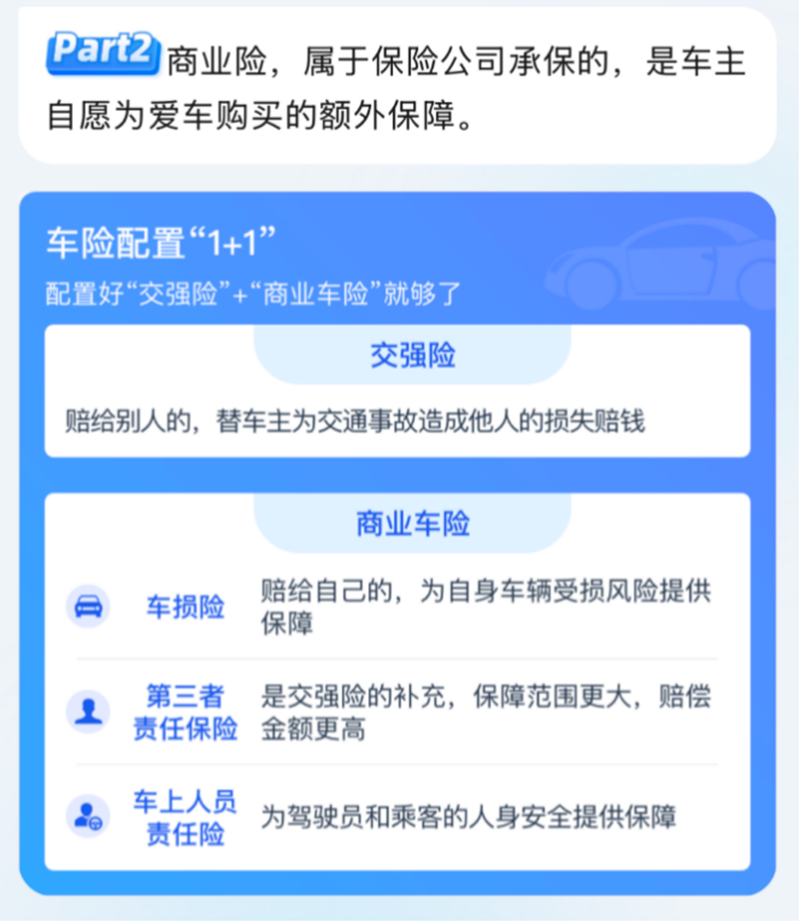
Later, whenever I compared the differences between two insurance products, Ant Insurance Agent would also highlight the key differences for me. Here, I must say, an insurance agent that can create tables is a good agent.
Another remarkable point is that if I request recommendations for products outside the Ant platform, even if I might purchase elsewhere, the agent still prioritizes recommending them to me. Ant Insurance Agent is truly impartial, which aligns with what Sun Zhenxing, CTO of Ant Group’s insurance division, described: “Ant Insurance Agent” features “zero commission orientation” and “zero knowledge blind spots.”
I plan to challenge Ant Insurance Agent further.
This time, I asked in reverse; I only mentioned characteristics and let Ant Insurance Agent find products that matched those characteristics. For example, I wanted to select high-satisfaction million medical insurance products and requested two such products, and Ant Insurance Agent indeed provided them.
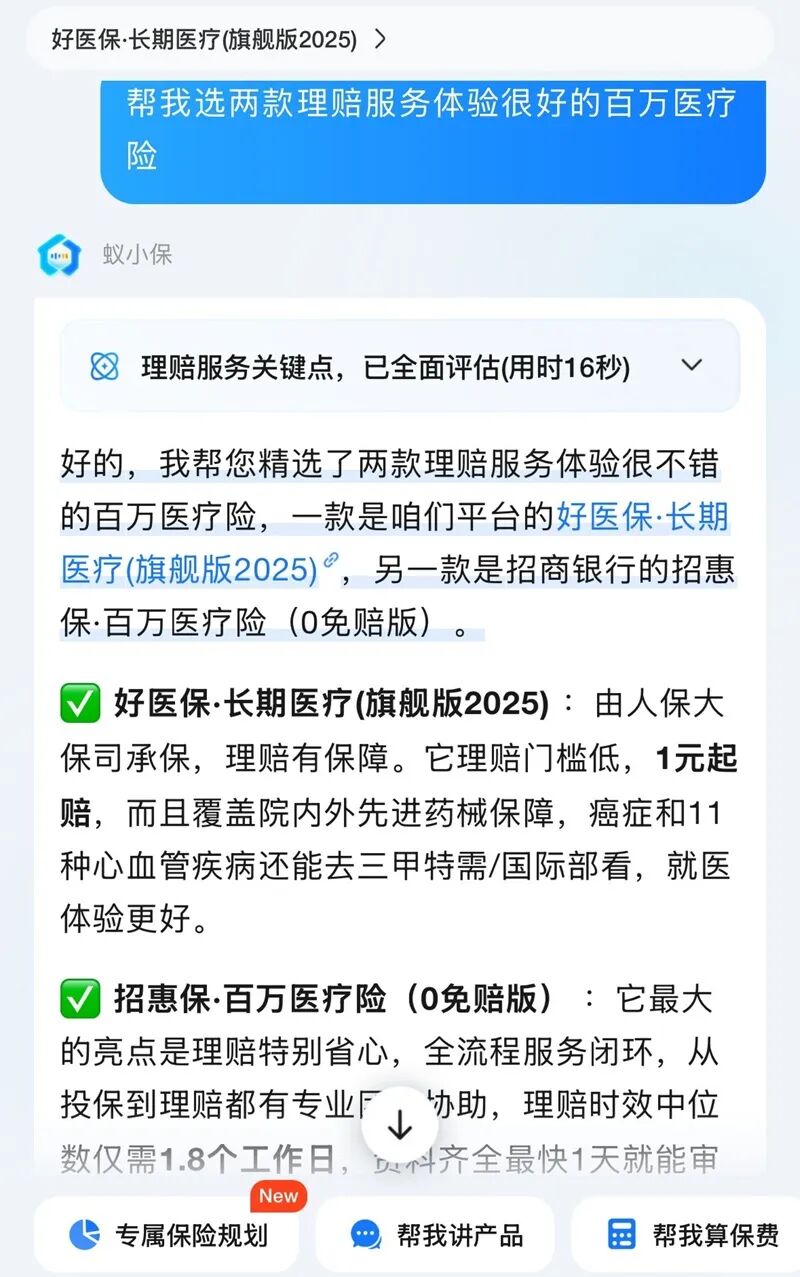
In critical illness insurance, a crucial scenario is whether cancer and cardiovascular diseases support multiple claims. This is a very practical clause, so I asked Ant Insurance Agent to help me find products that allow for second claims, and it successfully did so.
At this point, I realized that natural language-based thinking is crucial; it aligns with users’ help-seeking habits, allowing the agent to trace back clauses based on a user’s statement and search the insurance knowledge base. This may be the functionality that an insurance AI agent should possess.
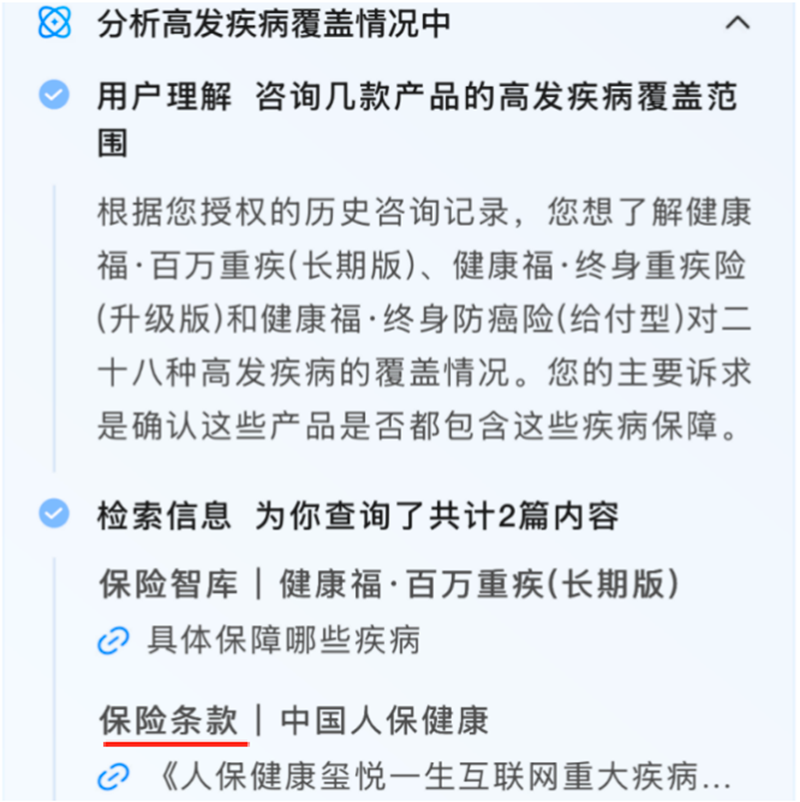
In the past, buying insurance required relying on people to explain these issues, with users having to sift through clauses one by one. Today, when users present their needs, the agent helps them find the relevant clauses.
Ant Insurance Agent emphasizes presenting the reasoning chain of AI, where the answers are extremely concise, but the reasoning process is thoroughly displayed, allowing us to clearly see the information path. In the words of AI industry researchers, “All work is to make users see.” The visualization of reasoning provides users with a sense of satisfaction. A concise answer is satisfying, while a fully presented reasoning process, showing the reasoning model in action, is also a form of satisfaction.
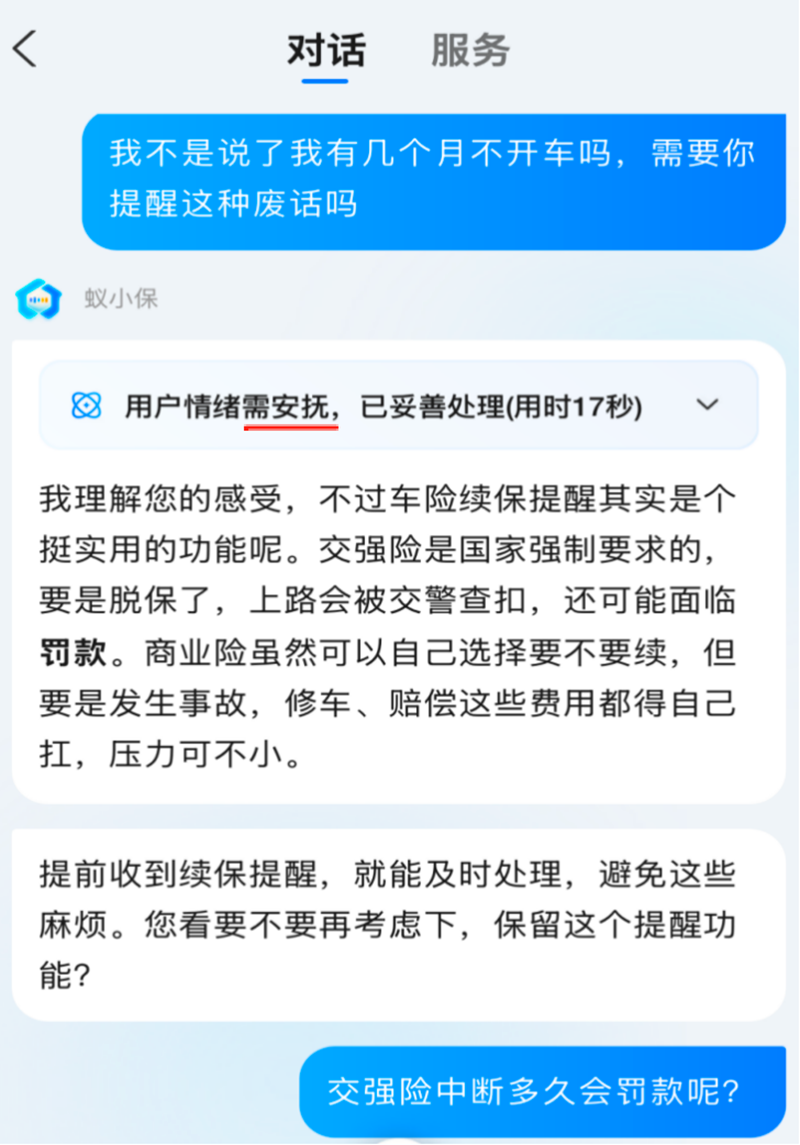
At this point, I discovered the significant differences in intelligent insurance advisors in the AI era. Compared to the past, large models greatly shorten the user path, and the Q&A habit is “humanized.” Insurance is indeed the most suitable industry for multi-turn Q&A with large models. For instance, sometimes I feel that Ant Insurance Agent asks too many questions, and I feign impatience. At this moment, Ant Insurance Agent can recognize my agitation and immediately adjust its tone and wording to provide a more concise and clear answer.
Former Google CEO Eric Schmidt and David Parakh, CEO of the Stanford Research Institute, had a conversation at the PARC Forum, discussing how AI is changing the interaction between humans and computers. The relationship between humans and tools will inevitably change, and this change is already happening.
Indeed, this change is occurring in the insurance sector.
 02 Trying More Insurance AIs
After using Ant Insurance Agent, I felt like I had seen the ideal form of an agent. I wondered if other companies could achieve the same. So, I went to other platforms to ask the same questions, only to realize how naive I was.
For example, when I asked DeepSeek, its reasoning chain was also relatively complete, and it could use tables for product comparisons. However, when I clicked on the links it provided to check the information sources, I found that many of the sources were from obscure websites, which raised doubts about their credibility.
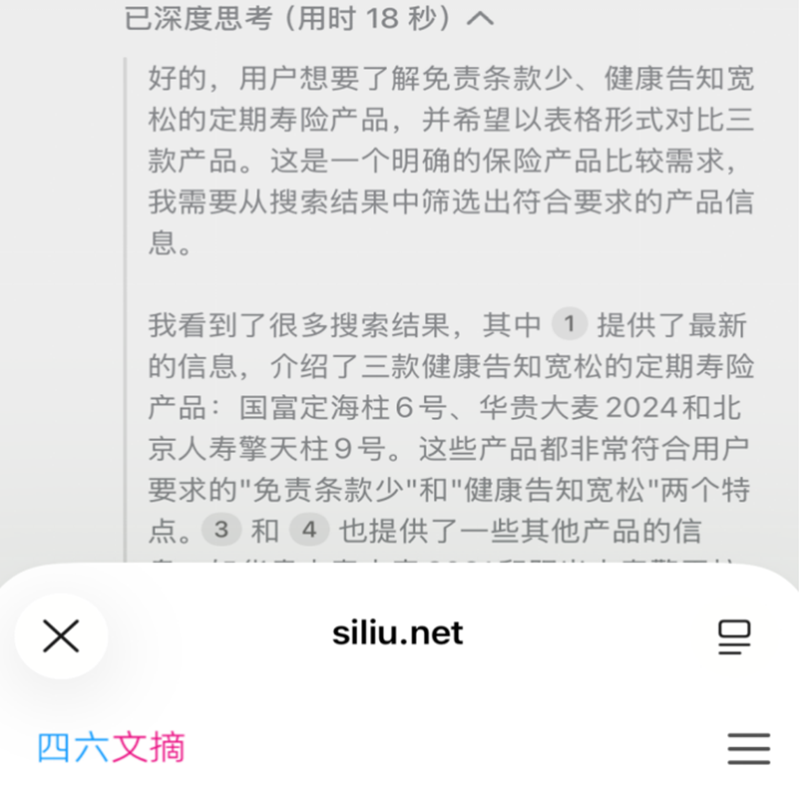
Ant Insurance Agent’s reasoning chain also marks information sources. So, I tried clicking on the information sources from Ant Insurance Agent and found that most were from Ant’s own “Industry Selections,” which is a carefully curated and edited knowledge base, providing a different level of trust.
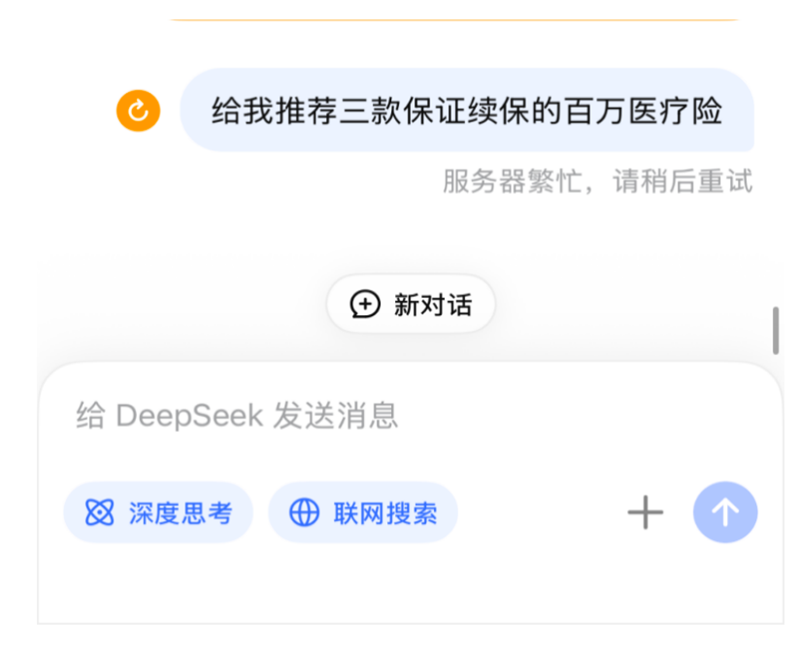
Returning to DeepSeek for further questions, I found that once I asked a few more questions, DeepSeek’s response slowed down. After submitting my questions, I waited a long time, and a minute later, it displayed: “Currently busy, please try again later.”
So, I decided to switch back to insurance platforms, selecting two well-known insurance companies and platforms, and asked similar questions, only to find that I did not receive effective answers.
I discovered that other platforms lacked logical reasoning capabilities; if the keywords did not match, they could not understand the questions and could not respond. Additionally, Ant Insurance Agent allows for voice interaction, while these two insurance platforms currently do not support voice input.

These two platforms are also more marketing-oriented; as soon as you click to find an advisor, it redirects you to WeChat, requiring you to add the customer service’s corporate WeChat. What started as a simple question now requires an additional step, and once you add the corporate WeChat, you will receive advertisements in your Moments, which is more intrusive. Therefore, I am reluctant to add WeChat, and my testing stops here.
 03 Integrating Multiple Capabilities into Ant Insurance Agent
Why are Ant Insurance Agent’s answers so effective and straightforward? After some research, I found that Ant has integrated a wealth of past capabilities into the AI agent of Ant Insurance.
It can be understood as a single entry point, an interactive interface that aggregates the capabilities of multiple agents, matching the appropriate assistant based on the user’s natural language.
This is not an overnight achievement; from the “selection, configuration, and claims” stages, Ant Insurance has been using AI models to tackle these issues.
For instance, in selecting insurance, Ant Insurance has integrated a set of AI models into its “Gold Selection” feature. The AIMM Gold Selection model has five dimensions (insurance threshold, coverage, cost-effectiveness, insurer operation, service claims), subdividing into 12 insurance categories, scoring the product’s strength and the company’s strength, with 851 decision factors covering various issues that different consumers care about. From hundreds of products on the “Ant Insurance” platform, it selects the top 10% of products in each insurance category.
Yanjie, the head of Ant Insurance’s Gold Selection, stated that the Gold Selection standards are not linked to sales volume; the goal of Gold Selection is to build a robust model and product evaluation system.
With different KPIs, the results are naturally different.
Once the Gold Selection model is established, it moves to the “Worry-Free Configuration” stage. According to Zhang Cheng from Ant Insurance’s Worry-Free Configuration team, they developed the HRAAM insurance configuration model. After users input basic information, the HRAAM model goes through risk analysis, coverage assessment, and product matching to generate a recommendation plan.
Zhang Cheng also mentioned that Worry-Free Configuration adheres to the principles of objectivity and fairness, recommending configuration plans based on users’ personal situations and actual needs, completely unaffected by product popularity, sales commissions, or other factors, and does not charge fees to users or insurance companies. The recommendation logic in Worry-Free Configuration does not mix commercial interests, focusing entirely on user benefits.
Insiders have emphasized a concept: for the platform, they hope that Worry-Free Configuration services are as decoupled as possible from commercial goals, while ultimately achieving alignment, providing valuable services and assisting customers in accurately and scientifically configuring insurance, while also achieving commercial goals.
From Gold Selection to Worry-Free Configuration, each module’s intention is to decouple from commission monetization, which allows Ant Insurance Agent to achieve a zero-commission orientation, aligning itself with the user’s side.
In addition to selecting the right products, claims service is the most crucial aspect, representing the moment when users feel a sense of gain. A slight misstep can easily lead to a trust crisis. For this, Ant Insurance still uses AI to address claims issues.
This is the Anxin Claims service. The underlying technology supporting Anxin Claims is referred to as the “Claims Brain.” Ant Insurance’s approach is to “teach machines to make decisions.” In simple terms, it involves establishing a foundational knowledge graph, training machines to analyze and form judgments using a sufficient number of cases, while experts intervene promptly for corrections, making it the first commercially used claims system in the insurance industry without human intervention.
Ant Insurance has been aggressive in claims, directly displaying the claims indicators that users cannot know in advance at the sales end. Starting in 2024, the Anxin Claims service will display four indicator scores for each selected insurance product: submission success rate, timeliness achievement rate, conclusion acceptance rate, and claims satisfaction. This score will be shown on the front-end purchase page, allowing users to intuitively understand the claims service level of the product when purchasing insurance, rather than waiting until they need to file a claim.
I believe this pushes insurance companies closer to users, leveraging AI capabilities.
Moreover, according to insider information, Ant Insurance plans to externally output these systematic capabilities. The “Ant Insurance Agent” will be simultaneously integrated into the intelligent insurance service open platform “Ant Insurance Bridge” (referred to as “Ant Bridge”), allowing insurance companies connected to Ant Bridge to utilize the capabilities of Ant Insurance Agent to serve customers, achieving “answering all questions and providing full protection,” significantly enhancing the service experience and operational efficiency of insurance companies.
For intelligent insurance advisors, I have gradually grasped two layers of evaluation criteria. The first layer is usability, where everything has a response. The second layer is to avoid being overly sales-oriented, with conflicts of interest being too obvious.
A simple product may hide profound changes touching the soul of the insurance industry. While the answers seem straightforward, they actually involve sacrificing significant interests. Such decoupled insurance AI advisors are currently rare but represent the direction the industry should take.
*This is only a product introduction and does not constitute insurance recommendation advice.
- END -
Zhou Tian Industry AnalysisOriginal Production | techfinsight
Focusing on in-depth analysis and trend interpretation of technology industries and business phenomena, also paying attention to entrepreneurs and corporate culture.
Zhou Tian Finance Selected Works
The Year of AI Glasses: Xiaomi and Alibaba Start the Battle for Entry
In the AI Era, Algorithms Stir Up Discord Among Everyone
Humanoid Robots Rush Towards IPO
Unmanned Equipment’s IPO Sprint: How to Escape the “5 Billion Valuation Trap”
Three Wars in Crisis: Unmanned Boats Disrupt Naval Warfare Patterns, Generational Gaps Will Eliminate Arrogant Strongholds
Insights into the Silver Economy: Blue Ocean, Washing Customers, Ponzi Schemes, and 3 Billion Revenue Giants
For more exciting content, click below to follow