In-Depth Analysis of Linux Memory Pool Management: From Principles to Practice
1 Basic Concepts of Memory Pools and Background Issues
In computer systems, memory management has always been a key factor affecting system performance and stability. Traditional dynamic memory allocation methods, such as <span>malloc()</span> and <span>free()</span> in the C standard library, while convenient and flexible, have significant performance bottlenecks and resource utilization issues in certain specific scenarios. Let us first delve into the essence of these problems to better understand the background of memory pool technology and the core issues it aims to address.
1.1 Performance Challenges of Memory Allocation
Each time a program calls <span>malloc()</span> to request memory, the underlying memory manager must perform a series of complex operations: searching for a sufficiently large free memory block, splitting memory blocks, updating internal data structures, etc. The time complexity of these operations is usually not constant, especially when the system has been running for a long time and memory allocation and deallocation are frequent. The internal data structures of the memory manager become complex, leading to more time-consuming search and allocation operations.
Imagine a scenario in a library: if every time a reader borrows a book, the librarian has to search through all the bookshelves in the entire library, the efficiency would undoubtedly be very low. Similarly, frequent memory allocation and deallocation can lead to performance degradation, especially in real-time systems, embedded systems, or high-performance computing scenarios where performance is critical; this performance loss may be unacceptable.
1.2 The Dilemma of Memory Fragmentation
Another key issue is memory fragmentation. As memory is continuously allocated and released, many small and scattered free blocks appear in physical memory. Even if the total free memory is sufficient, it may not be possible to find enough contiguous space when a larger contiguous memory block is needed. Memory fragmentation is mainly divided into two types:
- • External Fragmentation: Scattered free memory located between allocated memory blocks, which cannot be merged to satisfy larger memory requests due to their discontinuity.
- • Internal Fragmentation: Space that is not actually utilized within allocated memory blocks due to alignment or fixed block size.
Using a parking lot analogy: external fragmentation is like scattered empty parking spaces in a parking lot; although there are many, when a large truck needs several contiguous spaces, these scattered empty spots cannot meet the demand. Internal fragmentation is like the gaps between parked vehicles and the marked boundaries; although space exists, it cannot be used by other vehicles.
1.3 The Solution of Memory Pools
In response to the above challenges, the memory pool (Memory Pool) technology has emerged. Its core idea is to pre-allocate a large block of memory and then let the application manage the allocation and deallocation of this memory. This approach brings multiple advantages:
- • Performance Improvement: By pre-allocating and customizing allocation strategies, the time overhead for each allocation is greatly reduced, and allocation operations can typically be completed in constant time.
- • Fragmentation Control: By using fixed-size allocations or carefully designed block size strategies, memory fragmentation is effectively reduced.
- • Determinism: For real-time systems, memory pools provide predictable allocation times, avoiding the poor performance of traditional memory allocators in the worst-case scenarios.
- • Locality Advantage: Memory blocks of the same object are usually located in adjacent memory areas, which is beneficial for cache locality and improves access efficiency.
In Linux systems, memory pool technology has multi-layered and multi-scenario applications. From kernel-level <span>genalloc</span>, <span>slab</span> allocators, <span>mempool</span>, to various user-space memory pool implementations, a rich and complete memory management ecosystem has been formed. Next, let us explore the specific implementation mechanisms of memory pools in the Linux kernel.
2 Detailed Explanation of Linux Kernel Memory Pool Mechanisms
The Linux kernel, as a complex and high-performance operating system core, implements various memory pool mechanisms, each optimized for different usage scenarios and requirements. We will analyze several key memory pool implementations in depth, revealing their internal working principles and design philosophies.
2.1 genalloc General Memory Pool
genalloc (General Memory Pool) is a flexible and general memory pool implementation in the Linux kernel, particularly suitable for managing dedicated memory on specific devices or memory areas with special alignment requirements. Its design goal is to provide a hardware-independent general memory management framework that can be used by various drivers or kernel subsystems.
2.1.1 Core Data Structures
The core data structures of genalloc are defined in <span><linux/genalloc.h></span>, mainly including the following two key structures:
struct gen_pool {
    spinlock_t lock;                    // Spinlock protecting the pool
    struct list_head chunks;            // List of memory blocks
    int min_alloc_order;                // Minimum allocation order
    const char *name;                   // Memory pool name
    struct gen_pool_chunk *chunks;      // Pointer to the first memory block
};

struct gen_pool_chunk {
    struct list_head next_chunk;        // List pointer
    unsigned long start_addr;           // Start address of the memory block
    unsigned long end_addr;             // End address of the memory block
    unsigned long bits[0];              // Bitmap array tracking allocation status
};
<span>gen_pool</span> structure represents the entire memory pool, while <span>gen_pool_chunk</span> represents a contiguous memory area within the pool. A memory pool can consist of multiple chunks, which is very useful when dynamic expansion of pool capacity is needed.
2.1.2 Creating and Initializing Memory Pools
The process of creating a genalloc memory pool involves several key steps, as shown in the following diagram:
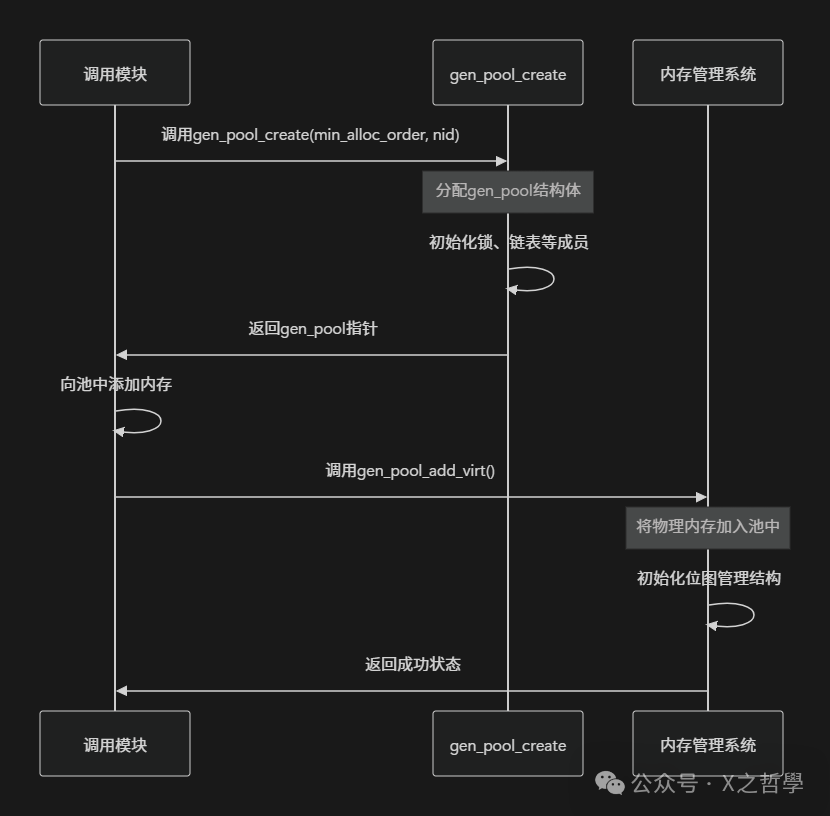
After creating the memory pool, actual memory regions need to be added to it. This is accomplished through the <span>gen_pool_add_virt()</span> function, which associates physical memory with virtual addresses and initializes the bitmap used to track memory allocation status.
2.1.3 Allocation Algorithms and Strategies
genalloc provides various allocation algorithms, which can be set using <span>gen_pool_set_algo()</span>. Each algorithm is suitable for different usage scenarios:
- • First-Fit: Searches from the start of the memory pool and selects the first sufficiently large free block. This is the default algorithm, simple and efficient.
- • Best-Fit: Searches for the smallest free block that can satisfy the request, reducing memory waste but increasing search time.
- • Fixed Address Allocation: Allocates at a specified address, suitable for hardware devices with strict address requirements.
Bitmap management is one of the core mechanisms of genalloc. The system uses a bitmap to track the status of each minimum allocation unit: 0 indicates free, and 1 indicates allocated. This design makes allocation and deallocation operations very efficient, requiring only simple bit operations to complete.
2.2 Slab Allocator and kmalloc System
The slab allocator is a core component in the Linux kernel for managing memory allocation for kernel objects, particularly optimized for small object allocations. Its design addresses the performance issues of traditional memory allocators when frequently allocating and deallocating objects of the same size.
2.2.1 Three-Layer Architecture
The slab allocator adopts a classic three-layer architecture, with each layer having specific responsibilities:
- • kmalloc Layer: Provides a general small block memory allocation interface, one of the most commonly used allocation APIs in the kernel.
- • slab Layer: Manages caches of the same type of objects, implementing optimizations such as object reuse and memory coloring.
- • Page Frame Allocator Layer: Obtains physical pages from the kernel page allocator, serving as the underlying storage for the slab layer.
2.2.2 Relationships of Core Data Structures
The relationships between the core data structures of the slab allocator are quite complex and can be visually represented in the following diagram:
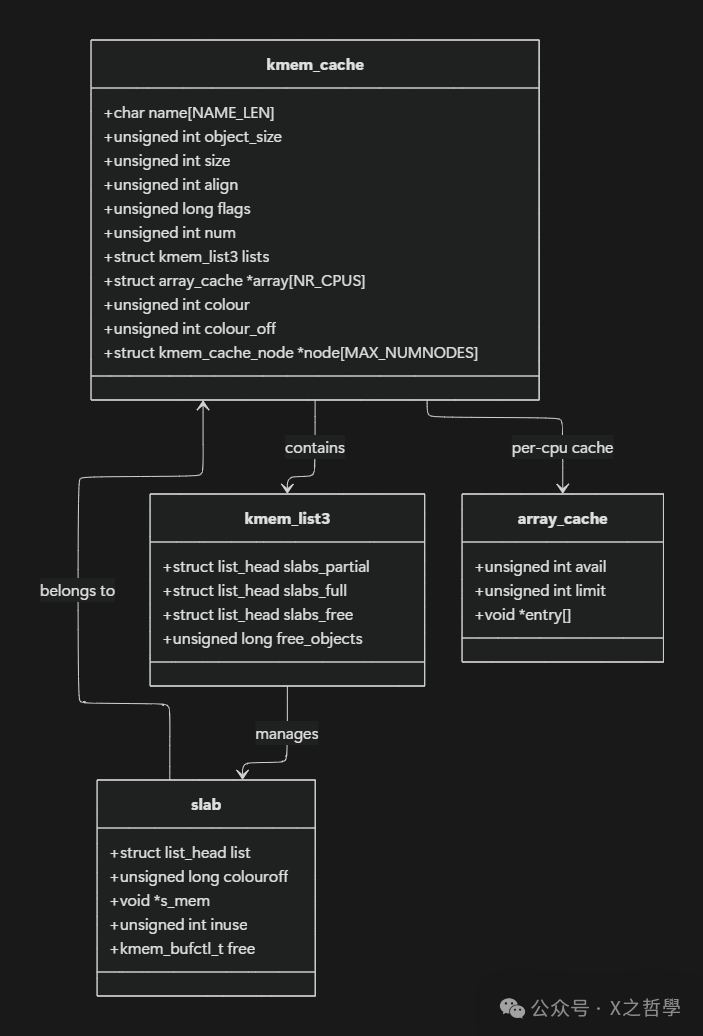
kmem_cache structure is the core of the slab allocator, representing a cache for a specific type of object. Each cache maintains three lists: <span>slabs_partial</span> (partially free slabs), <span>slabs_full</span> (fully allocated slabs), and <span>slabs_free</span> (completely free slabs). This multi-state design allows the allocator to efficiently meet allocation requests while effectively managing memory resources.
2.2.3 Performance Optimization Features
The slab allocator includes several carefully designed performance optimization features:
- • Per-CPU Cache (array_cache): Maintains an object cache for each CPU core, reducing lock contention and improving allocation speed. When an object needs to be allocated, it first attempts to obtain it from the current CPU’s cache, avoiding the overhead of cross-CPU synchronization.
- • Memory Coloring: By adjusting the starting offset of objects within the slab, it ensures that objects of the same type have different cache line alignments in different slabs, reducing CPU cache conflicts.
- • Object Reuse: Released objects are not immediately returned to the system but are retained in the cache for subsequent allocation reuse. This avoids frequent page allocation and deallocation operations.
- • Constructors and Destructors: Each cache can define optional constructors and destructors to initialize and clean up object states during allocation and release.
2.2.4 Implementation Mechanism of kmalloc
<span>kmalloc()</span> is one of the most commonly used memory allocation functions in the kernel, and it is actually built on top of the slab allocator. The kernel pre-creates a series of slab caches of different sizes, typically in powers of two (e.g., 32, 64, 128, 256 bytes, etc.). When calling <span>kmalloc(size, flags)</span>, the system rounds up to the nearest standard size and then allocates an object from the corresponding slab cache.
The advantage of this design is that it classifies different size allocation requests into dedicated caches, improving allocation efficiency and reducing memory fragmentation. Additionally, since objects of the same size are concentrated in the same cache, it also enhances CPU cache utilization.
2.3 Mempool Emergency Memory Pool
In certain critical paths of the kernel, memory allocation must not fail. To address this situation, the Linux kernel provides the mempool (emergency memory pool) mechanism. Mempool ensures that critical components’ memory needs are met even when system memory is tight by pre-allocating some memory objects.
2.3.1 Design Principles and Core Data Structures
The core idea of mempool is to pre-allocate a certain number of objects as a backup reserve. Under normal circumstances, allocation requests will attempt to obtain memory from the underlying allocator (such as slab or page allocator); if that fails, they will fall back to the pre-allocated object pool.
The main data structure of mempool is as follows:
typedef struct mempool_s {
    spinlock_t lock;                    // Protection lock
    int min_nr;                         // Minimum number of objects to keep in the pool
    int curr_nr;                        // Current number of available objects
    void **elements;                    // Array of object pointers
    void *pool_data;                    // Private data of the pool
    mempool_alloc_t *alloc;             // Allocation function
    mempool_free_t *free;               // Free function
    wait_queue_head_t wait;             // Wait queue
} mempool_t;
2.3.2 Working Mechanism
The working mechanism of mempool embodies the “reserve backup” design philosophy, and its complete workflow is illustrated in the following diagram:
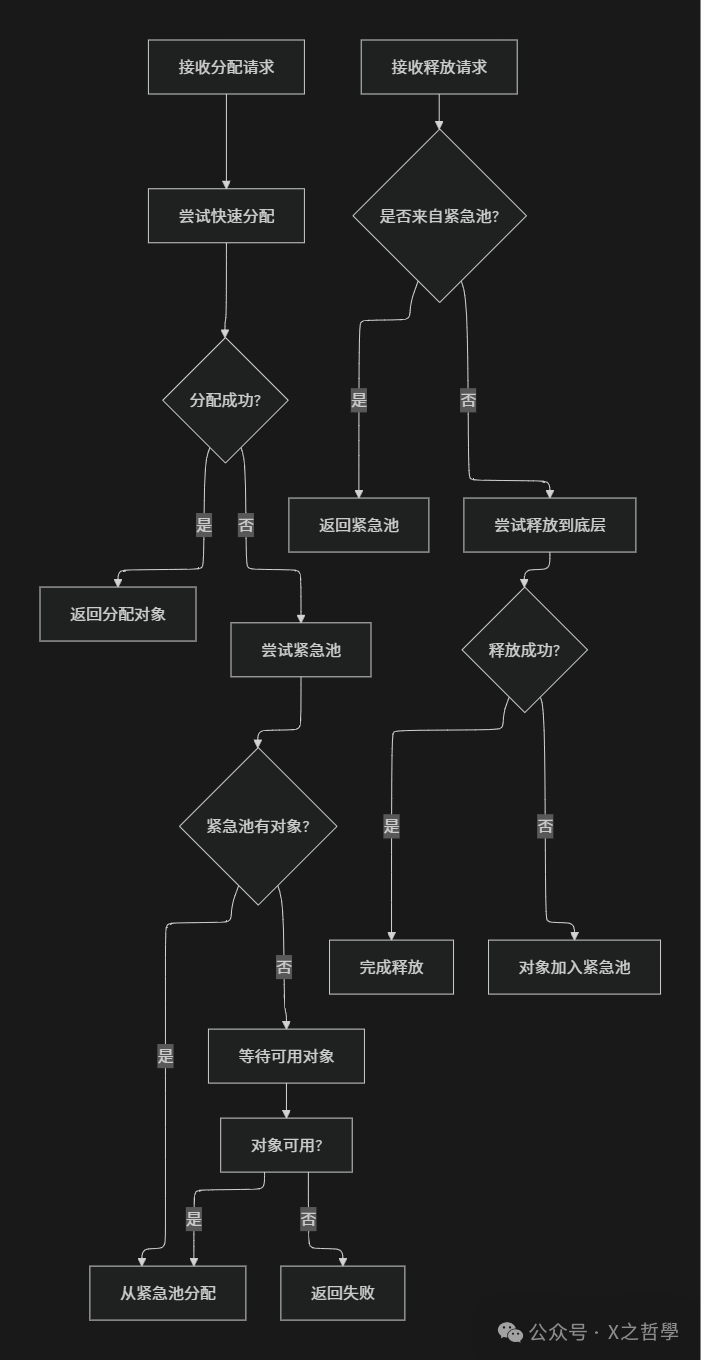
As shown in the diagram, mempool prioritizes attempts to allocate from the underlying allocator, only using pre-allocated objects when regular allocation fails. This design ensures reliability during memory tightness while avoiding excessive use of pre-allocated memory under normal circumstances, thus preventing waste.
2.3.3 Application Scenarios and Considerations
Mempool is mainly applied in the following scenarios:
- • Block Device Layer: Ensures that memory allocation for I/O requests can still succeed even when memory is tight, preventing I/O paths from being blocked.
- • File System: Memory allocation for critical metadata operations.
- • Device Drivers: Ensures memory needs for critical paths such as interrupt handlers.
However, using mempool also requires caution, as it permanently occupies a portion of memory that cannot be reclaimed even when system memory is tight. Therefore, the kernel documentation clearly states:“If your driver has any way to cope with allocation failures without compromising system integrity, it is better not to use mempool.”
3 Key Design Patterns and Core Models
After deeply understanding the various implementations of Linux memory pools, we need to abstract the design patterns and core models they commonly follow from a higher level. These design principles are not only applicable to kernel development but also provide guidance for any application scenario requiring high-performance memory management.
3.1 Lifecycle Model of Memory Pools
Regardless of the specific memory pool implementation, its lifecycle typically follows a unified pattern, including basic stages such as creation, initialization, allocation, deallocation, and destruction. The following diagram illustrates this complete lifecycle:
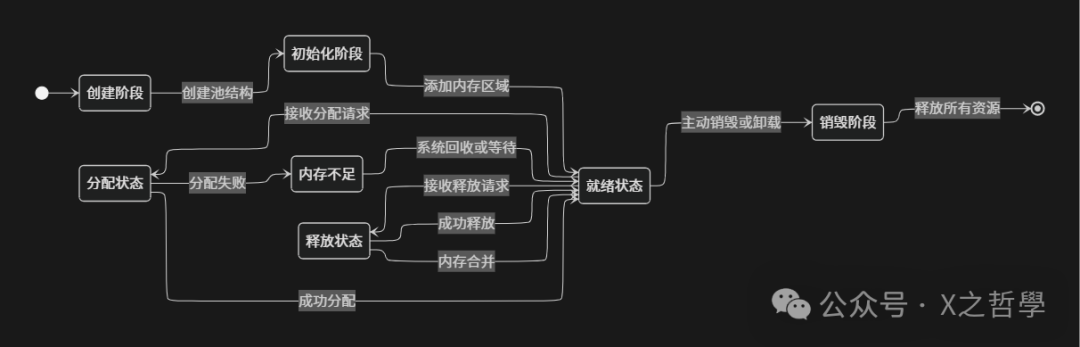
In the creation phase, the memory pool manager initializes necessary data structures, such as control blocks, linked lists, bitmaps, etc., but no actual memory is available for allocation at this point. The initialization phase is the process of adding actual memory regions to the memory pool, which can come from the system page allocator, reserved physical memory, or specific device memory. The ready state indicates that the memory pool is prepared to handle allocation and deallocation requests. When processing allocation requests, the system may enter the allocation state; if there is not enough memory to satisfy the request, it enters the memory shortage state, which may trigger memory reclamation, waiting, or direct failure depending on the specific implementation. The release state handles operations that return memory to the pool, and advanced implementations may perform memory merging at this stage, combining adjacent free blocks into larger blocks to reduce fragmentation. Finally, the destruction phase is responsible for cleaning up resources and returning all memory to the system.
3.2 Comparison and Analysis of Allocation Algorithms
Different memory pool implementations may adopt different allocation algorithms, each with its advantages and disadvantages, suitable for different scenarios. The following table compares the characteristics of common allocation algorithms:
| Algorithm Type | Working Principle | Advantages | Disadvantages | Applicable Scenarios |
|---|---|---|---|---|
| First-Fit | Searches from the start of the memory pool and selects the first sufficiently large block. | Simple and fast, low memory overhead. | Prone to external fragmentation, allocation speed decreases as the pool size increases. | General scenarios, moderate memory pool size. |
| Best-Fit | Searches for the smallest free block that can satisfy the request. | High memory utilization, reduces internal fragmentation. | Requires traversing the entire free list, poorer performance. | Memory-tight environments, large object size variations. |
| Worst-Fit | Always allocates the largest free block. | Reduces external fragmentation, retains large contiguous memory. | May not satisfy large block requests. | Real-time systems, need to avoid fragmentation. |
| Buddy System | Divides memory into blocks of powers of two, can merge adjacent free blocks. | Effectively reduces external fragmentation, efficient allocation and deallocation. | Severe internal fragmentation, low memory utilization. | Kernel page allocation, large memory management. |
| Fixed Size Blocks | Pre-defines a set of fixed-size blocks, requests are rounded up. | Extremely fast allocation, no external fragmentation. | Severe internal fragmentation, poor flexibility. | Object pools, frequent allocation and deallocation of similar-sized objects. |
In actual systems, these algorithms are often used in combination. For example, the Linux slab allocator uses the buddy system at a high level to obtain large blocks of memory, and then uses fixed-size block strategies internally to manage object allocation.
3.3 Multi-Level Memory Pool Architecture
Modern operating systems often adopt a multi-level memory pool architecture to balance performance and generality. This architecture is similar to the cache hierarchy in computer storage systems, with each level optimized for different access characteristics.
The multi-layer architecture of Linux memory management includes:
- • Page Allocator (Buddy System): Manages physical page frames, allocating memory in page units (usually 4KB), handling large memory allocation requests. This is the lowest level of memory management, directly interacting with hardware.
- • Slab Allocator: Built on top of the page allocator, managing small object allocations in the kernel, providing object caching and reuse mechanisms.
- • Specific Subsystem Caches: Such as file system inode caches, directory entry caches, etc., further optimized for specific object types.
- • User-Space Memory Allocators: Such as glibc’s malloc, managing process heap memory, typically implemented using ptmalloc, etc.
- • Application-Specific Custom Memory Pools: Highly optimized memory management for specific application scenarios, such as database buffers, network server connection pools, etc.
This multi-level architecture shields the upper layers from the details of the lower layers while providing simplified interfaces and better performance. For example, when the slab allocator needs more memory, it requests whole pages from the page allocator, which are then divided into uniformly sized objects for management. When an application calls malloc, if the requested memory is large, it may directly obtain memory from the page allocator via the mmap system call, while small objects are obtained from the heap maintained by the user-space memory allocator.
4 Practical Applications and Debugging Techniques
Having understood the theoretical knowledge of memory pools, this section will focus on practical applications, including how to implement and use memory pools in user space and kernel space, as well as related debugging and optimization techniques.
4.1 User-Space Memory Pool Implementation
Although the Linux kernel provides rich memory pool mechanisms, sometimes it is necessary to implement custom memory pools in user-space applications to meet specific performance requirements. Below is a simplified but complete memory pool implementation:
4.1.1 Basic Data Structure Definition
#include <stdlib.h>
#include <string.h>
#include <pthread.h>

#define MP_ALIGNMENT       16
#define MP_PAGE_SIZE       4096
#define MP_MAX_ALLOC_FROM_POOL  (MP_PAGE_SIZE - 1)

typedef struct mp_large_s {
    struct mp_large_s *next;
    void *alloc;
} mp_large_t;

typedef struct mp_node_s {
    unsigned char *last;     // Current allocation cursor of the node
    unsigned char *end;      // End position of the node
    struct mp_node_s *next;  // Next node
    size_t failed;           // Number of allocation failures
} mp_node_t;

typedef struct mp_pool_s {
    size_t max;              // Threshold for large and small blocks
    mp_node_t *current;      // Current node
    mp_large_t *large;       // Large block linked list
    mp_node_t head[0];       // Small node header
} mp_pool_t;
4.1.2 Creating and Initializing Memory Pools
mp_pool_t *mp_create_pool(size_t size) {
    mp_pool_t *p;
    int ret = posix_memalign((void**)&p, MP_ALIGNMENT, size + sizeof(mp_pool_t) + sizeof(mp_node_t));
    if (ret) {
        return NULL;
    }

    p->max = (size < MP_MAX_ALLOC_FROM_POOL) ? size : MP_MAX_ALLOC_FROM_POOL;
    p->current = p->head;
    p->large = NULL;

    // Initialize the first node
    p->head->last = (unsigned char *)p + sizeof(mp_pool_t) + sizeof(mp_node_t);
    p->head->end = p->head->last + size;
    p->head->failed = 0;
    p->head->next = NULL;

    return p;
}
4.1.3 Memory Allocation Implementation
Memory allocation in the memory pool is divided into two cases: small block allocation and large block allocation:
// Small block allocation
static void *mp_alloc_small(mp_pool_t *pool, size_t size, int align) {
    unsigned char *m;
    mp_node_t *p = pool->current;

    while (p) {
        m = align ? mp_align_ptr(p->last, MP_ALIGNMENT) : p->last;

        if ((size_t)(p->end - m) >= size) {
            p->last = m + size;
            return m;
        }
        p = p->next;
    }

    return mp_alloc_block(pool, size);
}

// Large block allocation
static void *mp_alloc_large(mp_pool_t *pool, size_t size) {
    void *p = malloc(size);
    if (p == NULL) return NULL;

    mp_large_t *large;
    // Find existing large block structure or create a new one
    for (large = pool->large; large; large; large = large->next) {
        if (large->alloc == NULL) {
            large->alloc = p;
            return p;
        }
    }

    // No available large block structure, need to allocate a new one
    large = mp_alloc_small(pool, sizeof(mp_large_t), 1);
    large->alloc = p;
    large->next = pool->large;
    pool->large = large;

    return p;
}

// Unified allocation interface
void *mp_alloc(mp_pool_t *pool, size_t size) {
    if (size <= pool->max) {
        return mp_alloc_small(pool, size, 1);
    }
    return mp_alloc_large(pool, size);
}
This user-space memory pool implementation demonstrates the core concept of memory pools: by pre-allocating and distinguishing between large and small blocks, it improves memory allocation efficiency while reducing fragmentation. In practical applications, this implementation can be extended and optimized according to specific needs.
4.2 Using Memory Pools in Kernel Modules
In kernel module development, the memory pool mechanisms provided by the kernel can be used directly. The following example demonstrates how to use mempool in a character device driver:
#include <linux/module.h>
#include <linux/kernel.h>
#include <linux/fs.h>
#include <linux/slab.h>
#include <linux/mempool.h>
#include <linux/blkdev.h>

#define DEVICE_NAME "mempool_example"
#define MINOR_NUMBER 0
#define POOL_SIZE 32
#define OBJECT_SIZE 256

struct example_device {
    struct cdev cdev;
    mempool_t *pool;
    void *objects[POOL_SIZE];
};

static struct example_device *example_dev;

static void *example_alloc(gfp_t gfp_mask, void *pool_data)
{
    return kmalloc(OBJECT_SIZE, gfp_mask);
}

static void example_free(void *element, void *pool_data)
{
    kfree(element);
}

static int example_open(struct inode *inode, struct file *file)
{
    printk(KERN_INFO "Example device opened\n");
    return 0;
}

static int example_release(struct inode *inode, struct file *file)
{
    printk(KERN_INFO "Example device closed\n");
    return 0;
}

static ssize_t example_read(struct file *file, char __user *buf,
                           size_t count, loff_t *ppos)
{
    struct example_device *dev = example_dev;
    void *item;

    if (count > OBJECT_SIZE)
        return -EINVAL;

    // Allocate object from memory pool
    item = mempool_alloc(dev->pool, GFP_KERNEL);
    if (!item)
        return -ENOMEM;

    // Simulate data operation
    memset(item, 0xAB, OBJECT_SIZE);

    // Copy data to user space
    if (copy_to_user(buf, item, count)) {
        mempool_free(item, dev->pool);
        return -EFAULT;
    }

    mempool_free(item, dev->pool);
    return count;
}

static struct file_operations example_fops = {
    .owner = THIS_MODULE,
    .open = example_open,
    .release = example_release,
    .read = example_read,
};

static int __init example_init(void)
{
    int ret;
    dev_t devno;

    // Allocate device number
    ret = alloc_chrdev_region(&devno, MINOR_NUMBER, 1, DEVICE_NAME);
    if (ret < 0) {
        printk(KERN_ERR "Failed to allocate device number\n");
        return ret;
    }

    // Allocate device structure
    example_dev = kzalloc(sizeof(*example_dev), GFP_KERNEL);
    if (!example_dev) {
        ret = -ENOMEM;
        goto fail_alloc;
    }

    // Create memory pool
    example_dev->pool = mempool_create(POOL_SIZE, example_alloc,
                                      example_free, NULL);
    if (!example_dev->pool) {
        ret = -ENOMEM;
        goto fail_pool;
    }

    // Initialize character device
    cdev_init(&example_dev->cdev, &example_fops);
    example_dev->cdev.owner = THIS_MODULE;

    // Add character device to system
    ret = cdev_add(&example_dev->cdev, devno, 1);
    if (ret) {
        printk(KERN_ERR "Failed to add character device\n");
        goto fail_cdev;
    }

    printk(KERN_INFO "Example module loaded with mempool\n");
    return 0;

fail_cdev:
    mempool_destroy(example_dev->pool);
fail_pool:
    kfree(example_dev);
fail_alloc:
    unregister_chrdev_region(devno, 1);
    return ret;
}

static void __exit example_exit(void)
{
    dev_t devno = example_dev->cdev.dev;

    cdev_del(&example_dev->cdev);
    mempool_destroy(example_dev->pool);
    kfree(example_dev);
    unregister_chrdev_region(devno, 1);

    printk(KERN_INFO "Example module unloaded\n");
}

module_init(example_init);
module_exit(example_exit);
MODULE_LICENSE("GPL");
MODULE_AUTHOR("Kernel Developer");
This example demonstrates how to use mempool in a character device driver to ensure successful allocation of objects even under memory tight conditions. By using <span>mempool_create</span> to pre-allocate a certain number of objects, and using <span>mempool_alloc</span> and <span>mempool_free</span> in the <span>read</span> operation to allocate and free these objects.
4.3 Debugging Tools and Techniques
Debugging memory pool-related issues requires specialized tools and techniques. Below are several commonly used debugging methods:
4.3.1 Viewing Slab Information
By using <span>/proc/slabinfo</span>, you can view the detailed status of slab allocators in the system:
# View all slab caches
cat /proc/slabinfo

# View information for a specific cache
grep "kmalloc" /proc/slabinfo

# Use slabtop to view slab usage in real-time
slabtop
4.3.2 Memory Leak Detection
The kernel provides the kmemleak tool for detecting kernel memory leaks:
# Enable kmemleak
echo scan > /sys/kernel/debug/kmemleak

# View detected memory leaks
cat /sys/kernel/debug/kmemleak
4.3.3 Monitoring Memory Pool Status
For custom memory pools, you can monitor their status by adding statistical information:
struct mp_pool_stats {
    size_t total_allocated;
    size_t current_allocated;
    size_t peak_allocated;
    size_t allocation_count;
    size_t free_count;
    size_t failed_count;
};

// Add statistical fields to the memory pool structure
typedef struct mp_pool_s {
    // ... other fields
    struct mp_pool_stats stats;
    // ...
} mp_pool_t;

// Update statistics in the allocation function
void *mp_alloc_with_stats(mp_pool_t *pool, size_t size) {
    void *p = mp_alloc(pool, size);
    if (p) {
        pool->stats.allocation_count++;
        pool->stats.current_allocated += size;
        if (pool->stats.current_allocated > pool->stats.peak_allocated) {
            pool->stats.peak_allocated = pool->stats.current_allocated;
        }
    } else {
        pool->stats.failed_count++;
    }
    return p;
}
4.3.4 Performance Analysis
Using the perf tool, you can analyze memory allocation hotspots and performance bottlenecks:
# Record memory allocation-related events
perf record -e kmem:kmalloc -e kmem:kfree -g ./your_program

# Analyze performance data
perf report
Through these tools and techniques, developers can gain insights into the operational status of memory pools, promptly identify and resolve memory leaks, performance bottlenecks, and other issues.
5 Summary and Outlook
Through an in-depth analysis of Linux memory pool management, we can clearly see the significant value of memory pool technology in enhancing system performance and reliability. From the general genalloc to the specifically optimized slab allocator, and to the reliability assurance provided by mempool, the Linux kernel offers multi-layered and multi-scenario memory pool solutions.
5.1 Core Value of Memory Pool Technology
The core value of memory pool technology is mainly reflected in the following aspects:
- • Performance Improvement: By pre-allocating and customizing allocation strategies, it significantly reduces the time overhead of memory allocation, providing more predictable performance.
- • Fragmentation Control: Through fixed-size allocations, block merging, and other techniques, it effectively reduces memory fragmentation and improves memory utilization.
- • Reliability Assurance: In tight memory situations, it ensures that memory allocation for critical paths does not fail through backup mechanisms.
- • Locality Optimization: By concentrating the storage of similar types of objects, it increases CPU cache hit rates and reduces cache thrashing.
5.2 Practical Recommendations
When applying memory pool technology in actual projects, consider the following recommendations:
- • Avoid Over-Engineering: In scenarios where performance requirements are not particularly stringent, prioritize using the memory allocation mechanisms provided by the system.
- • Targeted Optimization: Design customized memory pools based on the specific access patterns of the application; for example, a network server may consider a dedicated memory pool for connections.
- • Comprehensive Testing: The implementation of memory pools requires rigorous testing, especially for concurrency safety and edge case testing.
- • Monitoring Integration: Integrate comprehensive memory monitoring in production environments to promptly detect memory leaks and performance issues.