A pointer is one of the most fundamental and complex concepts in the C language. Essentially, a pointer is a variable that stores a memory address. Just like a house number in real life, a pointer tells us where data is stored in memory.
int var = 42;       // Define an integer variable
int *ptr = &var;    // Define a pointer that stores the address of var
1.2 Core Characteristics of Pointers
Characteristic
Description
Example
Address Storage
Stores the memory address of other variables
<span>&var</span>
Indirect Access
Accesses target data through pointers
<span>*ptr</span>
Type Association
The pointer type determines how memory is interpreted
<span>int *</span> vs <span>char *</span>
Arithmetic Operations
Supports addition and subtraction of addresses
<span>ptr++</span>, <span>ptr + n</span>
2. Linux Memory Management Framework
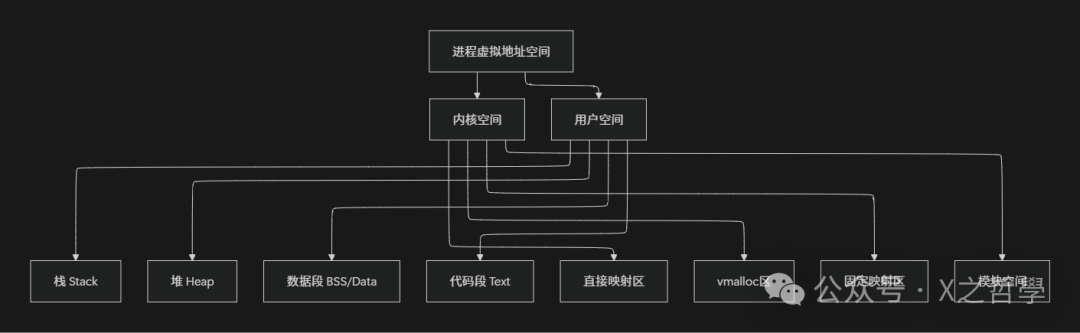
2.1 Virtual Memory Space Layout
In a Linux system, each process runs in its own independent virtual address space, typically laid out as follows:
2.2 Core Data Structures
2.2.1 Process Memory Descriptor <span>mm_struct</span>
struct mm_struct {
    struct vm_area_struct *mmap;           // Linked list of virtual memory areas
    struct rb_root mm_rb;                  // Red-black tree of virtual memory areas
    unsigned long task_size;               // Size of user virtual address space
    unsigned long start_code, end_code;    // Start and end addresses of code segment
    unsigned long start_data, end_data;    // Start and end addresses of data segment
    unsigned long start_brk, brk, start_stack; // Stack information
    unsigned long arg_start, arg_end, env_start, env_end; // Argument and environment variables
    pgd_t *pgd;                           // Page global directory
    atomic_t mm_users;                    // Number of users of this address space
    atomic_t mm_count;                    // Main reference count
    struct list_head mmlist;              // List of all mm_structs
};
2.2.2 Virtual Memory Area <span>vm_area_struct</span>
struct vm_area_struct {
    unsigned long vm_start;               // Start address of the area
    unsigned long vm_end;                 // End address of the area
    struct mm_struct *vm_mm;              // Associated address space
    pgprot_t vm_page_prot;                // Access permissions
    unsigned long vm_flags;               // Area flags
    struct rb_node vm_rb;                 // Red-black tree node
    union {
        struct {
            struct list_head list;
            void *parent;
            struct vm_area_struct *head;
        } vm_set;
        struct raw_prio_tree_node prio_tree_node;
    } shared;
    struct list_head anon_vma_chain;
    struct anon_vma *anon_vma;
    const struct vm_operations_struct *vm_ops; // Operations function table
    unsigned long vm_pgoff;               // Offset in the file
    struct file *vm_file;                 // Mapped file
    void *vm_private_data;                // Private data
};
2.3 Address Translation Mechanism
2.3.1 Page Table Translation Process
2.3.2 Address Translation Code Implementation
// Simplified address translation process
static pte_t *follow_page(struct vm_area_struct *vma,
                         unsigned long address,
                         unsigned int flags)
{
    pgd_t *pgd;
    p4d_t *p4d;
    pud_t *pud;
    pmd_t *pmd;
    pte_t *pte;

    // Query page table step by step
    pgd = pgd_offset(vma->vm_mm, address);
    if (pgd_none(*pgd) || pgd_bad(*pgd))
        return NULL;

    p4d = p4d_offset(pgd, address);
    if (p4d_none(*p4d) || p4d_bad(*p4d))
        return NULL;

    pud = pud_offset(p4d, address);
    if (pud_none(*pud) || pud_bad(*pud))
        return NULL;

    pmd = pmd_offset(pud, address);
    if (pmd_none(*pmd) || pmd_bad(*pmd))
        return NULL;

    pte = pte_offset_map(pmd, address);
    if (!pte_present(*pte))
        return NULL;

    return pte;
}
3. Detailed Pointer Type System
3.1 Basic Pointer Types
// Declaration and usage of different types of pointers
int *int_ptr;           // Integer pointer
char *char_ptr;         // Character pointer
float *float_ptr;       // Float pointer
void *void_ptr;         // Void pointer
const int *const_ptr;   // Pointer to a constant
int *const ptr_const;   // Constant pointer
3.2 Multi-level Pointers
int var = 100;
int *ptr1 = &var;       // Single-level pointer
int **ptr2 = &ptr1;     // Double-level pointer
int ***ptr3 = &ptr2;    // Triple-level pointer
3.3 Function Pointers
// Function pointer type definition
typedef int (*compare_func_t)(const void *, const void *);

// Example of using function pointers
int numeric_compare(const void *a, const void *b) {
    return *(int*)a - *(int*)b;
}

// Using function pointer
compare_func_t cmp = numeric_compare;
qsort(array, size, sizeof(int), cmp);
4. Pointer Arithmetic and Memory Operations
4.1 Pointer Arithmetic Operations
int array[5] = {10, 20, 30, 40, 50};
int *ptr = array;

printf("ptr: %p, *ptr: %d\n", ptr, *ptr);      // Output: 0x..., 10
ptr++; // Move to the next integer position
printf("ptr: %p, *ptr: %d\n", ptr, *ptr);      // Output: 0x...+4, 20

// Essence of pointer arithmetic
char *char_ptr = (char*)array;
char_ptr += sizeof(int); // Move 4 bytes
4.2 Structure Pointers and Member Access
struct person {
    char name[32];
    int age;
    float height;
};

struct person john = {"John Doe", 30, 175.5};
struct person *person_ptr = &john;

// Comparison of two access methods
printf("Name: %s\n", john.name);           // Direct access
printf("Name: %s\n", person_ptr->name);    // Pointer access
printf("Name: %s\n", (*person_ptr).name);  // Indirect access
5. Special Pointers in the Kernel
5.1 User Space and Kernel Space Pointers
// User space pointer validation
long copy_from_user(void *to, const void __user *from, unsigned long n)
{
    if (!access_ok(VERIFY_READ, from, n))
        return -EFAULT;

    // Actual copy operation
    return __copy_from_user(to, from, n);
}

// Kernel space pointer operation
void kernel_memcpy(void *dest, const void *src, size_t n)
{
    memcpy(dest, src, n);
}
// Debug print macro
#define DEBUG_POINTER(fmt, ...) \
    printk(KERN_DEBUG "POINTER_DEBUG %s:%d: " fmt, \
           __func__, __LINE__, ##__VA_ARGS__)

// Pointer validation function
void debug_pointer_info(const char *name, void *ptr)
{
    DEBUG_POINTER("Pointer %s: Address=%p, Physical Address≈%lx\n", \
                  name, ptr, __pa(ptr));

    if (!ptr) {
        DEBUG_POINTER("Warning: %s is a null pointer\n", name);
        return;
    }

    if (is_kernel_pointer(ptr)) {
        DEBUG_POINTER("Pointer %s points to kernel space\n", name);
    } else {
        DEBUG_POINTER("Pointer %s points to user space\n", name);
    }
}

// Usage in code
void example_function(struct data_struct *data)
{
    debug_pointer_info("data", data);

    if (data) {
        debug_pointer_info("data->next", data->next);
        // Other operations...
    }
}
10. Performance Optimization and Best Practices
10.1 Performance Considerations for Pointer Usage
// Cache-friendly data structure layout
struct optimized_struct {
    int frequently_accessed_field1;
    int frequently_accessed_field2;
    char padding[64 - 2*sizeof(int)]; // Cache line alignment
    struct list_head list;            // Less frequently used fields at the end
    void *rarely_used_pointer;
};

// Prefetch optimization
static inline void prefetch_data(void *ptr)
{
    if (likely(ptr)) {
        __builtin_prefetch(ptr, 0, 3); // Read prefetch, high locality
    }
}

// Batch pointer operation optimization
void batch_pointer_processing(struct data_node **nodes, int count)
{
    int i;

    // Prefetch next node
    for (i = 0; i < count - 1; i++) {
        prefetch_data(nodes[i + 1]);
        process_node(nodes[i]);
    }

    // Process the last node
    if (count > 0)
        process_node(nodes[count - 1]);
}
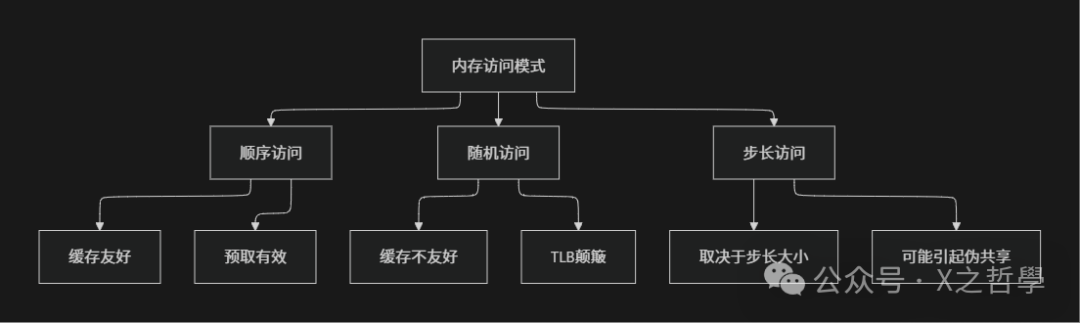
10.2 Memory Access Pattern Optimization
11. Summary and Key Points
11.1 Core Summary of Pointer Mechanisms
1. Hierarchical Address Translation: Virtual addresses are translated to physical addresses through multi-level page tables
2. Importance of Type Safety: Pointer types determine how memory is interpreted
3. Space Isolation: Strict separation of user space and kernel space pointers
4. Lifecycle Management: Pointer validity depends on the lifecycle of the target object